
Mathematics 2005 Jamb Examination

Question 11
A polynomial in x whose zeros are -2, -1 and 3 is
If the zeros are -2, -1, 3, the polynomial is:
\[(x+2)(x+1)(x-3) = x^3 - 7x - 6\]
Because: Product of the factors
(x+2)(x+1)(x-3) = 0
(x2 + 3x + 2)(x-3)
x(x2 + 3x + 2) -3(x2 + 3x + 2) = 0
x3 + 3x2 + 2x - 3x2 - 9x - 6 = 0
x3 - 7x - 6 = 0
Not clear enough?
Question 12
The time taken to do a piece of work is inversely proportional to the number of men employed. If it takes 30 men to do a piece of work in 6 days, how many men are required to do the work in 4 days?
Let the number of men required be \(30 \times 6 = x \times 4 \quad \Rightarrow \quad x = 45\)
Alternatively:
Let
t = time taken and N = number of men
t ∝ 1/N
t = K/N
K = Nt
K = 30 * 6
K = 180
∴t = 180/N
4 = 180/N
4N = 180
N = 180/4
45 men
Not clear enough?
Question 13
Since \(W \propto L d^2\), \(W = k L d^2\).
When \(W = 140, L = 54, d = 42/3\), solve for k and rearrange to express \(d\) in terms of \(W\) and \(L\):
\[d = \sqrt{\dfrac{42 W}{5 L}}\]
Not clear enough?
Question 14
Find the range of values of x for which 7x - 3 > 25 + 3x
7x - 3 > 25 + 3x
7x - 3x > 25 + 3
4x > 28
x > 28/4
x > 7
Not clear enough?
Question 15
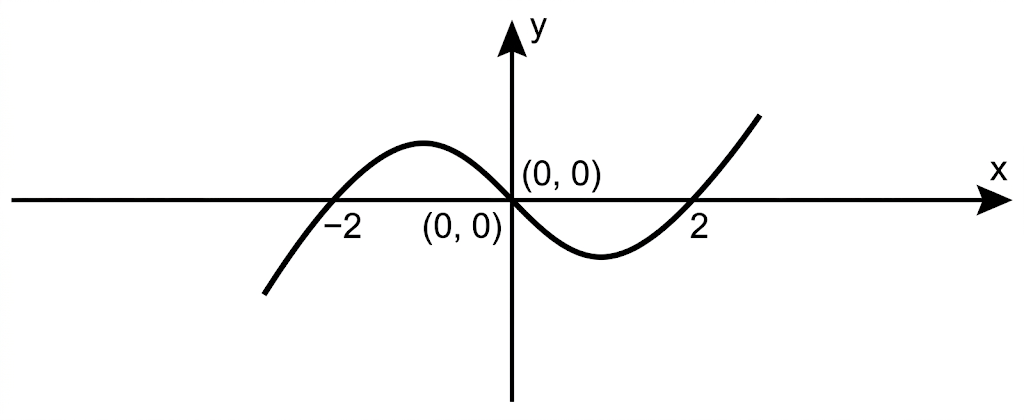
The diagram above is the graph of the function \(f(x)\). Determine the range of values of x for which \(f(x) \le 0\)
From the graph, \(f(x) \le 0\) for \(x \le -2\) and \(0 \le x \le 2\)
Not clear enough?
Question 16
Let the first term be \(a\) and common difference \(d\).
7th term: \(a + 6d\), 3rd term: \(a + 2d\)
Given: \(a + 6d = 2(a + 2d) \implies a + 6d = 2a + 4d \implies a = 2d\)
Sum of first 4 terms:
S4 = 4/2 (2a + 3d)
2(2a + 3d) = 4d + 6d
10d = 42
d = 42/10 = 4.2
S4 = 2(2a + 3d)
2(4d + 3d) =
14d = 42
d = 3
Not clear enough?
Question 17
AP with first term \(a=8\), common difference \(d=4\).
Sum of n terms: \(S_n = n/2 [2a + (n-1)d]\)
\(S_{20} = 20/2 [2*8 + 19*4] = 10 [16 + 76] = 10*92 = 920\)
Option D: 920
Not clear enough?
Question 18
Let identity element be \(e\). Then \(a * e = a\) for all \(a\).
\(a e + 2(a + e +1) = a \)
\(\implies ae + 2a + 2e + 2 = a \)
\(\implies ae + a + 2e +2 = 0 \)
\(\implies e(a+2) + (a+2) =0 \)
\(\implies e+1 =0 \implies e = -1\)
Not clear enough?
Question 19
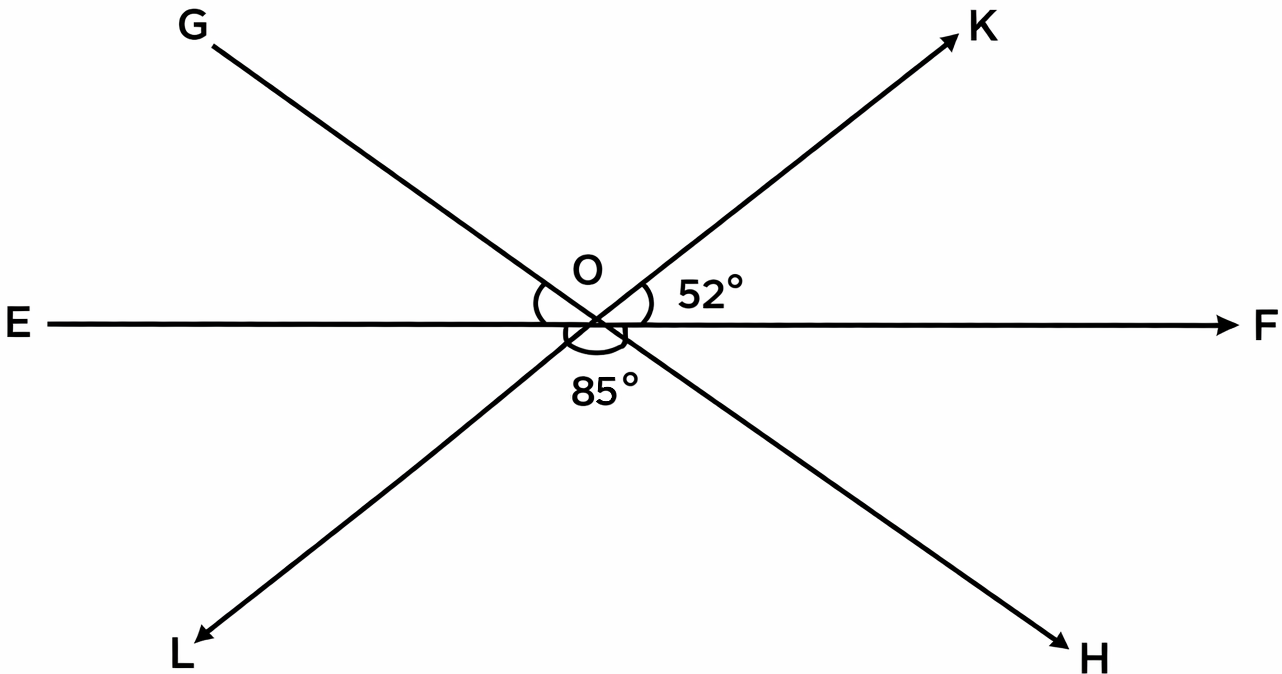
Three straight lines EF, GH and LK intersect at O as shown above. If \(\angle KOF = 52^\circ\) and \(\angle LOH = 85^\circ\), calculate the size of \(\angle EOG\).
Using properties of intersecting lines and vertical angles:
\(\angle EOG = 180 - (52 + 85) = 43^\circ\)
Not clear enough?
Question 20
Recall the formula for the sum of interior angles of a polygon:
\[S = (n-2) \cdot 180°\]
Substitute the given sum:
\[1800° = (n-2) \cdot 180° \]\[\implies n-2 = \dfrac{1800}{180} = 10\]\[ \implies n = 12\]
Find one exterior angle using:
\[\text{Exterior angle} = \dfrac{360°}{n} = \dfrac{360°}{12} = 30°\]
Not clear enough?
You might like
Identify the following serial communication error: "The prior character received was not yet read by the CPU before being overwritten by a new incoming character."
'That year the harvest was sad, like a funeral and many farmers wept as they dug up the miserable yams. One man tied his clothe to a tree branch and hanged himself.
Chinua Achebe: Things Fall Apart.
The mood conveyed in the excerpt above is one of
Name the term that is used to describe the gas accumulated on thesurface of a material, such as the grain of a reservoir rock, or more particularly the organic particles in a shale reservoir.
Choose the option nearest in meaning to the underlined word.
The attempt to count the population was largely successful?