
Mathematics 2006 Jamb Examination

Question 1
$$
\begin{array}{c|cccccccc}
\text{Score} & 1 & 2 & 3 & 4 & 5 & 6 & 7 & 8 \\
\hline
\text{Frequency} & 2 & 3 & 5 & 12 & 10 & 6 & 4 & 1 \\
\end{array}
$$
The table above shows the scores of a group of students in a physics test. If the mode is m and the number of students who scored 4 or more is n, what is (n, m)?
A. (33, 4)
Mode is score with highest frequency = 4 (frequency 12). Number scoring ≥4 = 12+10+6+4+1 = 33.
Not clear enough?
Question 2
Number of ways = C(6,4) = 6!/(4!2!) = 15.
Not clear enough?
Question 3
Five consecutive integers have the middle value equal to the mean = 30, so largest = 30+2 = 32.
Not clear enough?
Question 4
x/(9+x)=2/5 ⇒ 5x = 18+2x ⇒ 3x = 18 ⇒ x = 6.
Not clear enough?
Question 5
Mean = 2x. Deviations: 0, -1, +1. Variance = (0^2+(-1)^2+1^2)/3 = 2/3.
Not clear enough?
Question 6
The table above shows the distribution of recharge cards of four major GSM operators. What is the probability that a recharge card selected at random will be GTN or Qtel?
Total cards = 5+6+3+6 = 20. GTN or Qtel = 5+3 = 8. Probability = 8/20 = 2/5.
Not clear enough?
Question 7
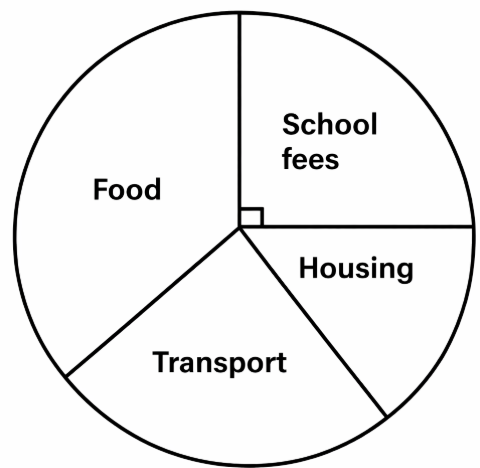
The pie chart above shows the expenditure of a family whose income is N30,000. If the expenditure on food is twice that on housing and that on school fees is twice that on transport, how much does the family spend on food?
Not clear enough?
Question 8
D. 3
\[^{n+1}C_3 = 4(^nC_3)\] \[=\dfrac{(n+1)!}{(n+1-3)!3!} = 4\left(\dfrac{n!}{(n-3)!3!}\right)\] \[\dfrac{(n+1)n!}{(n-2)(n-3)!}=4\left(\dfrac{n!}{n-3!}\right)\] \[=\dfrac{n+1}{n-2}=\dfrac{4}{1}\] \[n+1 = 4(n-2)\] \[n+1 = 4n-8\] \[-3n = -9\] \[\dfrac{-9}{-3}=3\]
Not clear enough?
Question 9
The gradient of a curve is 2x+7 and the curve passes through point (2,0). Find the equation of the curve.
B. \(y = x^2 + 7x - 18\)
Integrate the gradient to get the curve:\[y'=2x+7\Rightarrow y=\int(2x+7)\,dx = x^2+7x+C.\] Use point (2,0): \[0 = 2^2 +7\cdot2 + C \]\[= 4+14 + C =18 + C\Rightarrow C=-18.\] Hence \[y = x^2 + 7x - 18.\]
Not clear enough?
Question 10
Let \(u = x^2 - x^{-1}.\) Then \(\dfrac{d}{dx}(u^2)=2u\,u'.\) Compute:\[u'=2x + x^{-2}.\] So\[\dfrac{d}{dx}\left(x^2-\dfrac{1}{x}\right)^2 = 2\left(x^2-\dfrac{1}{x}\right)\left(2x+\dfrac{1}{x^2}\right).\] Expand stepwise:\[\left(x^2-\dfrac{1}{x}\right)\left(2x+\dfrac{1}{x^2}\right)\]\[=2x^3+1-2-\dfrac{1}{x^3}=2x^3-1-\dfrac{1}{x^3}.\] Multiply by 2:\[4x^3-2-\dfrac{2}{x^3}.\] That is \(4x^3-2-2/x^3\).
Not clear enough?
You might like
A and B together can do a piece of work in 12 days, while B alone can finish it in 30 days. A alone can finish the work in ?
Windows 95 was Microsoft's first 'full-blown' Graphical User Interface (GUI) operating system that did not require a separate DOS installation to boot.

\[
\begin{array}{|l|r|}
\hline
\textbf{Description} & \textbf{₦} \\
\hline
\text{Materials consumed} & 16{,}600 \\
\text{Direct cost} & 5{,}400 \\
\text{Factory rent} & 2{,}300 \\
\text{Factory lighting} & 1{,}200 \\
\hline
\end{array}
\]
Cost of production to be transferred at cost plus 20% mark-up
The gross profit on manufacture is
If aggregate income is N500.00 and aggregate consumption is N400.00, this means that the average propensity to consume is?