
Mathematics 2006 Jamb Examination

Question 31
The set of points equidistant from two parallel lines can be determined by the perpendicular distance from a point to each line.
Given the lines are of the form ax + by + k1 = 0 and ax + by + k2 = 0, the locus of points equidistant from these lines is another line parallel to them.
To find this line, which represents the equation of the locus, we need to find the average k1 and k2, which we shall be denoted by q
This line will have the same coefficients for x and y as the original lines.
Thus, the equation of the locus is: ax + by + q = 0
Not clear enough?
Question 32
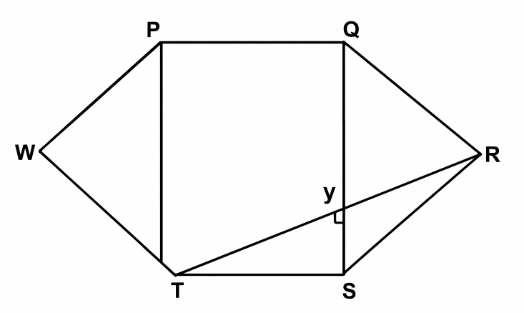
PQRSTW is a regular hexagon and QS intersects RT at V. Calculate ∠TVS
Not clear enough?
Question 33
Thus, N is the midpoint of PQ, so PN = NQ.
Not clear enough?
Question 34

In the diagram above, PQ = 10 cm, PS = 8 cm and ∠PSR is 60o while ∠SRQ is a right angle. Find SR
\[ \text{In } \triangle PST, \quad \cos 60^\circ = \dfrac{ST}{8} \] \[ \Rightarrow ST = 8 \times \cos 60^\circ = 8 \times \dfrac{1}{2} = 4 \] \[ \text{Since } PQRT \text{ is a rectangle, } TR = 10 \] \[ \therefore \; SR = ST + TR = 4 + 10 = 14 \,\text{cm} \]
Not clear enough?
Question 35
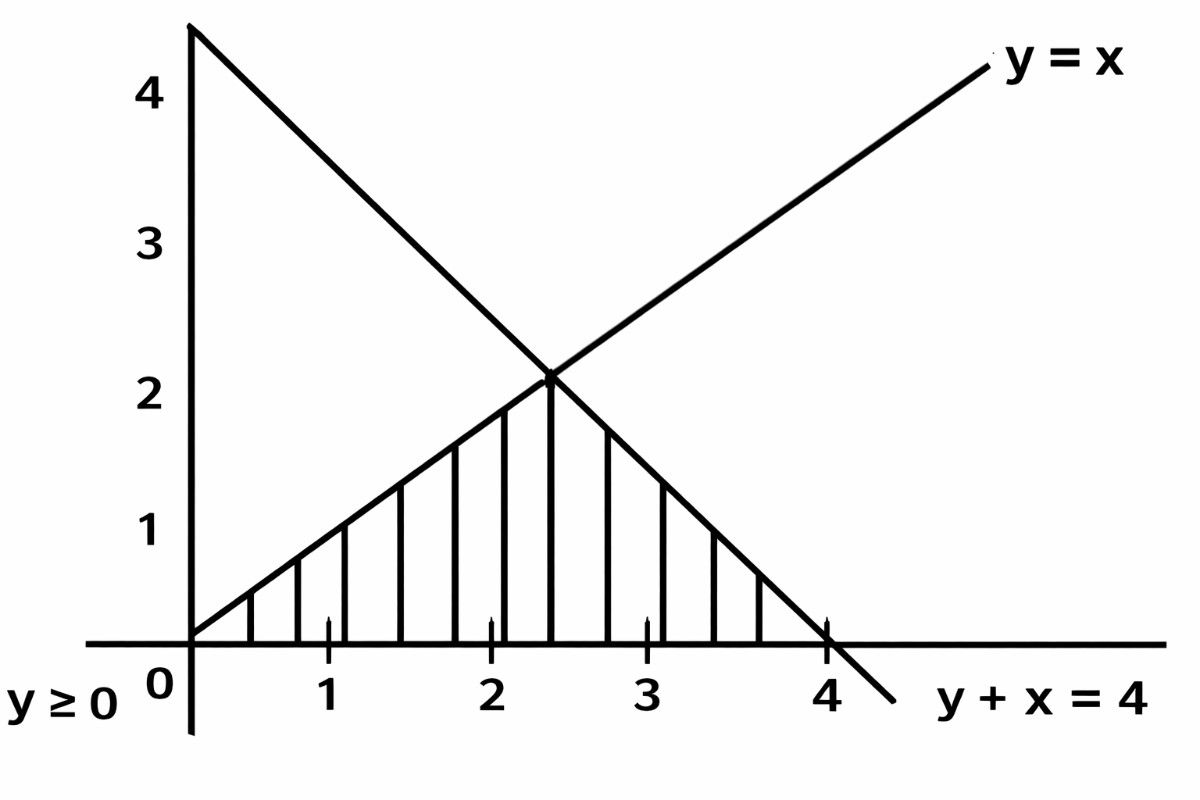
The solution set of the shaded area above is
Thus, the solution set is y ≤ x, y + x ≤ 4 and y ≥ 0.
Not clear enough?
Question 36
The inverse of 20 is \(b\) such that:\[ 20 ⊕ b = \dfrac{20b}{6} = 6 \]\[ 20b = 36 \Rightarrow b = \dfrac{36}{20} = \dfrac{9}{5} \].
Not clear enough?
Question 37
So, \(p \propto \dfrac{1}{r^6}\).
Not clear enough?
Question 38
Not clear enough?
Question 39
Substitute into \(kx^3 + x^2 - 5x - 2\):\[ k(-\tfrac{1}{2})^3 + (-\tfrac{1}{2})^2 - 5(-\tfrac{1}{2}) - 2 = 2 \]\[ -\tfrac{k}{8} + \tfrac{1}{4} + \tfrac{5}{2} - 2 = 2 \]\[ -\tfrac{k}{8} + \tfrac{3}{4} = 2 \]\[ -\tfrac{k}{8} = \tfrac{5}{4} \Rightarrow k = -10 \].
Not clear enough?
Question 40
Not clear enough?
You might like
This question is based on George Orwell's Animal Farm.
The turn of events in the novel shows that the novelist is
In which of the following systems is the power of the component units more than that of the central government?
The formula (index of export prices)/(index of import prices) × 100 is used to measure the____________
A poultry farmer realized 200 eggs from his birds and sold 5 \(\frac{1}{2}\) crates of eggs. What percentage of eggs are left? (Note: 1 crate = 30 eggs)
Financial allocation to local governments by the federal or the state government to supplement the cost of a project is called_____