
Mathematics 2007 Jamb Examination

Question 41
Any point equidistant from two parallel lines lies on the line midway between them (the midline).
The midline's y-coordinate is the average: \(y=\dfrac{5+3}{2}=4\).
Therefore the locus is \(y-4=0\).
Not clear enough?
Question 42
For the points \((1-k,-4)\) and \((2,k+1)\) the midpoint is \(\left(\dfrac{1-k+2}{2},\dfrac{-4+(k+1)}{2}\right)=\left(\dfrac{3-k}{2},\dfrac{k-3}{2}\right)\).
Set this equal to \((-k,k)\) and equate coordinates:
\(\dfrac{3-k}{2}=-k\) \(\Rightarrow 3-k=-2k\) \(\Rightarrow k=-3\).
Checking the second coordinate: \(\dfrac{k-3}{2}=k\) \(\Rightarrow k-3=2k\) \(\Rightarrow k=-3\), consistent.
Hence \(k=-3\).
Not clear enough?
Question 43
For an octagon \(n=8\), so each exterior angle is \(\dfrac{360^\circ}{8}=45^\circ\).
Therefore each exterior angle is \(45^\circ\).
Not clear enough?
Question 44
Numerator: \(\sqrt{3}-\dfrac{1}{\sqrt{3}}=\dfrac{3-1}{\sqrt{3}}=\dfrac{2}{\sqrt{3}}\).
Denominator: \(\sqrt{3}+\dfrac{1}{\sqrt{3}}=\dfrac{3+1}{\sqrt{3}}=\dfrac{4}{\sqrt{3}}\).
Divide numerator by denominator: \(\dfrac{2/\sqrt{3}}{4/\sqrt{3}}=\dfrac{2}{4}=\dfrac{1}{2}\).
Therefore the value is \(\dfrac{1}{2}\).
Not clear enough?
Question 45
The diagonal \(d\) of a square satisfies \(d=s\sqrt{2}\), hence \(d=12\sqrt{2}\).
Thus the diagonal length is \(12\sqrt{2}\) cm.
Not clear enough?
Question 46
None of the options matches this general form unless a specific value of \(R\) is intended. The set of options suggests \(R=2\). If \(R=2\), then \(y=(1+x)^2\) and \(\dfrac{dy}{dx}=2(1+x)=2+2x\), which is option B.
So under the (implicit) assumption \(R=2\) the derivative is \(2+2x\).
Not clear enough?
Question 47
Let their ages be \(3k\) and \(4k\). Then \(3k+4k=7k=28\) so \(k=4\).
Lawal's age is \(4k=4\times 4=16\) years.
Not clear enough?
Question 48
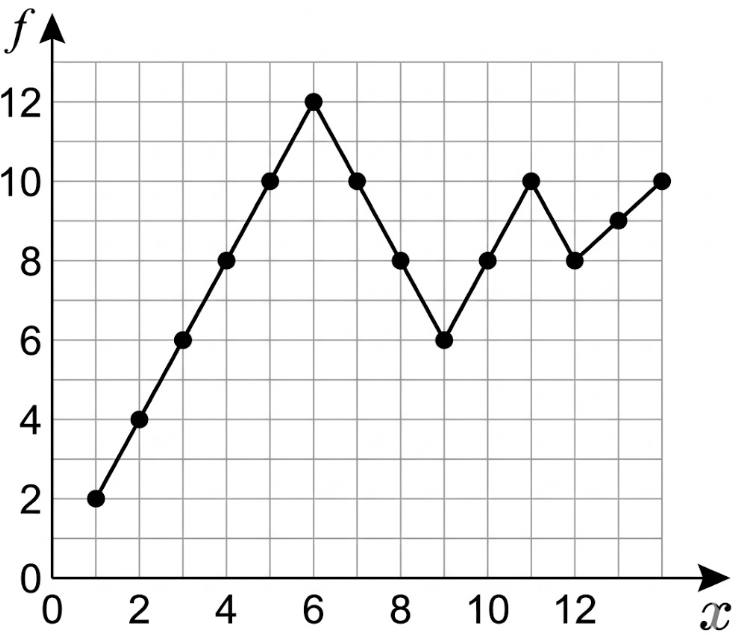
The cumulative frequency for from the distribution above is
The cumulative frequency 5\(\leq\) x \(\leq\) 12 = 10 + 12 + 10 + 8 + 6 + 8 + 10 + 8 = 72
Not clear enough?
Question 49
Not clear enough?
Question 50
First \(3P=3\begin{pmatrix}2 & 1 \\ -1 & 0 \end{pmatrix}=\begin{pmatrix}6 & 3 \\ -3 & 0 \end{pmatrix}\).
Subtract \(2I=\begin{pmatrix}2 & 0 \\ 0 & 2 \end{pmatrix}\) to get \(\begin{pmatrix}6-2 & 3-0 \\ -3-0 & 0-2 \end{pmatrix}=\begin{pmatrix}4 & 3 \\ -3 & -2 \end{pmatrix}\).
So \(f(P)=\begin{pmatrix}4 & 3 \\ -3 & -2 \end{pmatrix}\), which is option D.
Not clear enough?
You might like
15 men can finish a piece of work in 40 days. The number of days after which 5 men should leave the work so that the work is finished in 45 days altogether is ?
The discovery of __________ in processed beef products made by Irish firms and sold by UK supermarket chains led to a major food scandal across Europe in early 2013.
Given:
I. Cash refunds
II. Debit note issued
III. Dishonoured cheque
IV. Purchases
The item on the credit side of purchases ledger control account includes
If there had been double the number of Pure Gap plc sales in Year 2, what fraction would Make Fit Ltd sales have been of combined Pure Gap plc and Make Fit Ltd sales in Year 2?
Choose the option that best completes the gap(s).
Until he lost the election, Agbo ....... to be Student Union president?
Choose the option that best completes the gap:
It was very easy for the two political parties to form a _______ Government.