Mathematics 2007 Jamb Examination
Mathematics 2007 Jamb Examination

Question 1
If 5, 8, 6 and 2 occur with frequencies 3, 2, 4 and 1 respectively. Find the product of the modal and the median number
The data set is: 5,5,5,8,8,6,6,6,6,2
The mode is 6 (most frequent).
The median is the 5th element in the ordered list: 2,5,5,5,6,6,6,6,8,8 → median = 6.
Product = 6 × 6 = 36.
The mode is 6 (most frequent).
The median is the 5th element in the ordered list: 2,5,5,5,6,6,6,6,8,8 → median = 6.
Product = 6 × 6 = 36.
Not clear enough?
Question 2
In a basket, there are 6 grapes, 11 bananas and 13 oranges. If one fruit is chosen at random. What is the probability that the fruit is either a grape or a banana
Total fruits = 6 + 11 + 13 = 30.
Favorable = 6 + 11 = 17.
Probability = $\dfrac{17}{30}$.
Favorable = 6 + 11 = 17.
Probability = $\dfrac{17}{30}$.
Not clear enough?
Question 3
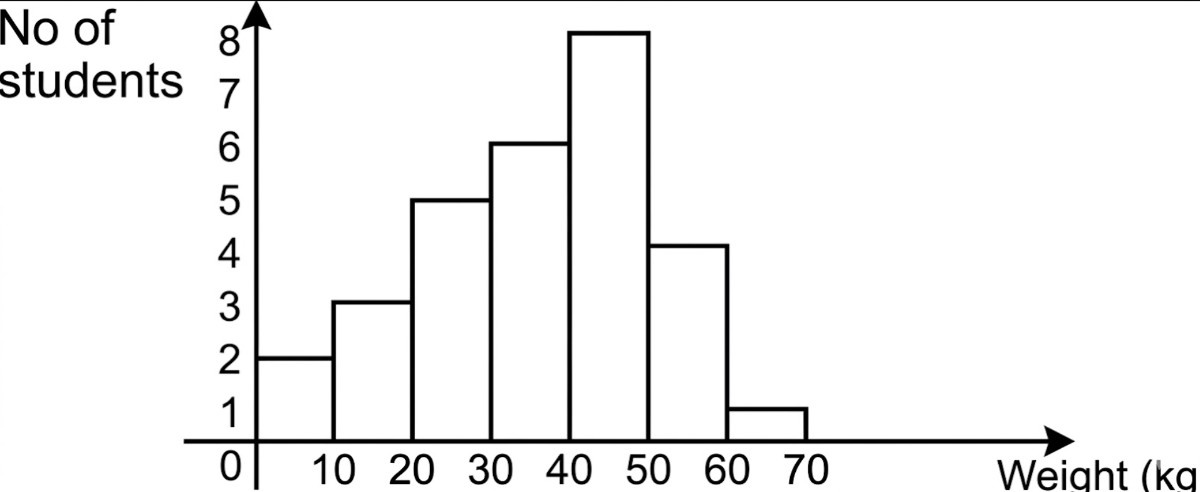
The histogram above represents the weights of students who traveled out to their school for an examination. How many people made the trip?
| Weight | Number of students |
|---|---|
| 10 | 2 |
| 20 | 3 |
| 30 | 5 |
| 40 | 6 |
| 50 | 8 |
| 60 | 4 |
| 70 | 1 |
| 29 |
students who made the trip = 2 + 3 + 4 + 5 + 6 + 8 + 1 = 29
Not clear enough?
Question 4
A senatorial candidate had planned to visit seven cities prior to a primary election. However, he could only visit four of the cities. How many different itineraries could be considered?
Number of different itineraries = $_7P_4 = \dfrac{7!}{(7-4)!} = \dfrac{7!}{3!} = 7 \times 6 \times 5 \times 4 = 840.$
Not clear enough?
Question 5
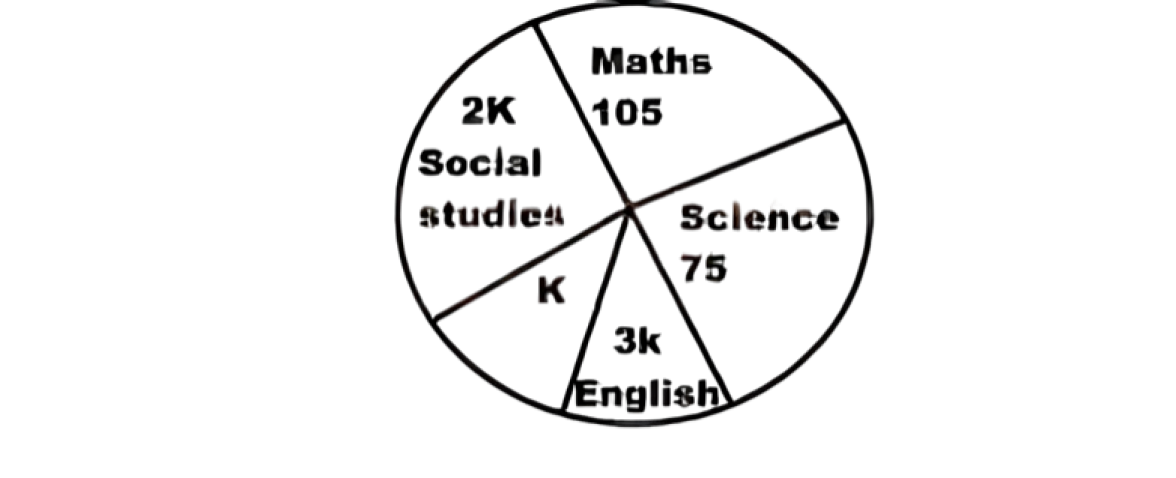
The pie chart above illustrate the amount of private time a student spends in a week studying various subjects. Find the value of k
The missing angle in the pie chart is 90°.
Thus, $k = 90^{\circ}$. K + 2K + 3K + 75 + 105 = 360 (at a point) 6K + 180 = 360
6K = 360 - 180
6K = 180
k = 180/6 = 30º
Thus, $k = 90^{\circ}$. K + 2K + 3K + 75 + 105 = 360 (at a point) 6K + 180 = 360
6K = 360 - 180
6K = 180
k = 180/6 = 30º
Not clear enough?
Question 6
\[\begin{array}{c c c c}\hline \text{Age in years} & 10 & 11 & 12 \\ \text{No of pupils} & 6 & 27 & 7 \\ \hline \end{array}\]
The table above shows the number of pupils in each age group in a class. What is the probability that a pupil chosen at random is at least 11 years old?
The table above shows the number of pupils in each age group in a class. What is the probability that a pupil chosen at random is at least 11 years old?
Total pupils = 6 + 27 + 7 = 40.
At least 11 years = 27 + 7 = 34.
Probability = $\dfrac{34}{40} = \dfrac{17}{20}$.
At least 11 years = 27 + 7 = 34.
Probability = $\dfrac{34}{40} = \dfrac{17}{20}$.
Not clear enough?
Question 7
What is the mean deviation of 3, 5, 8, 11, 12 and 21?
Mean = $\dfrac{3+5+8+11+12+21}{6} = \dfrac{60}{6} = 10$.
Deviations = |3−10|, |5−10|, |8−10|, |11−10|, |12−10|, |21−10| = 7,5,2,1,2,11.
Total deviation = 28.
Mean deviation = $\dfrac{28}{6} = 4.7$.
Deviations = |3−10|, |5−10|, |8−10|, |11−10|, |12−10|, |21−10| = 7,5,2,1,2,11.
Total deviation = 28.
Mean deviation = $\dfrac{28}{6} = 4.7$.
Not clear enough?
Question 8
$$
\begin{array}{c|c|c|c|c|c|c|c}
\text{Marks} & 3 & 4 & 5 & 6 & 7 & 8 \\
\hline
\text{Frequency} & 5 & y-1 & y & 9 & 4 & 1 \\
\end{array}
$$
The table above gives the frequency distribution of marks obtained by a group of students in a test. If the total mark scored is 200, calculate the value of y
The table above gives the frequency distribution of marks obtained by a group of students in a test. If the total mark scored is 200, calculate the value of y
Total mark scored = 200
∴200 = 15 + 4y - 4 + 5y + 54 + 28 + 8
200 = 9y + 101
200 - 101 = 9y
99 = 9y
∴y = 11
∴200 = 15 + 4y - 4 + 5y + 54 + 28 + 8
200 = 9y + 101
200 - 101 = 9y
99 = 9y
∴y = 11
Not clear enough?
Question 9
In how many ways can 6 subjects be selected from 10 subjects for an examination
$$^{10}C_6 = \dfrac{10!}{(10-6)!6!}$$
$$=\dfrac{10!}{4!6!}$$
=210
Not clear enough?
Question 10
Integrate $\dfrac{x^2−\sqrt{x}}{x}$ with respect to x
$\dfrac{x^2−\sqrt{x}}{x} = x − x^{-1/2}$.
Integrate: $\int (x − x^{-1/2}) dx = \dfrac{x^2}{2} − 2\sqrt{x} + K$.
Integrate: $\int (x − x^{-1/2}) dx = \dfrac{x^2}{2} − 2\sqrt{x} + K$.