
Mathematics 2007 Jamb Examination
Mathematics 2007 Jamb Examination

Question 11
If y = x cos x, find dy/dx
Use the product rule: if y = x\cos x then \(\dfrac{dy}{dx} = 1\cdot\cos x + x\cdot(-\sin x) = \cos x - x\sin x\).
Not clear enough?
Question 12
Find the value of x for which the function $f(x) = 2x^3 - x^2 - 4x + 4$ has a maximum value
Compute stationary points: \(f'(x)=6x^2-2x-4\).
Solve \(6x^2-2x-4=0\) divide by 2
We have \(3x^2-x-2=0\).
Roots: $$x=\dfrac{1\pm\sqrt{1+24}}{6}=\dfrac{1\pm5}{6}$$ Giving \(x=1\) and \(x=-\tfrac{2}{3}\).
Second derivative $$f''(x)=12x-2$$ At \(x=1\), \(f''(1)=10>0\) → local minimum.
At \(x=-\tfrac{2}{3}\), \(f''(-\tfrac{2}{3})=-10<0\) → local maximum.
So the function has its maximum at \(x=-\tfrac{2}{3}\).
Not clear enough?
Question 13
Determine the value of $\displaystyle\int_{0}^{\dfrac{\pi}{2}} \left(-2 \cos x \right)dx$
$$
\int_{0}^{\dfrac{\pi}{2}} -\left(2\cos x\right)\, dx
$$
Factor out the $-2$:
$$
= -2 \int_{0}^{\dfrac{\pi}{2}} \cos x \, dx
$$
Integrate $\cos x$:
$$
\int \cos x \, dx = \sin x
$$
Apply bounds:
$$
-2 \big[\sin x \big]_{0}^{\pi/2} = -2 \left( \sin\left(\tfrac{\pi}{2}\right) - \sin(0) \right)
$$
$$
= -2 (1 - 0) = -2
$$
Not clear enough?
Question 14
A binary operation $\oplus$ on real numbers is defined by $x\oplus y = xy + x + y$ for any two real numbers x and y. The value of $(-3/4)\oplus 6$ is
Compute $(-\tfrac{3}{4})\oplus 6 $
$= (-\tfrac{3}{4})\cdot 6 + (-\tfrac{3}{4}) + 6 $
$= -\tfrac{18}{4} -\tfrac{3}{4} + 6 $
$= -\tfrac{21}{4} + \tfrac{24}{4} = \tfrac{3}{4}$.
$= (-\tfrac{3}{4})\cdot 6 + (-\tfrac{3}{4}) + 6 $
$= -\tfrac{18}{4} -\tfrac{3}{4} + 6 $
$= -\tfrac{21}{4} + \tfrac{24}{4} = \tfrac{3}{4}$.
Not clear enough?
Question 15
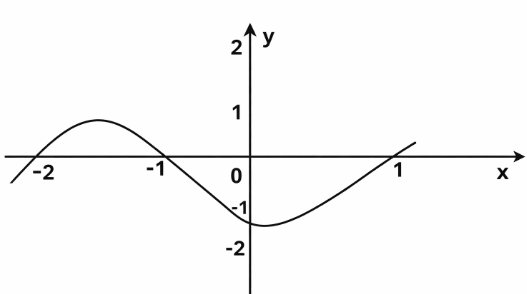
The graph above is represented by
From the graph, the x-intercepts are $x=-2, -1,$ and $1$.
The cubic with these roots is $(x+2)(x+1)(x-1)=x^3+2x^2-x-2$.
This matches option B exactly, with the correct y-intercept at $y=-2$.
The cubic with these roots is $(x+2)(x+1)(x-1)=x^3+2x^2-x-2$.
This matches option B exactly, with the correct y-intercept at $y=-2$.
Not clear enough?
Question 16
Make L the subject of the formula if
$$d = \sqrt{\dfrac{42w}{5l}}$$
$$d = \sqrt{\dfrac{42w}{5l}}$$
Answer: B. $\dfrac{42w}{5d^2}$.
Step 1 — square both sides to remove the square root:
\[ d^2 = \dfrac{42w}{5l}.\]
Step 2 — multiply both sides by $5l$ to isolate $l$ in the denominator:
\[5l d^2 = 42w.\]
Step 3 — solve for $l$ by dividing both sides by $5d^2$:
\[ l = \dfrac{42w}{5d^2}.\]
So $l=\dfrac{42w}{5d^2}$ (option B).
Not clear enough?
Question 17
The solution of the quadratic inequality $(x^2 + x - 12) \ge 0$ is
Answer: D. $x\ge 3$ or $x\le -4$.
Step 1 — factor the quadratic:
\[x^2+x-12=(x+4)(x-3).\]
Step 2 — find the roots: $x=-4$ and $x=3$. The parabola $y=x^2+x-12$ opens upward (coefficient of $x^2$ is positive), so the quadratic is \(\ge 0\) outside the interval between the roots.
Step 3 — therefore the solution set is
\[x\le -4\quad\text{or}\quad x\ge 3.\]
This matches option D.
Not clear enough?
Question 18
Factorize $2t^2 + t - 15$
Answer: B. $(t+3)(2t-5)$.
Step 1 — multiply $2\times(-15)=-30$. We seek two integers whose product is $-30$ and whose sum is the middle coefficient $+1$.
Step 2 — $6$ and $-5$ work because $6\times(-5)=-30$ and $6+(-5)=1$.
Step 3 — split the middle term and factor by grouping:
\[2t^2+6t-5t-15=2t(t+3)-5(t+3)=(t+3)(2t-5).\]
So the factorization is $(t+3)(2t-5)$ (option B).
Not clear enough?
Question 19
Solve the inequality $-3(x - 2) < -2(x + 3)$
Answer: A. $x>12$.
Step 1 — expand both sides:
\[-3x+6 < -2x-6.\]
Step 2 — collect like terms. Add $3x$ to both sides:
\[6 < x - 6.\]
Step 3 — add $6$ to both sides:
\[12 < x\quad\text{or}\quad x>12.\]
So the solution is $x>12$ (option A).
Not clear enough?
Question 20
If $W \propto L^2$ and $W=6$ when $L=4$. If $L=\sqrt{17}$ find $W$
Write the proportionality as an equation: $W=kL^2$ for some constant $k$.
Use $W=6$ at $L=4$ to find $k$: \[6 = k(4^2)=16k\Rightarrow k=\dfrac{6}{16}=\dfrac{3}{8}.\] Compute W at $L=\sqrt{17}$: \[W = \dfrac{3}{8}\cdot(\sqrt{17})^2 = \dfrac{3}{8}\cdot17 = \dfrac{51}{8}.\]
Use $W=6$ at $L=4$ to find $k$: \[6 = k(4^2)=16k\Rightarrow k=\dfrac{6}{16}=\dfrac{3}{8}.\] Compute W at $L=\sqrt{17}$: \[W = \dfrac{3}{8}\cdot(\sqrt{17})^2 = \dfrac{3}{8}\cdot17 = \dfrac{51}{8}.\]
Not clear enough?
You might like
Which of the following nerves provides the primary motor and sensory supply to the muscles and skin of the perineum?
Given that the first and fourth terms of a G.P are 6 and 162 respectively, find the sum of the first three terms of the progression.
This question is based on J.C De Graft Sons and Daughters.
'I simply don't understand what's the matter with everybody today. everybody let me down, and ......
The speaker above is referring to
Choose the word or phrase which is most nearly opposite in meaning to the word in capitals.
SKEPTICISM:
Choose the option nearest in meaning to the word or phrase underlined.
Obi's dog is old but still lively.