
Mathematics 2007 Jamb Examination
Mathematics 2007 Jamb Examination

Question 31
Given
P = {1, 3, 5, 7, 9, 11}
and Q = {2, 4, 6, 8, 10, 12}. Determine the relationship between P and Q
P = {1, 3, 5, 7, 9, 11}
and Q = {2, 4, 6, 8, 10, 12}. Determine the relationship between P and Q
P contains only odd numbers and Q contains only even numbers. There are no elements common to both sets. Therefore the intersection is the empty set: P ∩ Q = ∅.
Not clear enough?
Question 32
Evaluate $(1011_2)^2 - (101_2)^2$
First, convert to decimal: 1011₂ = 11, 101₂ = 5.
Then square: 11² = 121, 5² = 25.
Subtract: 121 - 25 = 96.
Convert 96 back to base 2: 1100000₂.
Hence the correct result is 1100000₂.
Then square: 11² = 121, 5² = 25.
Subtract: 121 - 25 = 96.
Convert 96 back to base 2: 1100000₂.
Hence the correct result is 1100000₂.
Not clear enough?
Question 33
If X = {all the perfect squares less than 40} and Y = {all the odd numbers from 1 to 15}. Find X ∩ Y.
Perfect squares less than 40: 1, 4, 9, 16, 25, 36. Odd numbers from 1 to 15: 1, 3, 5, 7, 9, 11, 13, 15. The common elements are 1 and 9, so X ∩ Y = {1, 9}.
Not clear enough?
Question 34
Calculate the length of an arc of a circle diameter 14 cm, which subtends an angle of 90° at the center of the circle
Radius r = diameter/2 = 14/2 = 7 cm. Angle θ = 90° = $\tfrac{\pi}{2}$ radians. Arc length s = rθ = 7 × $\tfrac{\pi}{2}$ = $\tfrac{7\pi}{2}$ cm.
Not clear enough?
Question 35
If the lines $3y = 4x - 1$ and $qy = x + 3$ are parallel to each other, the value of q is
Find slopes. From 3y = 4x - 1 ⇒ y = (4/3)x - 1/3, so slope m1 = 4/3. From qy = x + 3 ⇒ y = (1/q)x + 3/q, so slope m2 = 1/q. Parallel lines have equal slopes: 1/q = 4/3 ⇒ q = 3/4.
Not clear enough?
Question 36
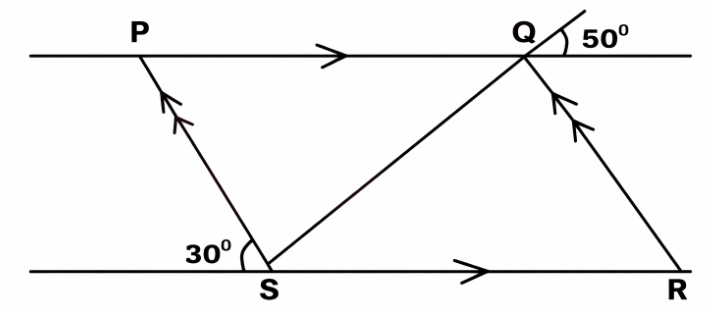
In the parallelogram PQRS above, find angle SQR
x = 30o (alternate ∠s b/c PQ//Sr)
Y = 50o (vertical opposite ∠s)
r = 30o (alternate ∠s b/c PQ//SR)
But = y + q + t = 180o (∠s on a straight line)
50 + q + 30 = 180
q + 80 = 180
q = 180 -80
q = 100o
Y = 50o (vertical opposite ∠s)
r = 30o (alternate ∠s b/c PQ//SR)
But = y + q + t = 180o (∠s on a straight line)
50 + q + 30 = 180
q + 80 = 180
q = 180 -80
q = 100o
Not clear enough?
Question 37
The volume of a hemispherical bowl is $718\tfrac{2}{3}$. Find its radius.
Answer: C. 7.0 cm.
Step-by-step:
1. Convert the mixed number to an improper fraction: \(718\tfrac{2}{3}=718+\tfrac{2}{3}=\tfrac{2154}{3}+\tfrac{2}{3}=\tfrac{2156}{3}.\)
2. Volume of a hemisphere: \(V=\dfrac{2}{3}\pi r^3.\)
3. Set up the equation: \(\dfrac{2}{3}\pi r^3 = \dfrac{2156}{3}.\)
4. Multiply both sides by 3 and divide by 2π:
\[r^3 = \dfrac{2156}{2\pi} = \dfrac{1078}{\pi}.\]
5. Compute numerically: \(\dfrac{1078}{\pi}\approx 343.16\). Take cube root: \(r\approx\sqrt[3]{343.16}\approx 7.00\) (note \(7^3=343\), so this is consistent).
6. Therefore the radius ≈ 7.0 cm (option C).
Not clear enough?
Question 38
A particle P moves between points S and T such that angle SPT is always constant and ST is constant. Find the locus of P
It is a semicircle with ST as diameter (general locus principle).
The locus problem states: all points P that subtend a fixed angle at the segment ST. A classical theorem (the circle angle theorem) says: all points from which a given chord ST is seen under a fixed angle lie on an arc of a circle (an arc of the circle that subtends ST at that angle).
The special and commonly tested case is when the constant angle is 90° (a right angle). In that case the locus is the semicircle with ST as diameter (Thales' theorem).
The available options include the semicircle with ST as diameter, which is the correct expression of this locus for the right-angle case and matches the general statement that the locus is an arc of a circle subtending ST under the constant angle.
Not clear enough?
Question 39
If the lines $2y - kx + 2 = 0$ and $y + x - \tfrac{k}{2} = 0$ intersect at $(1,-2)$, find the value of k
Answer: C. -2.
Step-by-step:
1. The point (1,−2) lies on both lines. Substitute x=1, y=−2 into the first equation:
\[2(-2) - k(1) + 2 = 0.\]
Simplify: \(-4 - k + 2 = 0\Rightarrow -2 - k = 0\Rightarrow k = -2.\)
2. Verify in the second equation: substitute x=1, y=−2:
\[-2 + 1 - k/2 = 0 \Rightarrow -1 - k/2 = 0 \Rightarrow k/2 = -1 \Rightarrow k = -2.\]
3. Both equations agree, so k = −2 (option C).
Not clear enough?
Question 40
A man 40 m from the foot of a tower observes the angle of elevation of the tower to be 30º. Determine the height of the tower.
Answer: A. $\dfrac{40\sqrt{3}}{3}$ m.
Step-by-step:
1. Let the height of the tower be h and the horizontal distance from the man to the tower base be 40 m.
2. Using right-triangle trigonometry: \(\tan(30^\circ)=\dfrac{\text{opposite}}{\text{adjacent}}=\dfrac{h}{40}.\)
3. Since \(\tan 30^\circ=\dfrac{1}{\sqrt{3}}\), we have \(\dfrac{1}{\sqrt{3}}=\dfrac{h}{40}\Rightarrow h=\dfrac{40}{\sqrt{3}}.\)
4. Rationalize the denominator if desired: \(h=\dfrac{40\sqrt{3}}{3}.\)
5. Thus the tower's height is $\dfrac{40\sqrt{3}}{3}$ meters (option A).
Not clear enough?
You might like
This question is based on General Literary Principles.
That quality in a literary work which evokes tenderness, pity or sorrow is:
When shares are oversubscribed and money returned to unsuccessful applicants, the entry to record such money is to debit
Select the option that best explains the information conveyed in the sentence.
If he were here, it could be more fun.
In a code language, if ‘VERY’ is written as ‘UDQX’ ,then in the same language, how will you write the word ‘URGENT’ ?