
Mathematics 2011 Jamb Examination
Mathematics 2011 Jamb Examination

Question 31
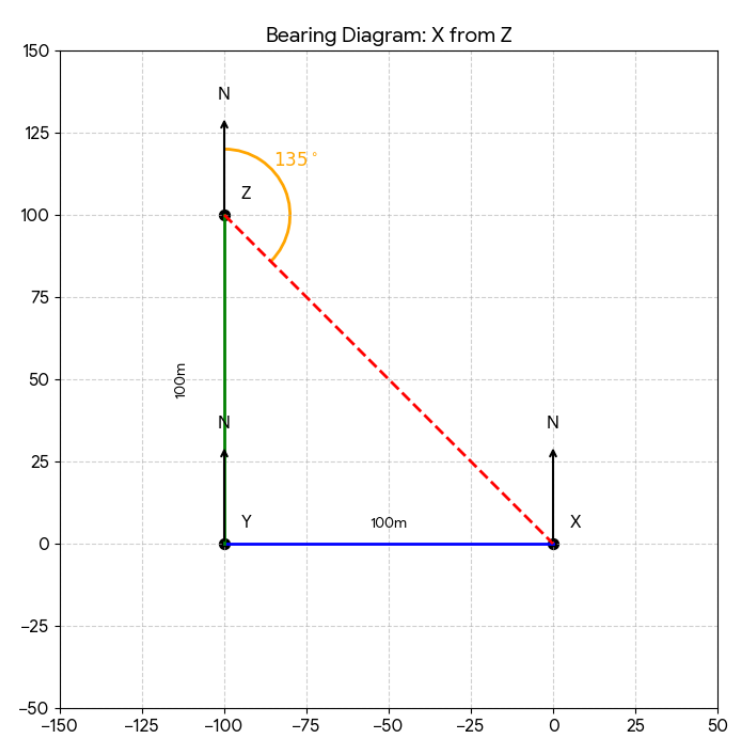
A man walks 100 m due West from a point X to Y, he then walks 100 m due North to a point Z. Find the bearing of X from Z.
Let X be the origin. Walking 100m West to Y and 100m North to Z forms a right-angled isosceles triangle.
At point Z, the direction back to Y is South (180°). To find the bearing of X, we need the clockwise angle from North at Z. Since \(ZY = YX = 100\)m, the internal angle \(\angle YZX\) is \(45^\circ\).
Looking from Z, X is to the East of the South line. The bearing is measured clockwise from North:\[\text{Bearing} = 180^\circ - 45^\circ = 135^\circ\]
Not clear enough?
Question 32
The derivative of \((2x + 1)(3x + 1)\) is:
To find the derivative, we first expand the product of the two linear factors:\[y = (2x + 1)(3x + 1) = 6x^2 + 2x + 3x + 1 = 6x^2 + 5x + 1\]Now, we apply the power rule for differentiation, \(\frac{d}{dx}(ax^n) = anx^{n-1}\):\[\frac{dy}{dx} = \frac{d}{dx}(6x^2) + \frac{d}{dx}(5x) + \frac{d}{dx}(1)\]\[\frac{dy}{dx} = 12x + 5\]
Not clear enough?
Question 33
Find the mode of the following distribution:
\(\begin{array}{|c|c|c|c|c|} \hline \text{Class Intervals} & 0-2 & 3-5 & 6-8 & 9-11 \\ \hline \text{Frequency} & 3 & 2 & 5 & 3 \\ \hline \end{array}\)
\(\begin{array}{|c|c|c|c|c|} \hline \text{Class Intervals} & 0-2 & 3-5 & 6-8 & 9-11 \\ \hline \text{Frequency} & 3 & 2 & 5 & 3 \\ \hline \end{array}\)
The mode for grouped data is found using the formula:\[\text{Mode} = L + \left( \frac{d_1}{d_1 + d_2} \right) w\]The modal class is 6–8 (highest frequency of 5).
\(L\) (lower boundary) = 5.5
\(d_1\) (frequency difference with previous class) = 5 - 2 = 3
\(d_2\) (frequency difference with next class) = 5 - 3 = 2
\(w\) (class width) = 3\[\text{Mode} = 5.5 + \left( \frac{3}{3 + 2} \right) 3 = 5.5 + \frac{9}{5} = 5.5 + 1.8 = 7.3\]The closest whole number option provided is 7.
Not clear enough?
Question 34
Find the value of x at the minimum point of the curve \(y = x^3 + x^2 - x + 1\).
To find the minimum point, we first find the stationary points by setting the first derivative to zero:\[y' = 3x^2 + 2x - 1 = 0\]Factorising the quadratic:\[(3x - 1)(x + 1) = 0 \implies x = \frac{1}{3} \text{ or } x = -1\]To determine which is the minimum, we use the second derivative test:\[y'' = 6x + 2\]At \(x = \frac{1}{3}\), \(y'' = 6(\frac{1}{3}) + 2 = 4 > 0\) (Minimum).
At \(x = -1\), \(y'' = 6(-1) + 2 = -4 < 0\) (Maximum).
Thus, the minimum occurs at \(x = \frac{1}{3}\).
At \(x = -1\), \(y'' = 6(-1) + 2 = -4 < 0\) (Maximum).
Thus, the minimum occurs at \(x = \frac{1}{3}\).
Not clear enough?
Question 35
Evaluate \(\displaystyle\int_{0}^{1} (3 - 2x) dx\).
We evaluate the definite integral by first finding the anti-derivative of the function:\[\int (3 - 2x) dx = 3x - x^2\]Now, we apply the limits from 0 to 1:\[[3x - x^2]_{0}^{1} = (3(1) - (1)^2) - (3(0) - (0)^2)\]\[= (3 - 1) - (0) = 2\]The value of the integral is 2.
Not clear enough?
Question 36
Find \(\displaystyle\int \cos 4x \, dx\)
To integrate the function \(\cos 4x\), we apply the general rule for integrating trigonometric functions of the form \(\cos(ax)\), which is:\[\int \cos(ax) \, dx = \frac{1}{a} \sin(ax) + C\]In this specific problem, the constant \(a\) is equal to 4. Applying the rule:\[\int \cos 4x \, dx = \frac{1}{4} \sin 4x + k\]Where \(k\) represents the constant of integration. Alternatively, using \(u\)-substitution where \(u = 4x\), then \(du = 4dx\) or \(dx = \frac{du}{4}\). Substituting these into the integral gives:\[\int \cos u \frac{du}{4} = \frac{1}{4} \sin u + k = \frac{1}{4} \sin 4x + k\]
Not clear enough?
Question 37
The sum of four consecutive integers is 34. Find the least of these numbers.
Let the four consecutive integers be represented as \(n\), \(n+1\), \(n+2\), and \(n+3\). According to the question, their sum is 34:\[n + (n + 1) + (n + 2) + (n + 3) = 34\]Combining the like terms on the left-hand side of the equation:\[4n + 6 = 34\]To solve for \(n\), we first subtract 6 from both sides:\[4n = 34 - 6\]\[4n = 28\]Dividing both sides by 4 gives:\[n = 7\]The four integers are therefore 7, 8, 9, and 10. The least of these numbers is 7.
Not clear enough?
Question 38
Find the median and range of the data provided in the table below:
| Number | 0 | 1 | 2 | 3 | 4 | 5 |
|---|---|---|---|---|---|---|
| Frequency | 1 | 4 | 3 | 8 | 2 | 5 |
To find the median, we first determine the total frequency (\(N\)) by summing all the frequencies:\[N = 1 + 4 + 3 + 8 + 2 + 5 = 23\]The median position for an odd number of data points is calculated as:\[\text{Position} = \frac{N + 1}{2} = \frac{23 + 1}{2} = 12^{\text{th}} \text{ term}\]By calculating the cumulative frequencies (1, 5, 8, 16, 18, 23), we see that the 12th term falls within the frequency of the number 3. Thus, the median is 3.
The range is calculated as the difference between the highest and lowest values in the data set:\[\text{Range} = \text{Maximum} - \text{Minimum} = 5 - 0 = 5\]Therefore, the median and range are 3 and 5 respectively.
The range is calculated as the difference between the highest and lowest values in the data set:\[\text{Range} = \text{Maximum} - \text{Minimum} = 5 - 0 = 5\]Therefore, the median and range are 3 and 5 respectively.
Not clear enough?
Question 39
Find the standard deviation of the following distribution:
| Class Interval | 3–5 | 6–8 | 9–11 |
|---|---|---|---|
| Frequency | 2 | 2 | 2 |
To find the standard deviation, we first calculate the midpoint (\(x\)) of each class interval:
For 3–5, \(x = 4\); for 6–8, \(x = 7\); for 9–11, \(x = 10\).
Next, we find the mean (\(\bar{x}\)):\[\bar{x} = \dfrac{\sum fx}{\sum f} = \dfrac{(2 \times 4) + (2 \times 7) + (2 \times 10)}{2 + 2 + 2} \]\[= \dfrac{8 + 14 + 20}{6} = \dfrac{42}{6} = 7\]Now, we calculate the variance (\(\sigma^2\)) using the formula \(\dfrac{\sum f(x - \bar{x})^2}{\sum f}\):\[\sigma^2 = \dfrac{2(4 - 7)^2 + 2(7 - 7)^2 + 2(10 - 7)^2}{6}\]\[\sigma^2 = \dfrac{2(-3)^2 + 2(0)^2 + 2(3)^2}{6} = \dfrac{2(9) + 0 + 2(9)}{6} = \dfrac{36}{6} = 6\]The standard deviation is the square root of the variance:\[\sigma = \sqrt{6}\]
Not clear enough?
Question 40
In how many ways can the letters of the word ELATION be arranged?
The word ELATION consists of 7 distinct letters: E, L, A, T, I, O, and N. Since there are no repeated letters, the number of possible permutations is determined by the factorial of the total number of letters.
The formula for the number of ways to arrange \(n\) distinct objects is \(n!\). In this case, \(n = 7\), so the number of arrangements is:\[7! = 7 \times 6 \times 5 \times 4 \times 3 \times 2 \times 1 = 5,040\]The correct mathematical expression for this value is \(7!\).
The formula for the number of ways to arrange \(n\) distinct objects is \(n!\). In this case, \(n = 7\), so the number of arrangements is:\[7! = 7 \times 6 \times 5 \times 4 \times 3 \times 2 \times 1 = 5,040\]The correct mathematical expression for this value is \(7!\).
Not clear enough?
You might like
Each of the questions below consists of two words that have a certain relationship to each other.
Select the pair of words.
INFANCY : SENILITY
A positive and a negative charge are initially 50 mm apart. When they are moved close together so that· they are now only 10 mm apart, the force between them will be ?