
Mathematics 2011 Jamb Examination
Mathematics 2011 Jamb Examination

Question 41
In how many ways can five people sit round a circular table?
When objects are arranged in a circle, the number of unique arrangements is different from a linear arrangement because the circle has no fixed starting or ending point. To account for rotational symmetry, we fix one person in a position and arrange the others relative to them.
The formula for circular permutations of \(n\) objects is:\[(n - 1)!\]For 5 people sitting around a table, the number of ways is:\[(5 - 1)! = 4!\]Calculating the factorial:\[4! = 4 \times 3 \times 2 \times 1 = 24\]
The formula for circular permutations of \(n\) objects is:\[(n - 1)!\]For 5 people sitting around a table, the number of ways is:\[(5 - 1)! = 4!\]Calculating the factorial:\[4! = 4 \times 3 \times 2 \times 1 = 24\]
Not clear enough?
Question 42
Find the probability that a number picked at random from the set \(\{43, 44, 45, \dots, 60\}\) is a prime number.
First, we determine the total number of items in the set. The set starts at 43 and ends at 60, so the total count of numbers is:\[60 - 43 + 1 = 18\]Next, we identify the prime numbers within this range. A prime number is a number greater than 1 that has no positive divisors other than 1 and itself. The primes in this set are: 43, 47, 53, and 59. There are 4 prime numbers in total.
The probability \(P\) is given by the ratio of the number of successful outcomes to the total number of outcomes:\[P = \frac{\text{Number of primes}}{\text{Total numbers}} = \frac{4}{18}\]Reducing the fraction to its lowest terms by dividing both the numerator and denominator by 2:\[P = \frac{2}{9}\]
The probability \(P\) is given by the ratio of the number of successful outcomes to the total number of outcomes:\[P = \frac{\text{Number of primes}}{\text{Total numbers}} = \frac{4}{18}\]Reducing the fraction to its lowest terms by dividing both the numerator and denominator by 2:\[P = \frac{2}{9}\]
Not clear enough?
Question 43
Find the derivative of \(\tan \theta\).
To find the derivative of \(\tan \theta\), we can use the quotient rule by expressing the tangent function as the ratio of sine to cosine:\[y = \tan \theta = \frac{\sin \theta}{\cos \theta}\]Using the quotient rule \(\frac{d}{d\theta}\left(\frac{u}{v}\right) = \frac{v u' - u v'}{v^2}\), where \(u = \sin \theta\) and \(v = \cos \theta\):\[\frac{dy}{d\theta} = \frac{\cos \theta (\cos \theta) - \sin \theta (-\sin \theta)}{\cos^2 \theta}\]\[\frac{dy}{d\theta} = \frac{\cos^2 \theta + \sin^2 \theta}{\cos^2 \theta}\]Applying the fundamental trigonometric identity \(\cos^2 \theta + \sin^2 \theta = 1\):\[\frac{dy}{d\theta} = \frac{1}{\cos^2 \theta} = \sec^2 \theta\]Therefore, the derivative of \(\tan \theta\) is \(\sec^2 \theta\).
Not clear enough?
Question 44
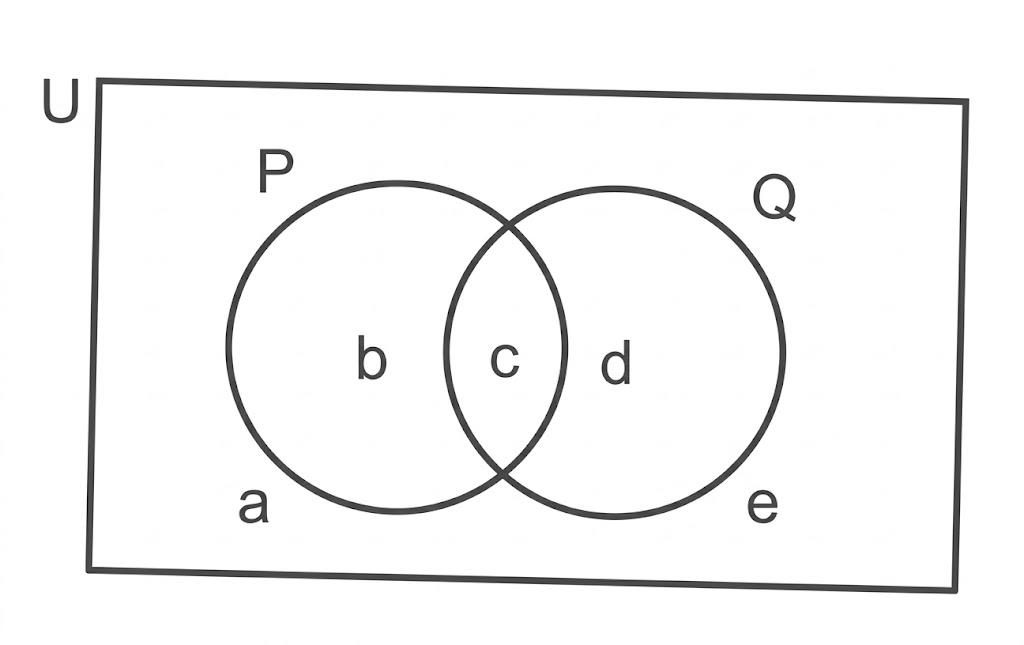
From the Venn diagram, the complement of the set \( P \cap Q \) is given by:
In set theory, the intersection \( P \cap Q \) represents the elements that are common to both set \( P \) and set \( Q \). From the diagram, the intersection contains the element \( \{c\} \).
The complement of a set, denoted as \( (P \cap Q)' \), consists of all elements in the universal set that are NOT in the intersection. Looking at the diagram, the elements outside the intersection are \( a \) (only in \( P \)), \( e \) (only in \( Q \)), and \( b, d \) (outside both sets but within the universal set). Combining these, the complement is \( \{a, b, d, e\} \).
The complement of a set, denoted as \( (P \cap Q)' \), consists of all elements in the universal set that are NOT in the intersection. Looking at the diagram, the elements outside the intersection are \( a \) (only in \( P \)), \( e \) (only in \( Q \)), and \( b, d \) (outside both sets but within the universal set). Combining these, the complement is \( \{a, b, d, e\} \).
Not clear enough?
Question 45
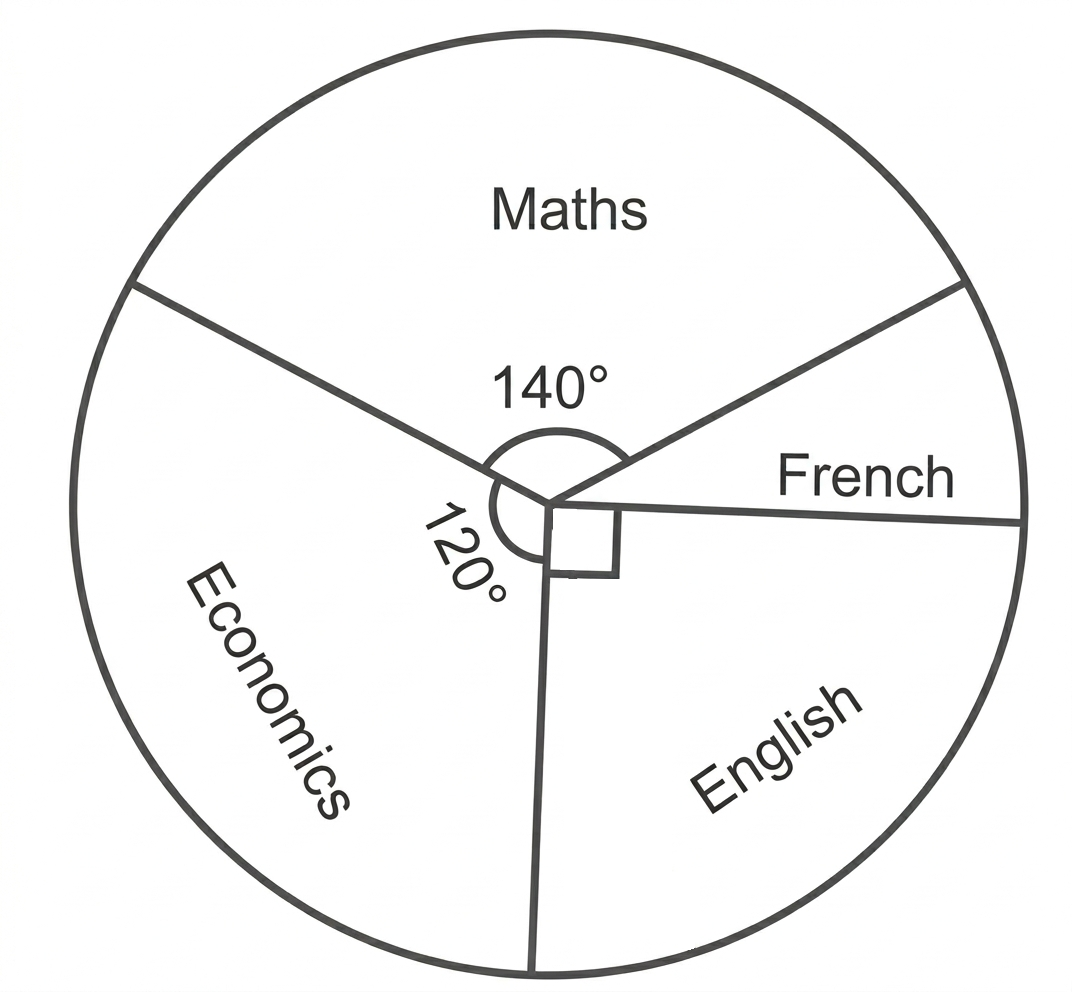
The pie chart shows the distribution of courses offered by students. What percentage of the students offer English?
A pie chart represents the total distribution as \( 360^\circ \).
To find the percentage for English, we determine the angle occupied by the English sector. From the data provided in the chart:
English: \( 90^\circ \)\[ \text{Percentage} = \left( \frac{90^\circ}{360^\circ} \right) \times 100 = \frac{1}{4} \times 100 = 25\% \]
To find the percentage for English, we determine the angle occupied by the English sector. From the data provided in the chart:
English: \( 90^\circ \)\[ \text{Percentage} = \left( \frac{90^\circ}{360^\circ} \right) \times 100 = \frac{1}{4} \times 100 = 25\% \]
Not clear enough?
Question 46
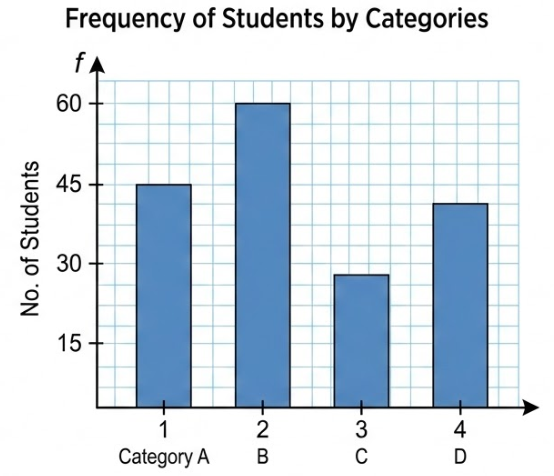
The bar chart above shows the distribution of SS2 students in a school. Find the total number of students.
To find the total number of students, we read the frequency (number of students) for each class from the bar chart and sum them together:
- SS2A: 45 students
- SS2B: 30 students
- SS2C: 40 students
- SS2D: 35 students
- SS2E: 30 students
Summing these values gives:\[\text{Total} = 45 + 30 + 40 + 35 + 30 = 180\]
- SS2A: 45 students
- SS2B: 30 students
- SS2C: 40 students
- SS2D: 35 students
- SS2E: 30 students
Summing these values gives:\[\text{Total} = 45 + 30 + 40 + 35 + 30 = 180\]
Not clear enough?
You might like
Each of the questions below consists of two words that have a certain relationship to each other.
Select the pair of words.
INVINCIBLE : SUBDUED
In which one of the following methods does the CPU poll to identify the interrupting module and branches to an interrupt service routine on detecting an interrupt?
If goods are sent to a branch at 25% on cost, what will be the cost of goods sent to the branch at a selling price of #100,000?
This question is based on Literary Appreciation.
A cursing rogue with a merry farce,
A bundle of rags upon a church,
Stumbled upon that windy place
Called Cruachan, and it was as much.
The rhyme scheme of the stanza above is