
Mathematics 2023 Jamb Examination

Question 61
Let the first term be \(a\) and the common ratio be \(r\). The second term of a geometric series is given by \(T_{2} = ar = -2/3\). The sum to infinity is given by \(S_{\infty} = \frac{a}{1 - r} = 3/2\).
From the second term, we can express \(a\) in terms of \(r\):\[ a = -\frac{2}{3r} \]Substitute this into the sum to infinity equation:\[ \frac{-2/3r}{1 - r} = \frac{3}{2} \]\[ \frac{-2}{3r(1 - r)} = \frac{3}{2} \]\[ -4 = 9r(1 - r) \implies -4 = 9r - 9r^{2} \]\[ 9r^{2} - 9r - 4 = 0 \]We solve this quadratic equation using the factors of \(9 \times -4 = -36\) that sum to \(-9\), which are \(-12\) and \(3\):\[ (3r + 1)(3r - 4) = 0 \]\[ r = -1/3 \text{ or } r = 4/3 \]For a sum to infinity to exist, the condition \(|r| < 1\) must be satisfied. Therefore, we discard \(4/3\) and accept \(r = -1/3\).
Not clear enough?
Question 62
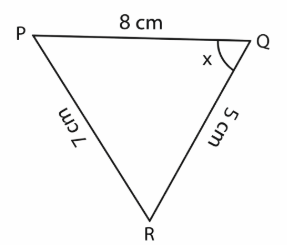
Find the value of the angle marked x in the diagram above
\(PR^2 = PQ^2 + RQ^2 - 2(PQ)(RQ)cos Q\)
\(\implies cos Q = \dfrac{PQ^2 + RQ^2 - PR^2}{2(PQ)(RQ)}\)
\(\implies cos Q = \dfrac{8^2 + 5^2 - 7^2}{2\times8\times5}\)
\(\implies cos Q = \dfrac{64 + 25 - 49}{80}\)
\(\implies cos Q = \dfrac{40}{80} = 0.5\)
\(\implies Q = cos^{-1} (0.5) = 60^0\)
\(\therefore x = 60^0\)
Not clear enough?
Question 63
If a point lies on a line, its coordinates must satisfy the equation of that line. The given equation is \(3y + 6x = 48\). We can simplify this by dividing the entire equation by 3:\[ y + 2x = 16 \]Point A is \((-2, k)\). Substituting \(x = -2\) and \(y = k\) into the equation:\[ k + 2(-2) = 16 \]\[ k - 4 = 16 \]\[ k = 16 + 4 = 20 \]We can verify this with point B \((4, 8)\):\[ 8 + 2(4) = 8 + 8 = 16 \]Since it satisfies the equation, the calculation for \(k\) is confirmed as 20.
Not clear enough?
Question 64
Let the number of children's tickets sold be \(c\). According to the problem, the number of adult tickets sold is five times that amount, so the number of adult tickets is \(5c\).
The total revenue is the sum of the sales from both groups:\[ (520 \times \text{Adults}) + (250 \times \text{Children}) = 171000 \]Substitute \(5c\) for Adults:\[ 520(5c) + 250c = 171000 \]\[ 2600c + 250c = 171000 \]\[ 2850c = 171000 \]To find \(c\), divide the total sales by the total coefficient:\[ c = \frac{171000}{2850} = 60 \]Therefore, 60 children's tickets were sold.
Not clear enough?
Question 65
First, rearrange the equation to group the logarithms on one side:\[ \log_{2} (6 - x) + \log_{2} x = 3 \]Using the addition law of logarithms (\(\log a + \log b = \log(ab)\)):\[ \log_{2} (x(6 - x)) = 3 \]Convert the logarithmic equation into exponential form:\[ x(6 - x) = 2^{3} \]\[ 6x - x^{2} = 8 \]Rearrange this into a standard quadratic equation:\[ x^{2} - 6x + 8 = 0 \]Factor the quadratic equation by looking for two numbers that multiply to 8 and add to \(-6\). These numbers are \(-4\) and \(-2\):\[ (x - 4)(x - 2) = 0 \]\[ x = 4 \text{ or } x = 2 \]Both values are valid because they result in positive arguments for the original logarithms (\(x > 0\) and \(6 - x > 0\)).
Not clear enough?
Question 66
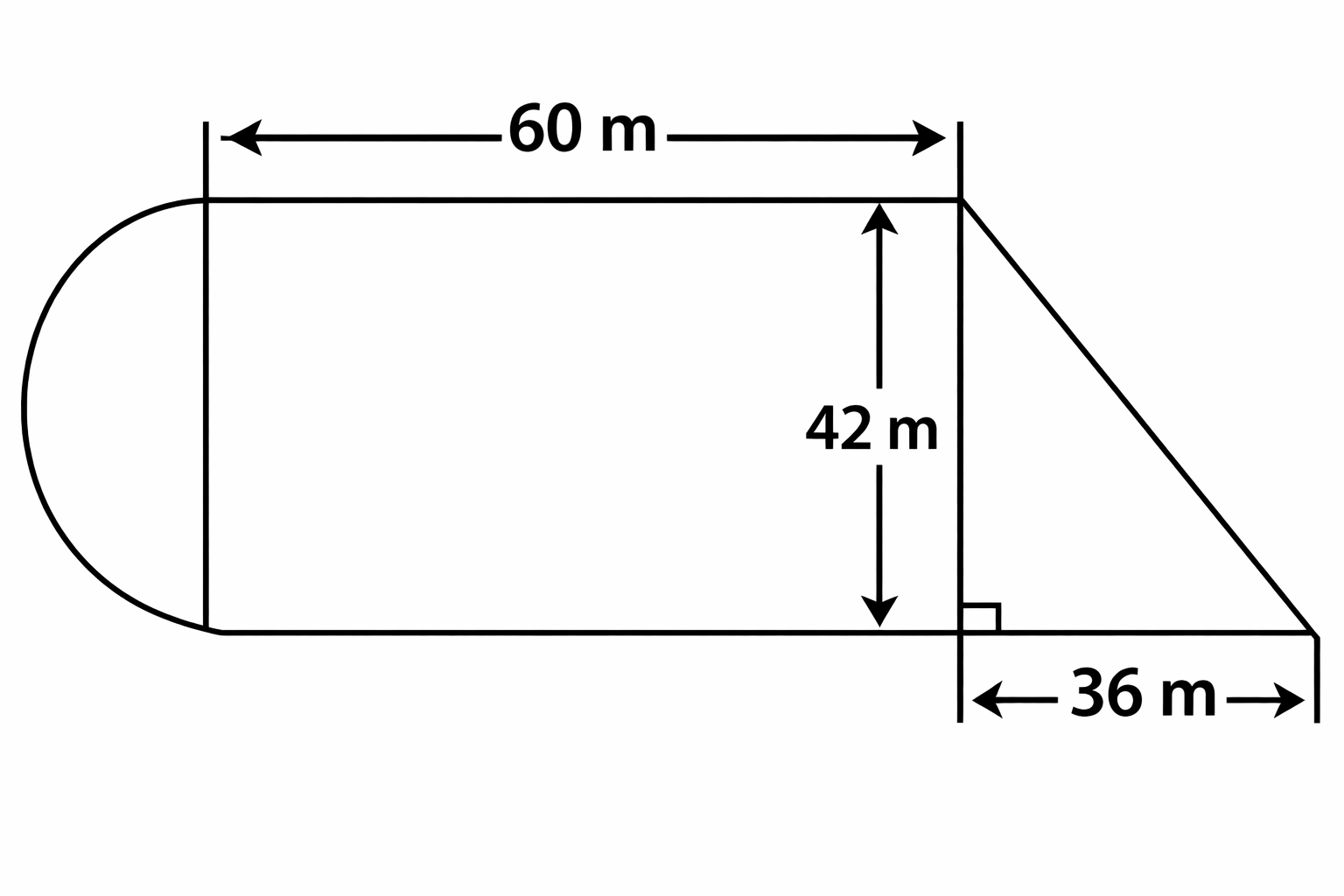
Calculate the area of the composite figure above.
Area of the composite figure = Area of semi circle + Area of rectangle + Area of triangle
Area of semi circle = \(\dfrac{1}{2}\pi r^2 = \dfrac{1}{2}\times\pi\times\dfrac{d^2}{4} = \dfrac{1}{2}\times\dfrac{22}{7}\times\dfrac{42^2}{4} = 693 m^2\)
Area of rectangle = l x b = 42 x 60 =2520 m\(^2\)
Area of triangle = \(\dfrac{1}{2}\times b \times h = \dfrac{1}{2}\times 36 \times 42 = 756 m^2\)
∴ Area of the composite figure = 693 + 2520 + 756 = 3969 m\(^2\)
Not clear enough?
Question 67
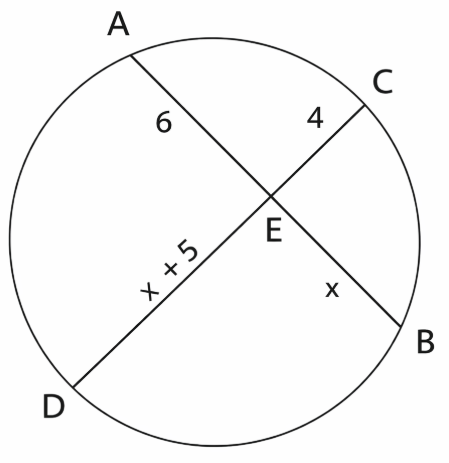
Find the value of x in the diagram above.
Intersecting Chords Theorem states that If two chords intersect in a circle, then the products of the measures of the segments of the chords are equal.
⇒ AE * EB = CE * ED
⇒ 6 * \(x\) = 4 * (\(x\) + 5)
⇒ 6\(x\) = 4\(x\) + 20
⇒ 6\(x\) - 4\(x\) = 20
⇒ 2\(x\) = 20
∴ \(x = \frac{20}{2}\) = 10 units
Not clear enough?
Question 68
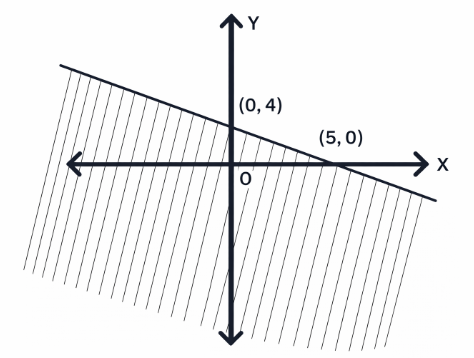
Which inequality describes the graph above?
First, we find the equation of the boundary line using the two intercepts.The slope is
m = \(\dfrac{4 - 0}{0 - 5} = {4}{5}\)
The y-intercept is 4
The slope-intercept form of the equation is therefore
y = -\(\dfrac{4}{5} x + 4\)
\(\implies y + \dfrac{4}{5} x = 4\)
Multiply both sides by \(\dfrac{5}{4}\)
\(\implies\dfrac{5}{4}(y +\dfrac{4}{5} x) = 4\times\dfrac{5}{4}\)
\(\implies\dfrac{5}{4} y + x = 5\)
Multiply both sides by 4
⇒ \(5y + 4x = 20\)
The inequality is therefore either \(5y + 4x ≤ 20\) or \(5y + 4x ≥ 20.\)
Using the test point (0, 0) -The origin
⇒ 5(0) + 4(0) ≤ 20
⇒ 0 ≤ 20 (True)
∴ The inequality is \(5y + 4x ≤ 20\)
Not clear enough?
Question 69
Calculate the perpendicular height \(h\) using Pythagoras theorem:\[ h = \sqrt{l^2 - r^2} = \sqrt{13^2 - 5^2} = \sqrt{169 - 25} = \sqrt{144} = 12 \text{ cm} \]Substitute \(r = 5\) cm and \(h = 12\) cm into the volume formula:\[ V = \frac{1}{3} \pi (5)^2 (12) = \frac{1}{3} \pi (25 \times 12) = \frac{300}{3} \pi = 100\pi \text{ cm}^3 \]
Not clear enough?
Question 70
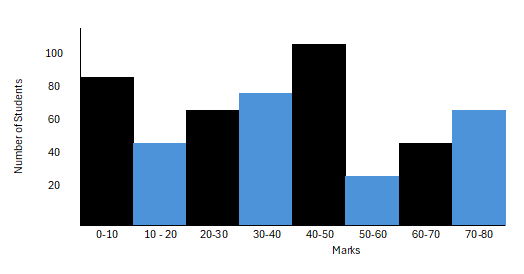
Study the given histogram above and answer the question that follows.
What is the total number of students that scored at most 50 marks?
Total number of students that scored at most 50 marks = 100 + 80 + 60 + 40 + 80 = 360