
Mathematics 2023 Jamb Examination

Question 51
To perform addition or subtraction in standard form, it is most efficient to convert all numbers to the same power of ten. Let us convert all terms to \(10^{-5}\):
First term: \(16.54 \times 10^{-5}\)
Second term: \(6.76 \times 10^{-8} = 0.00676 \times 10^{-5}\)
Third term: \(0.23 \times 10^{-6} = 0.023 \times 10^{-5}\)
Now, we can combine the coefficients:\[ 16.54 - 0.00676 + 0.023 \]\[ 16.54 + 0.023 = 16.563 \]\[ 16.563 - 0.00676 = 16.55624 \]The result is \(16.55624 \times 10^{-5}\). To convert this into proper standard form (where the first number is between 1 and 10), we shift the decimal point one place to the left and increase the exponent by 1:\[ 1.655624 \times 10^{-4} \]Rounding to two decimal places, we obtain \(1.66 \times 10^{-4}\).
Not clear enough?
Question 52
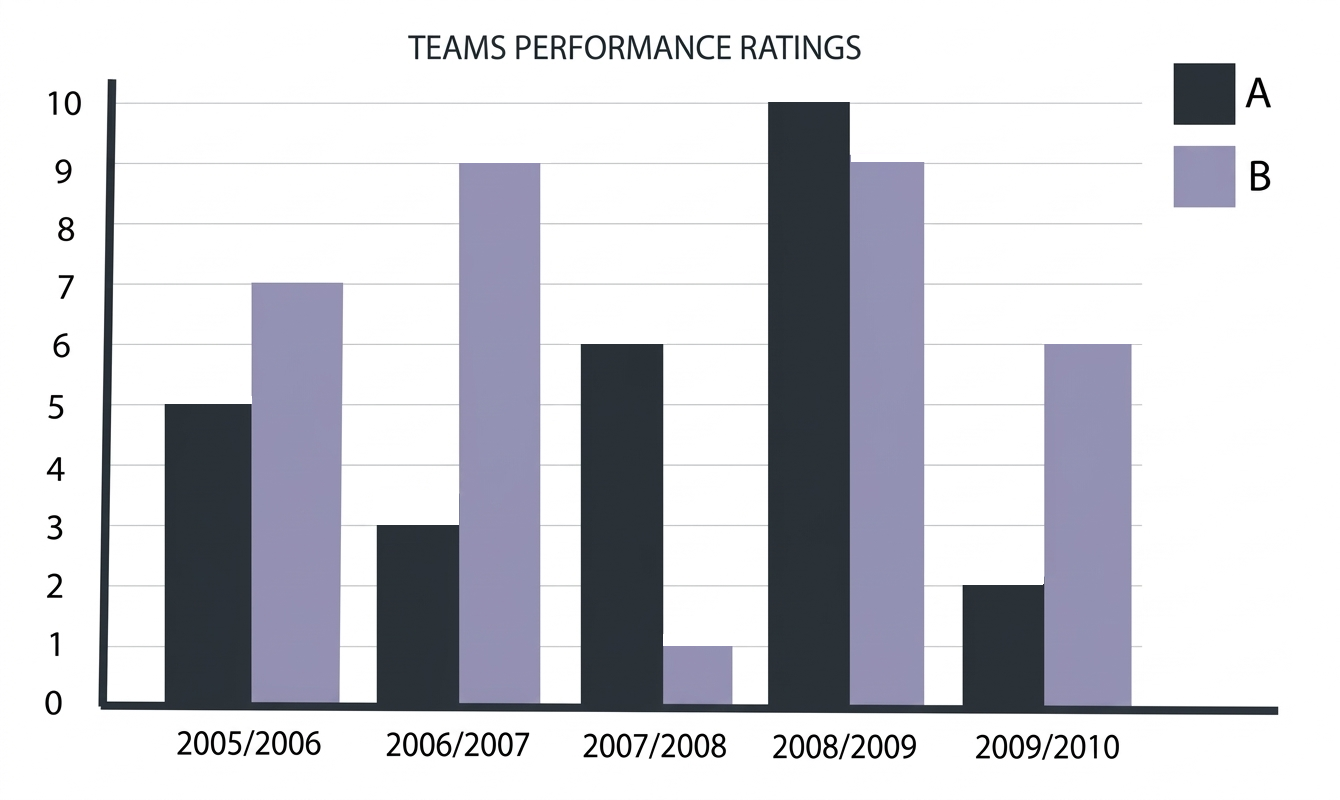
The graph above depicts the performance ratings of two sports teams A and B in five different seasons
In the last five seasons, what was the difference in the average performance ratings between Team B and Team A?
First, we extract the performance ratings for each team from the graph across the five seasons:
- Team A ratings: 5, 3, 6, 10, 2
- Team B ratings: 7, 9, 1, 9, 6
Average performance rating of Team B = \(\dfrac{7+9+1+9+6}{5} = \dfrac{32}{5}\) = 6.4
Average performance rating of Team A = \(\dfrac{5+3+6+10+2}{5} = \dfrac{26}{5}\) = 5.2
∴ The difference in the average performance ratings between Team B and Team A = 6.4 - 5.2 = 1.2
Not clear enough?
Question 53
Percentage error is a measure of how accurate a measurement is compared to the true or accepted value. The formula for percentage error is:\[ \text{Percentage Error} = \frac{|\text{Actual Value} - \text{Measured Value}|}{\text{Actual Value}} \times 100\% \]Given values:
Actual Value (Teacher's report) = 18.4 mL
Measured Value (Student's report) = 18 mL
Step 1: Find the absolute error:\[ |18.4 - 18| = 0.4 \]Step 2: Calculate the ratio of the absolute error to the actual value:\[ \frac{0.4}{18.4} \approx 0.021739 \]Step 3: Convert to a percentage:\[ 0.021739 \times 100 = 2.1739\% \]Rounding to two decimal places gives 2.17%.
Not clear enough?
Question 54
The formula for the exterior angle of a regular polygon with \(x\) sides is \(\dfrac{360^\circ}{x}\).
For a polygon with \(n - 1\) sides, the exterior angle is \(\dfrac{360}{n - 1}\).
For a polygon with \(n + 2\) sides, the exterior angle is \(\dfrac{360}{n + 2}\).
According to the question, the difference between these angles is \(6^\circ\):\[ \frac{360}{n - 1} - \frac{360}{n + 2} = 6 \]Dividing the entire equation by 6 to simplify:\[ \frac{60}{n - 1} - \frac{60}{n + 2} = 1 \]Factoring out 60 and finding a common denominator:\[ 60 \left( \frac{(n + 2) - (n - 1)}{(n - 1)(n + 2)} \right) = 1 \]\[ 60 \left( \frac{3}{n^2 + n - 2} \right) = 1 \]\[ 180 = n^2 + n - 2 \]\[ n^2 + n - 182 = 0 \]To solve this quadratic equation, we factor \(-182\) into numbers that add up to 1. The factors are 14 and \(-13\):\[ (n + 14)(n - 13) = 0 \]Since the number of sides \(n\) must be a positive integer, we discard \(n = -14\). Therefore, \(n = 13\).
Not clear enough?
Question 55
When two dice are tossed, the total number of possible outcomes in the sample space is \(6 \times 6 = 36\). A prime number is a number greater than 1 that has no positive divisors other than 1 and itself. The possible sums when tossing two dice range from 2 to 12. The prime numbers in this range are 2, 3, 5, 7, and 11.
Let us identify the outcomes for each prime sum:
| Sum | Outcomes | Count |
|---|---|---|
| 2 | (1,1) | 1 |
| 3 | (1,2), (2,1) | 2 |
| 5 | (1,4), (2,3), (3,2), (4,1) | 4 |
| 7 | (1,6), (2,5), (3,4), (4,3), (5,2), (6,1) | 6 |
| 11 | (5,6), (6,5) | 2 |
Total number of favourable outcomes = \(1 + 2 + 4 + 6 + 2 = 15\).
Probability is calculated as:\[ P(\text{Prime Sum}) = \frac{\text{Favourable Outcomes}}{\text{Total Outcomes}} = \frac{15}{36} \]Dividing both the numerator and the denominator by their highest common factor, 3:\[ \frac{15}{36} = \frac{5}{12} \]
Not clear enough?
Question 56
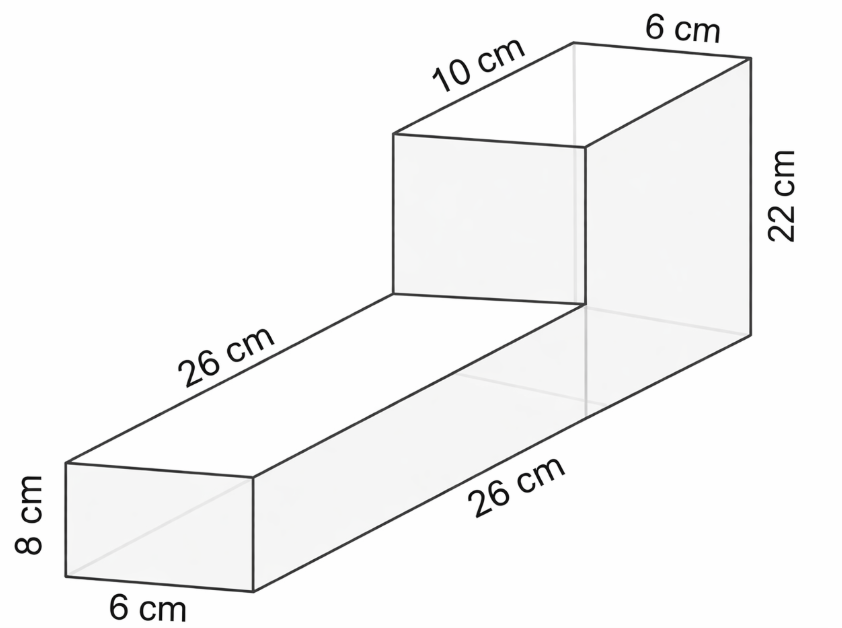
Find the volume of the composite solid above.
Volume of a cuboid = length x breadth x height
Volume of A = 6 x 26 x 8 = 1248 cm\(^3\)
Volume of B = 6 x 10 x 22 = 1320 cm\(^3\)
∴ Volume of the composite solid = 1248 + 1320 = 2568 cm\(^3\)
Not clear enough?
Question 57
In a square, the relationship between the side length (s) and the diagonal (d) is derived from the Pythagorean theorem, given by the formula \(d = s\sqrt{2}\).
First, we find the side length of the square:\[ 20\sqrt{2} = s\sqrt{2} \]\[ s = 20 \text{ cm} \]Now, we can calculate the area of the square:\[ \text{Area} = s^{2} = 20^{2} = 400 \text{ cm}^{2} \]Next, we calculate the perimeter of the square:\[ \text{Perimeter} = 4s = 4 \times 20 = 80 \text{ cm} \]Therefore, the area is 400 cm\(^{2}\) and the perimeter is 80 cm.
Not clear enough?
Question 58
To determine the gain percentage, we must first calculate the total cost price (CP), which includes both the purchase price and the additional expenses for repairs.
Total Cost Price (CP) = Purchase Price + Repair Costs\[ \text{CP} = 9200 + 1500 = 10700 \]The Selling Price (SP) is given as ₦13,400.00. The gain (profit) is found by subtracting the cost price from the selling price:\[ \text{Gain} = \text{SP} - \text{CP} = 13400 - 10700 = 2700 \]The gain percentage is calculated relative to the total cost price:\[ \text{Gain \%} = \left( \frac{\text{Gain}}{\text{CP}} \times 100 \right) \]\[ \text{Gain \%} = \left( \frac{2700}{10700} \times 100 \right) \approx 25.2336\% \]Rounding to two decimal places, the gain percentage is 25.23%.
Not clear enough?
Question 59
Using the BODMAS rule, we perform division and multiplication before subtraction.
Step 1: Perform the division \(\frac{3}{4} \div \frac{5}{12}\). Dividing by a fraction is the same as multiplying by its reciprocal:\[ \frac{3}{4} \times \frac{12}{5} = \frac{3 \times 3}{1 \times 5} = \frac{9}{5} \]Step 2: Perform the multiplication \(\frac{9}{5} \times \frac{1}{4}\):\[ \frac{9}{5} \times \frac{1}{4} = \frac{9}{20} \]Step 3: Perform the subtraction \(\frac{5}{8} - \frac{9}{20}\). We find a common denominator for 8 and 20, which is 40:\[ \frac{5 \times 5}{8 \times 5} - \frac{9 \times 2}{20 \times 2} = \frac{25}{40} - \frac{18}{40} \]\[ \frac{25 - 18}{40} = \frac{7}{40} \]
Not clear enough?
Question 60
Let the length of the longer side be \(x\) cm. Then the shorter side is \(x - 6\) cm. The initial area is:\[ \text{Area}_{1} = x(x - 6) = x^{2} - 6x \]If 2 cm is added to each side, the new sides become \(x + 2\) and \((x - 6) + 2 = x - 4\). The new area is:\[ \text{Area}_{2} = (x + 2)(x - 4) = x^{2} - 2x - 8 \]We are told the area increases by 68 cm\(^{2}\), meaning \(\text{Area}_{2} - \text{Area}_{1} = 68\):\[ (x^{2} - 2x - 8) - (x^{2} - 6x) = 68 \]\[ x^{2} - 2x - 8 - x^{2} + 6x = 68 \]\[ 4x - 8 = 68 \]\[ 4x = 76 \implies x = 19 \]The longer side is 19 cm. The shorter side is:\[ x - 6 = 19 - 6 = 13 \text{ cm} \]
Not clear enough?
You might like
"Arise, take possession of the vineyard of Naboth the Jezreelite, which he refused to give you for money.." Why did Naboth refuse to sell his vineyard?
The pitch of a musical note is determined by the frequency of the sound wave that it produces. If two instruments have the same frequency, which of the following factors will most affect the difference in their pitches?
A machine whose efficiency is 60% has a velocity ratio of 5. If a force of 500N is applied to lift a load P, what isthe magnitude of P?