
Mathematics 2023 Jamb Examination
Mathematics 2023 Jamb Examination

Question 71
The area of a trapezium is 200 cm\(^{2}\). Its parallel sides are in the ratio 2 : 3 and the perpendicular distance between them is 16 cm. Find the length of each of the parallel sides.
The area of a trapezium is calculated using the formula:\[ \text{Area} = \frac{1}{2}(a + b)h \]Given that the ratio of the parallel sides is 2 : 3, we can represent the lengths of the sides as \(2x\) and \(3x\). The perpendicular distance (height) is 16 cm, and the area is 200 cm\(^{2}\).
Substituting these values into the formula:\[ 200 = \frac{1}{2}(2x + 3x) \times 16 \]\[ 200 = 8(5x) \]\[ 200 = 40x \]\[ x = \frac{200}{40} = 5 \]
Now, find the lengths of the parallel sides:
First side = \(2x = 2(5) = 10\text{ cm}\)
Second side = \(3x = 3(5) = 15\text{ cm}\)
Therefore, the lengths of the parallel sides are 10 cm and 15 cm.
Not clear enough?
Question 72
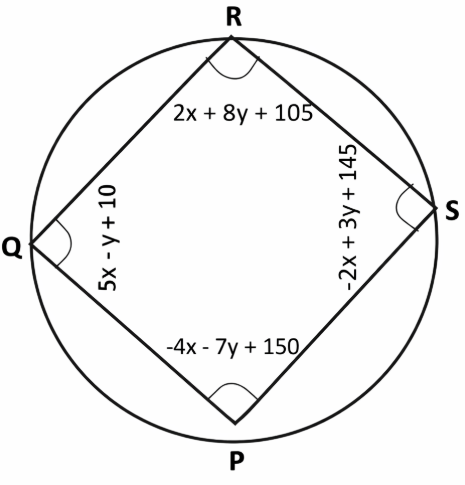
PQRS is a cyclic quadrilateral. Find \(x\) + \(y\)
Opposite angles in a cyclic quadrilateral are supplementary.\[ \angle PQR + \angle PSR = 180^\circ\] \[ (5x - y + 10) + (-2x + 3y + 145) = 180\] \[ 5x - y + 10 - 2x + 3y + 145 = 180\] \[ 3x + 2y + 155 = 180\] \[ 3x + 2y = 25 \qquad (i)\]
Also,\[ \angle QPS + \angle QRS = 180^\circ\] \[ (-4x - 7y + 150) + (2x + 8y + 105) = 180\] \[ -4x - 7y + 150 + 2x + 8y + 105 = 180\] \[ -2x + y + 255 = 180\] \[ -2x + y = -75 \qquad (ii)\]
From equation (ii):\[ y = -75 + 2x \qquad (iii)\]
Substitute \(y = -75 + 2x\) into equation (i):\[ 3x + 2(-75 + 2x) = 25\] \[ 3x - 150 + 4x = 25\] \[ 7x = 175\] \[ x = \frac{175}{7} = 25\]
Substituting into equation (iii):\[ y = -75 + 2(25)\] \[ y = -75 + 50\] \[ y = -25\] \[ x + y = 25 + (-25) = 0\]
Not clear enough?
Question 73
A student pilot was required to fly to an airport and then return as part of his flight training. The average speed to the airport was 120 km/h, and the average speed returning was 150 km/h. If the total flight time was 3 hours, calculate the distance between the two airports.
Let the distance between the two airports be \(d\).
Time taken to fly to the airport: \(t_{1} = \frac{d}{120}\)
Time taken to return: \(t_{2} = \frac{d}{150}\)
The total time is given as 3 hours:\[ \frac{d}{120} + \frac{d}{150} = 3 \]To solve for \(d\), find a common denominator for 120 and 150, which is 600:\[ \frac{5d + 4d}{600} = 3 \]\[ \frac{9d}{600} = 3 \]\[ 9d = 1800 \]\[ d = \frac{1800}{9} = 200\text{ km} \]
The distance between the two airports is 200 km.
Not clear enough?
Question 74
The perimeter of an isosceles right-angled triangle is 2 metres. Find the length of its longer side.
In an isosceles right-angled triangle, the two legs are equal in length. Let the length of each leg be \(x\). By the Pythagorean theorem, the hypotenuse (the longer side) is \(\sqrt{x^{2} + x^{2}} = x\sqrt{2}\).
The perimeter is the sum of all sides:\[ \text{Perimeter} = x + x + x\sqrt{2} = 2 \]\[ 2x + x\sqrt{2} = 2 \]\[ x(2 + \sqrt{2}) = 2 \]\[ x = \frac{2}{2 + \sqrt{2}} \]
The longer side is the hypotenuse, \(x\sqrt{2}\):\[ \text{Hypotenuse} = \left( \frac{2}{2 + \sqrt{2}} \right) \times \sqrt{2} = \frac{2\sqrt{2}}{2 + \sqrt{2}} \]To simplify, rationalise the denominator by multiplying the top and bottom by \(2 - \sqrt{2}\):\[ \frac{2\sqrt{2}(2 - \sqrt{2})}{(2 + \sqrt{2})(2 - \sqrt{2})} = \frac{4\sqrt{2} - 2(2)}{4 - 2} = \frac{4\sqrt{2} - 4}{2} = 2\sqrt{2} - 2 \]This can be rewritten as \(-2 + 2\sqrt{2}\) metres.
Not clear enough?
Question 75
A ship sets sail from port A (86\(^{\circ}\)N, 56\(^{\circ}\)W) for port B (86\(^{\circ}\)N, 64\(^{\circ}\)W), which is close by. Find the distance the ship covered from port A to port B, correct to the nearest km.
[Take \(\pi\) = 3.142 and R = 6370 km]
[Take \(\pi\) = 3.142 and R = 6370 km]
Both ports are on the same latitude (86\(^{\circ}\)N). The distance between two points on the same latitude is calculated along the small circle arc:\[ \text{Distance} = \frac{\theta}{360} \times 2\pi R \cos \alpha \]Where:
\(\theta\) = Longitude difference = \(64^{\circ} - 56^{\circ} = 8^{\circ}\)
\(\alpha\) = Latitude = 86\(^{\circ}\)
\(R\) = Radius of the Earth = 6370 km
Calculation:\[ \text{Distance} = \frac{8}{360} \times 2 \times 3.142 \times 6370 \times \cos(86^{\circ}) \]\[ \text{Distance} = \frac{1}{45} \times 6.284 \times 6370 \times 0.069756 \]\[ \text{Distance} \approx 0.02222 \times 40029.08 \times 0.069756 \]\[ \text{Distance} \approx 62.05\text{ km} \]Rounding to the nearest km, the distance is 62 km.
Not clear enough?
Question 76

Use the graph of sin (\(\theta\)) above to estimate the value of \(\theta\) when sin (\(\theta\)) = -0.6 for \(0^{\circ} \le \theta \le 360^{\circ}\)
From the scale of the graph:
On the \(y\)-axis, four equal boxes represent the interval from \(0\) to \(1\). Hence the value represented by each box is\[ \frac{1-0}{4} = \frac{1}{4} = 0.25 \text{ units}\] On the \(x\)-axis, six equal boxes cover the interval from \(0^\circ\) to \(90^\circ\). Therefore each box corresponds to\[ \frac{90^\circ-0}{6} = \frac{90^\circ}{6} = 15^\circ\] For the first angle, counting \(2.5\) boxes to the right of \(180^\circ\):\[ \theta_1 = 180^\circ + (2.5 \times 15^\circ)\] \[ \theta_1 = 180^\circ + 37.5^\circ\] \[ \theta_1 = 217.5^\circ \approx 218^\circ\] For the second angle, \(3.5\) boxes are measured to the right of \(270^\circ\):\[ \theta_2 = 270^\circ + (3.5 \times 15^\circ)\] \[ \theta_2 = 270^\circ + 52.5^\circ\] \[ \theta_2 = 322.5^\circ \approx 323^\circ\] \[ \therefore \theta = 218^\circ,\; 323^\circ\]
On the \(y\)-axis, four equal boxes represent the interval from \(0\) to \(1\). Hence the value represented by each box is\[ \frac{1-0}{4} = \frac{1}{4} = 0.25 \text{ units}\] On the \(x\)-axis, six equal boxes cover the interval from \(0^\circ\) to \(90^\circ\). Therefore each box corresponds to\[ \frac{90^\circ-0}{6} = \frac{90^\circ}{6} = 15^\circ\] For the first angle, counting \(2.5\) boxes to the right of \(180^\circ\):\[ \theta_1 = 180^\circ + (2.5 \times 15^\circ)\] \[ \theta_1 = 180^\circ + 37.5^\circ\] \[ \theta_1 = 217.5^\circ \approx 218^\circ\] For the second angle, \(3.5\) boxes are measured to the right of \(270^\circ\):\[ \theta_2 = 270^\circ + (3.5 \times 15^\circ)\] \[ \theta_2 = 270^\circ + 52.5^\circ\] \[ \theta_2 = 322.5^\circ \approx 323^\circ\] \[ \therefore \theta = 218^\circ,\; 323^\circ\]
Not clear enough?
Question 77
A circle has a radius of 13 cm with a chord 12 cm away from the centre of the circle. Calculate the length of the chord.
When a perpendicular line is drawn from the centre of a circle to a chord, it bisects the chord. This forms a right-angled triangle where:
The hypotenuse = Radius (r) = 13 cm
The perpendicular distance = 12 cm
The base = Half the chord (x)
Using the Pythagorean theorem:\[ r^{2} = 12^{2} + x^{2} \]\[ 13^{2} = 12^{2} + x^{2} \]\[ 169 = 144 + x^{2} \]\[ x^{2} = 169 - 144 = 25 \]\[ x = \sqrt{25} = 5\text{ cm} \]
Since \(x\) is only half of the chord, the full length of the chord is:\[ \text{Chord length} = 2x = 2(5) = 10\text{ cm} \]
Not clear enough?
Question 78
Give the number of significant figures of the population of a town which has approximately 5,020,700 people
[Image explaining the rules for significant figures including zeros between non-zero digits and trailing zeros]
To determine the number of significant figures, we apply the following rules:
1. All non-zero digits are significant (5, 2, 7).
2. Zeros between non-zero digits are significant (the zeros between 5 and 2, and between 2 and 7).
3. Trailing zeros in a whole number without a decimal point are generally not considered significant (they are place-holders).
In the number 5,020,700:
- The digits '5', '0', '2', '0', '7' are significant because the zeros are trapped between non-zero digits.
- The final two zeros ('00') are trailing zeros at the end of a whole number and are not significant.
Thus, there are 5 significant figures.
Not clear enough?
Question 79
200 tickets were sold for a show. VIP tickets costs ₦1,200 and ₦700 for regular. Total amount realised from the sale of the tickets was ₦180,000. Find the number of VIP tickets sold and the the number of regular ticket sold.
[Image illustrating simultaneous equations solving by substitution or elimination]
Let \(v\) be the number of VIP tickets and \(r\) be the number of regular tickets.
From the total tickets sold:\[ v + r = 200 \quad \text{--- (Equation 1)} \]From the total revenue:\[ 1200v + 700r = 180000 \quad \text{--- (Equation 2)} \]
Multiply Equation 1 by 700:\[ 700v + 700r = 140000 \quad \text{--- (Equation 3)} \]Subtract Equation 3 from Equation 2:\[ (1200v - 700v) + (700r - 700r) = 180000 - 140000 \]\[ 500v = 40000 \]\[ v = \frac{40000}{500} = 80 \]
Now, find \(r\) using Equation 1:\[ 80 + r = 200 \]\[ r = 200 - 80 = 120 \]
Therefore, 80 VIP tickets and 120 regular tickets were sold.
Not clear enough?
Question 80
It takes 12 men 8 hours a day to finish a piece of work in 4 days. In how many days will it take 4 men working 16 hours a day to complete the same piece of work?
The amount of work done is proportional to the number of men (M), the number of hours worked per day (H), and the number of days (D). For the same piece of work, we use the relation:\[ M_{1} \times H_{1} \times D_{1} = M_{2} \times H_{2} \times D_{2} \]
Given:
\(M_{1} = 12\), \(H_{1} = 8\), \(D_{1} = 4\)
\(M_{2} = 4\), \(H_{2} = 16\), \(D_{2} = ?\)
Calculation:\[ 12 \times 8 \times 4 = 4 \times 16 \times D_{2} \]\[ 384 = 64 \times D_{2} \]\[ D_{2} = \frac{384}{64} = 6 \]
It will take 6 days for the 4 men to complete the work.
Not clear enough?
You might like
A block of aluminium is heated electrically by a 30 W heater. If the temperature rises by 10°C in 5 minutes, the heat capacity of the aluminium is
A 35 kΩ is connected in series with a resistance of 40 kΩ. What resistance R must be connected in parallel with the combination so that the equivalent resistance is equal to 25 kΩ?
The price of sugar is increased by 20%. If the expenditure on sugar has to be kept the same as earlier, the ratio between the reduction in consumption and the original consumption is ?