
Mathematics 2024 Jamb Examination
Mathematics 2024 Jamb Examination

Question 1
Evaluate the determinant of the matrix M = \(\begin{bmatrix}3 & 4 & 6\\2 & 1 & -1\\-1 & 3 & 5\end{bmatrix}\)
To find the determinant of a \(3 \times 3\) matrix, we expand along the first row using the signs \((+ - +)\):\[ |M| = 3\begin{vmatrix} 1 & -1 \\ 3 & 5 \end{vmatrix} - 4\begin{vmatrix} 2 & -1 \\ -1 & 5 \end{vmatrix} + 6\begin{vmatrix} 2 & 1 \\ -1 & 3 \end{vmatrix} \]Now, calculate the \(2 \times 2\) determinants:\[ \begin{vmatrix} 1 & -1 \\ 3 & 5 \end{vmatrix} = (1 \times 5) - (-1 \times 3) = 5 + 3 = 8 \]\[ \begin{vmatrix} 2 & -1 \\ -1 & 5 \end{vmatrix} = (2 \times 5) - (-1 \times -1) = 10 - 1 = 9 \]\[ \begin{vmatrix} 2 & 1 \\ -1 & 3 \end{vmatrix} = (2 \times 3) - (1 \times -1) = 6 + 1 = 7 \]Substitute these values back into the main expression:\[ |M| = 3(8) - 4(9) + 6(7) \]\[ |M| = 24 - 36 + 42 \]\[ |M| = -12 + 42 = 30 \]
Not clear enough?
Question 2
Find the amount if simple interest is paid yearly at 5% per annum for 3 years, on a principal of ₦ 200,000.00
First, calculate the Simple Interest (SI) using the formula:\[ \text{SI} = \frac{P \times R \times T}{100} \]Where:
P (Principal) = ₦ 200,000
R (Rate) = 5%
T (Time) = 3 years
\[ \text{SI} = \frac{200,000 \times 5 \times 3}{100} = 2,000 \times 15 = 30,000 \]The Simple Interest is ₦ 30,000.00. The question asks for the Amount, which is the sum of the Principal and the Interest:\[ \text{Amount} = \text{Principal} + \text{Interest} \]\[ \text{Amount} = 200,000 + 30,000 = 230,000 \]Therefore, the total amount is ₦ 230,000.00.
Not clear enough?
Question 3
y is inversely proportional to x and y = 4, when x = \(\frac{1}{2}\), find x when y = 10
Inverse proportionality is expressed by the relationship \(y = \frac{k}{x}\), where \(k\) is the constant of proportionality.
First, find the value of \(k\) using the given values \(y = 4\) and \(x = 1/2\):\[ 4 = \frac{k}{1/2} \implies 4 = 2k \implies k = 2 \]The relationship is \(y = \frac{2}{x}\). Now, find \(x\) when \(y = 10\):\[ 10 = \frac{2}{x} \]\[ 10x = 2 \]\[ x = \frac{2}{10} = \frac{1}{5} \]
Not clear enough?
Question 4
Find the angle subtended by an arc 33cm long of a circle of diameter 28cm.
The formula for arc length (L) is given by:\[ L = \frac{\theta}{360} \times 2\pi r \]Given:
Diameter = 28 cm, so Radius (r) = 14 cm.
Arc length (L) = 33 cm.
Using \(\pi = 22/7\):\[ 33 = \frac{\theta}{360} \times 2 \times \frac{22}{7} \times 14 \]\[ 33 = \frac{\theta}{360} \times 44 \times 2 \]\[ 33 = \frac{\theta}{360} \times 88 \]Solve for \(\theta\):\[ \theta = \frac{33 \times 360}{88} \]\[ \theta = \frac{3 \times 360}{8} = 3 \times 45 = 135 \]The angle subtended is 135\(^{0}\).
Not clear enough?
Question 5
Solve 16\(^{x}\) = 0.25
Express both sides of the equation with the same base. We know that \(0.25\) is the same as \(1/4\):\[ 16^{x} = \frac{1}{4} \]Since \(16 = 4^{2}\) and \(1/4 = 4^{-1}\), the equation becomes:\[ (4^{2})^{x} = 4^{-1} \]\[ 4^{2x} = 4^{-1} \]Equating the exponents:\[ 2x = -1 \implies x = -\frac{1}{2} \]
Not clear enough?
Question 6
The ratio of men to women in a 20-member committee is 3:1. How many women must be added to the committee to make the ratio of men to women 3:2?
First, determine the current number of men and women. The sum of the ratio parts is \(3 + 1 = 4\).
Men = \(\frac{3}{4} \times 20 = 15\)
Women = \(\frac{1}{4} \times 20 = 5\)
Let \(w\) be the number of women to be added. The new number of women will be \(5 + w\), while the number of men remains 15. The new ratio must be 3:2:\[ \frac{15}{5 + w} = \frac{3}{2} \]Cross-multiply:\[ 15 \times 2 = 3(5 + w) \]\[ 30 = 15 + 3w \]\[ 15 = 3w \implies w = 5 \]So, 5 women must be added.
Not clear enough?
Question 7
If p * q = 2p + pq + q, find p when ( p * 2) - (p * 1) = 40
First, define the terms using the given operation \(p * q = 2p + pq + q\):\[ p * 2 = 2p + p(2) + 2 = 2p + 2p + 2 = 4p + 2 \]\[ p * 1 = 2p + p(1) + 1 = 2p + p + 1 = 3p + 1 \]
Now, substitute these into the equation \((p * 2) - (p * 1) = 40\):\[ (4p + 2) - (3p + 1) = 40 \]\[ 4p + 2 - 3p - 1 = 40 \]\[ p + 1 = 40 \implies p = 39 \]
Not clear enough?
Question 8
Which of the following is a measure of central tendency?
In statistics, measures of central tendency are values that describe the centre of a data set. These typically include the Mean, Median, and Mode.
Measures like Standard deviation, Range, and Variance are known as measures of dispersion or variation, as they describe how spread out the data points are from the centre. Therefore, the Mean is the only measure of central tendency listed.
Not clear enough?
Question 9
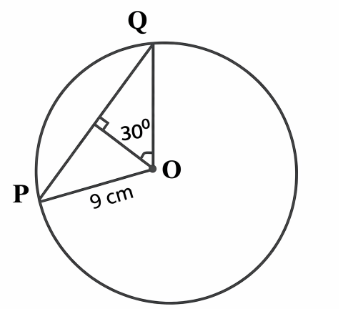
From the figure above, find the length of Chord PQ
The length of a chord in a circle can be determined using the formula
\[ \text{Chord length} = 2r\sin\left(\frac{\theta}{2}\right)\]
where \(r\) is the radius of the circle and \(\theta\) is the angle subtended at the centre.
Given that the central angle is \(60^\circ\) (not \(30^\circ\)) and the radius of the circle is \(9\text{ cm}\),
\[ \text{Chord length} = 2 \times 9 \times \sin\left(\frac{60^\circ}{2}\right)\] \[ = 2 \times 9 \times \sin 30^\circ\]
Since
\[ \sin 30^\circ = \frac{1}{2}\] \[ \text{Chord length} = 2 \times 9 \times \frac{1}{2}\] \[ = 9\text{ cm}\]
Not clear enough?
Question 10
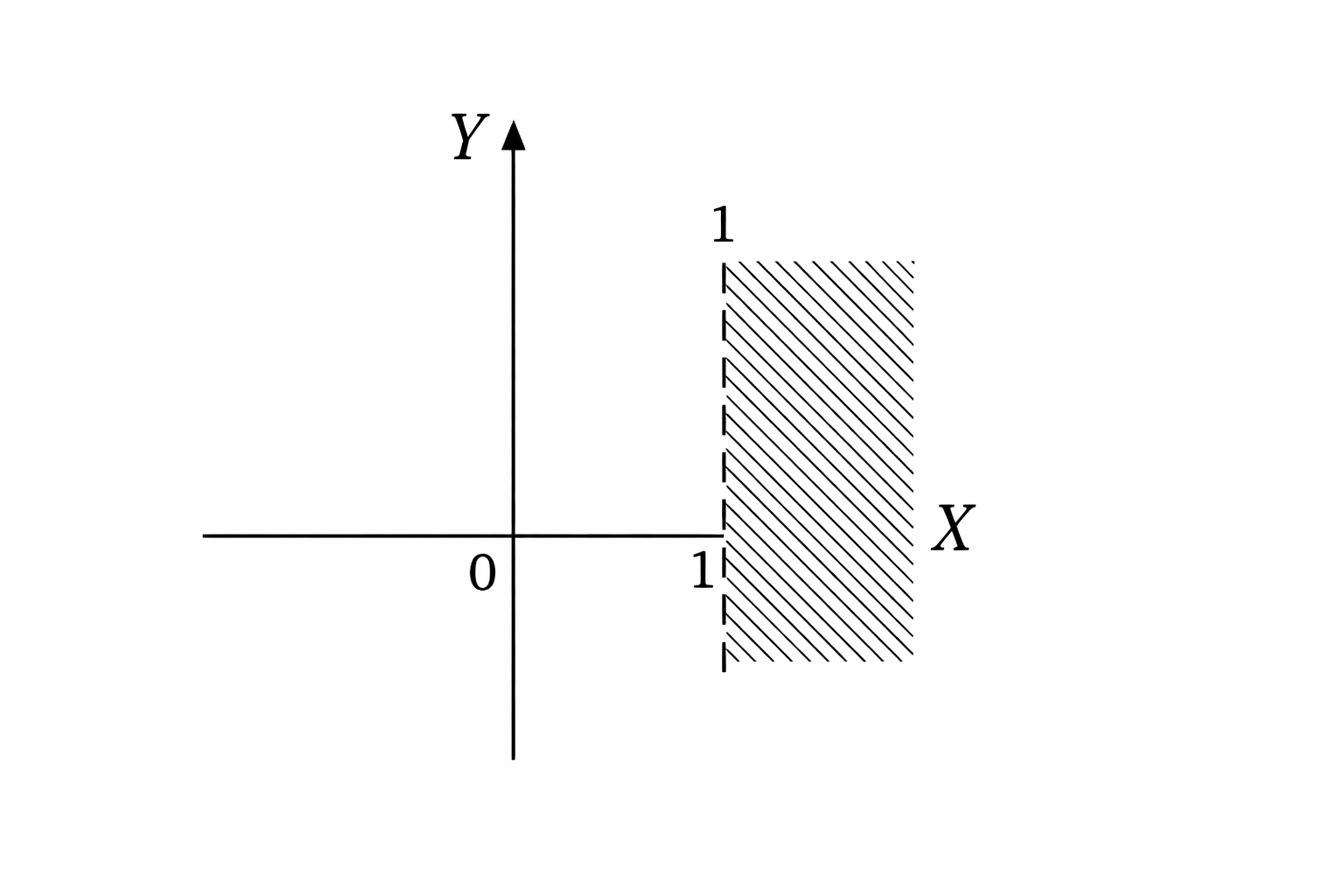
Identify the equation of the shaded region in the given graph
In coordinate geometry, a vertical line represents a constant value of \(x\). The graph shows a vertical line passing through the point where \(x = 1\).
The shaded region is located behind this line. In inequality notation, any area behind a specific value on the horizontal axis is represented by the 'greater than' symbol. Since the boundary line is often indicated as dashed (representing a strict inequality) or simply specifies the region, the corresponding equation for the region behind \(x = 1\) is \(x > 1\).
The shaded region is located behind this line. In inequality notation, any area behind a specific value on the horizontal axis is represented by the 'greater than' symbol. Since the boundary line is often indicated as dashed (representing a strict inequality) or simply specifies the region, the corresponding equation for the region behind \(x = 1\) is \(x > 1\).
Not clear enough?
You might like
Choose the option opposite in meaning to the word decrepit.
The film was shot in a decrepit police station.
Which epistle encourages believers to "eagerly desire spiritual gifts, especially the gift of prophecy"?
The use of income and expenditure instruments or policies to control or regulate the economic activities of a country is known as?
An economy in which both the public and private sectors contribute to economic growth is a__________?