
Mathematics 2024 Jamb Examination
Mathematics 2024 Jamb Examination

Question 11
In how many ways can 6 people sit around a table
When people are arranged in a circle, the number of ways to sit them is calculated using the circular permutation formula, which is \((n - 1)!\). This is because one position is fixed to account for the rotational symmetry of the circle.
For \(n = 6\):\[ (6 - 1)! = 5! \]\[ 5! = 5 \times 4 \times 3 \times 2 \times 1 = 120 \]Therefore, there are 120 ways for 6 people to sit around the table.
Not clear enough?
Question 12
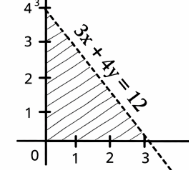
The graph above represents inequalities
The region shown on the graph is defined by the inequalities
\[ 3x + 4y < 12, \quad x \ge 0, \quad y \ge 0\]
The inequality \(3x + 4y < 12\) represents all the points lying below the straight line \(3x + 4y = 12\).
The conditions \(x \ge 0\) and \(y \ge 0\) restrict the solution to the first quadrant of the coordinate plane.
Hence, the required region is the set of points in the first quadrant that lie below the line \(3x + 4y = 12\).
Not clear enough?
Question 13
Let A = \(\begin{pmatrix}2 & -4 & 3\\5 & 1 & 0\end{pmatrix}\) and B = \(\begin{pmatrix}1 & 4 & -2\\-3 & 3 & -1\end{pmatrix}\). Find A + 2B
First, find \(2B\) by multiplying every element in matrix \(B\) by 2:\[ 2B = 2 \times \begin{pmatrix} 1 & 4 & -2 \\ -3 & 3 & -1 \end{pmatrix} = \begin{pmatrix} 2 & 8 & -4 \\ -6 & 6 & -2 \end{pmatrix} \]Now, add matrix \(A\) to \(2B\):\[ A + 2B = \begin{pmatrix} 2 & -4 & 3 \\ 5 & 1 & 0 \end{pmatrix} + \begin{pmatrix} 2 & 8 & -4 \\ -6 & 6 & -2 \end{pmatrix} \]\[ = \begin{pmatrix} (2+2) & (-4+8) & (3-4) \\ (5-6) & (1+6) & (0-2) \end{pmatrix} = \begin{pmatrix} 4 & 4 & -1 \\ -1 & 7 & -2 \end{pmatrix} \]
Not clear enough?
Question 14
The sum to infinity of a GP is 100, find its first term if the common ratio is -\(\frac{1}{2}\)
The formula for the sum to infinity of a geometric progression is:\[ S_{\infty} = \frac{a}{1 - r} \]Given \(S_{\infty} = 100\) and \(r = -1/2\):\[ 100 = \frac{a}{1 - (-1/2)} \]\[ 100 = \frac{a}{1 + 1/2} \]\[ 100 = \frac{a}{3/2} \]Multiply both sides by \(3/2\):\[ a = 100 \times \frac{3}{2} = 150 \]The first term is 150.
Not clear enough?
Question 15
PQR is a triangle such that |PQ| = |QR| = 8cm and \(\angle\) QPR = 60º. Find the area of \(\Delta\) PQR
In \(\Delta\) PQR, since \(|PQ| = |QR|\), it is an isosceles triangle, so \(\angle QPR = \angle QRP = 60^{\circ}\). The third angle \(\angle PQR = 180^{\circ} - (60^{\circ} + 60^{\circ}) = 60^{\circ}\). Since all angles are 60º, the triangle is equilateral with side \(s = 8\text{ cm}\).
The area of an equilateral triangle is given by:\[ \text{Area} = \frac{\sqrt{3}}{4}s^{2} \]\[ \text{Area} = \frac{\sqrt{3}}{4}(8)^{2} = \frac{\sqrt{3}}{4}(64) \]\[ \text{Area} = 16\sqrt{3}\text{ cm}^{2} \]
Not clear enough?
Question 16
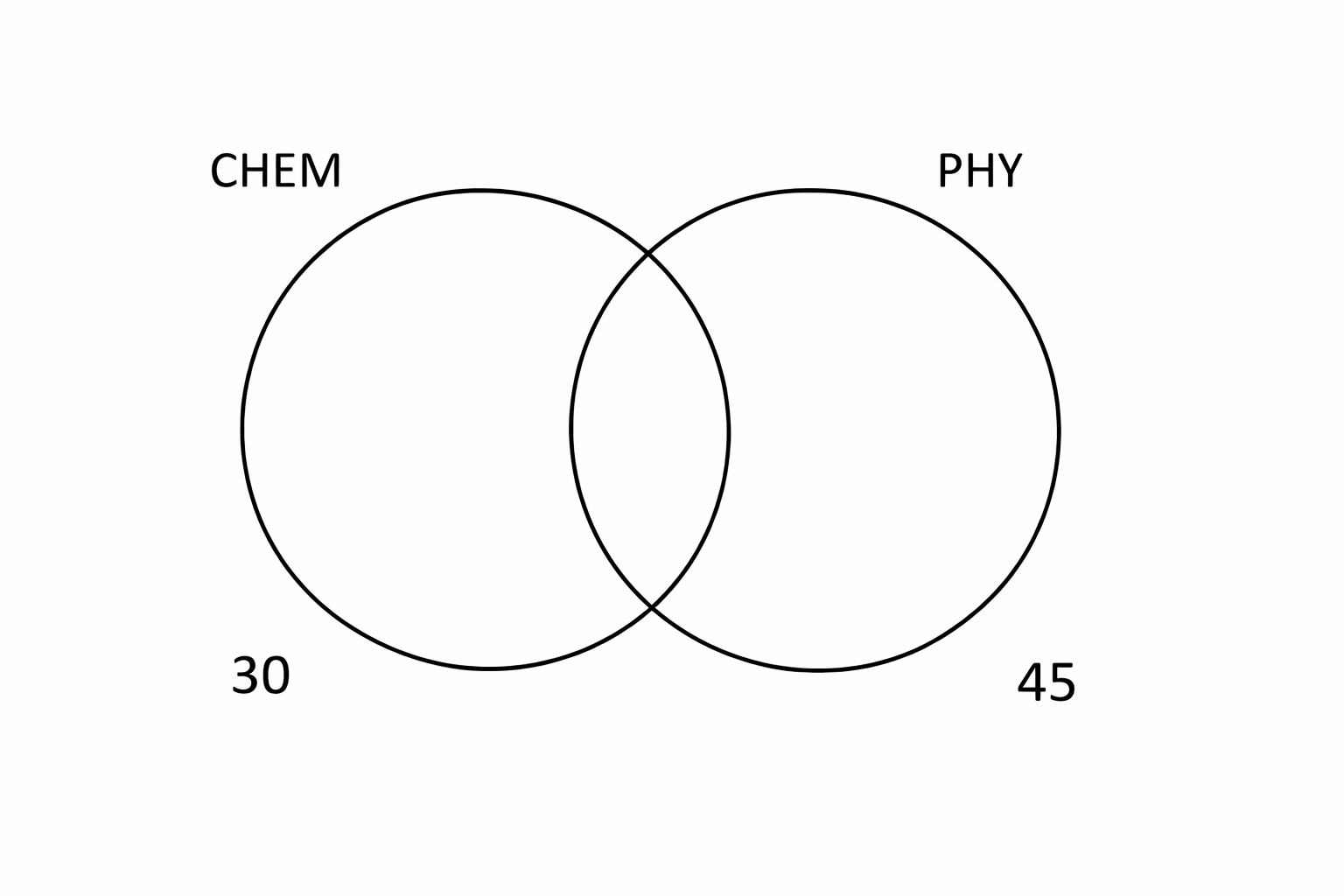
The Venn diagram above shows the number of students offering physics and chemistry in a class of 65. What is the probability that a student selected from the class offers physics and chemistry if every student offers at least one subject?
Let \(x\) represent the number of students offering both subjects.
Using the principle of inclusion for the total number of students:
\[ 65 = 30 + 45 - x\] \[ 65 = 75 - x\] \[ 65 - 75 = -x\] \[ -10 = -x\] \[ x = 10\]
Hence, \(10\) students offer both subjects.
The probability that a randomly selected student offers both subjects is
\[ P(\text{students offering both subjects}) = \frac{10}{65}\] \[ = \frac{2}{13}\]
Not clear enough?
Question 17
From the top of a building 10m high, the angle of elevation of a fruit on top of a tree 25m is 30º. Calculate the horizontal distance between the building and the tree.
Let the horizontal distance be \(x\). The building height is 10m and the tree height is 25m. The difference in height between the fruit and the top of the building is:\[ \text{Opposite side} = 25 - 10 = 15\text{m} \]Using tangent for the right-angled triangle formed:\[ \tan(30^{\circ}) = \frac{\text{Opposite}}{\text{Adjacent}} \]\[ \frac{1}{\sqrt{3}} = \frac{15}{x} \]\[ x = 15\sqrt{3}\text{m} \]
Not clear enough?
Question 18
A boy bought Oranges at the rate of ₦24.00 for 5 and sold it at the rate of ₦ 30.00 for 4 Oranges. Find the profit made of the ones sold
First, find the cost price (CP) and selling price (SP) per orange.\[ \text{CP per orange} = \frac{24}{5} = 4.80 \]\[ \text{SP per orange} = \frac{30}{4} = 7.50 \]The profit per orange is:\[ \text{Profit} = 7.50 - 4.80 = 2.70 \]Assuming the question refers to the profit made on the initial batch (4 or 5) or a specific set, if we calculate based on the lowest common multiple (20 oranges):
CP of 20 = \(20 \times 4.80 = 96\)
SP of 20 = \(20 \times 7.50 = 150\)
Profit = 54. However, looking at the options provided in the JAMB source, the question usually asks for a specific quantity. Based on a standard 4-orange batch sale profit:\[ \text{Total profit on 4 sold} = (7.50 \times 4) - (4.80 \times 4) = 30 - 19.2 = 10.80 \]
Not clear enough?
Question 19
Differentiate y = (5x + 1)\(^{4}\)
To differentiate \(y = (5x + 1)^{4}\), we use the chain rule (function of a function):
Let \(u = 5x + 1\), then \(y = u^{4}\).\[ \frac{dy}{du} = 4u^{3} \]\[ \frac{du}{dx} = 5 \]Applying the chain rule:\[ \frac{dy}{dx} = \frac{dy}{du} \times \frac{du}{dx} \]\[ \frac{dy}{dx} = 4(5x + 1)^{3} \times 5 = 20(5x + 1)^{3} \]
Not clear enough?
Question 20
Simplify \(\frac{5 + \sqrt{7}}{3 + \sqrt{7}}\)
To simplify, multiply the numerator and denominator by the conjugate of the denominator, which is \(3 - \sqrt{7}\):\[ \frac{5 + \sqrt{7}}{3 + \sqrt{7}} \times \frac{3 - \sqrt{7}}{3 - \sqrt{7}} \]\[ = \frac{5(3) - 5\sqrt{7} + 3\sqrt{7} - (\sqrt{7})^{2}}{3^{2} - (\sqrt{7})^{2}} \]\[ = \frac{15 - 2\sqrt{7} - 7}{9 - 7} \]\[ = \frac{8 - 2\sqrt{7}}{2} \]Divide both terms in the numerator by 2:\[ = 4 - \sqrt{7} \]
Not clear enough?
You might like
Given the production function: \( Y = 30 X_1^{0.25} X_2^{0.60} \) (where Y = output, \(X_1\) and \(X_2\) are inputs), what is the nature of the 'Returns to Scale'?
A government policy that encourages transfer of ownership from foreigners to indigenes of the country is known as ____?
An object moves in a circular path of radius 0.5m with a speed of 1ms\(^{-1}\). What is its angular velocity?