
Mathematics 2024 Jamb Examination
Mathematics 2024 Jamb Examination

Question 21
Find the perimeter of a triangle whose vertices pass through ( 3, 2), (4, 5) and (6, 2) in surd form.
To find the perimeter, we calculate the length of each side using the distance formula: \(d = \sqrt{(x_{2}-x_{1})^{2} + (y_{2}-y_{1})^{2}}\).
Let the vertices be A(3, 2), B(4, 5), and C(6, 2).
Length AB = \(\sqrt{(4-3)^{2} + (5-2)^{2}} = \sqrt{1^{2} + 3^{2}} = \sqrt{1 + 9} = \sqrt{10}\)
Length BC = \(\sqrt{(6-4)^{2} + (2-5)^{2}} = \sqrt{2^{2} + (-3)^{2}} = \sqrt{4 + 9} = \sqrt{13}\)
Length AC = \(\sqrt{(6-3)^{2} + (2-2)^{2}} = \sqrt{3^{2} + 0^{2}} = \sqrt{9} = 3\)
Perimeter = AB + BC + AC = \(\sqrt{10} + \sqrt{13} + 3\).
Not clear enough?
Question 22
Find the 7\(^{th}\) term of the sequence -10, 50, -250 ...........
This is a Geometric Progression (GP) where the first term \(a = -10\).
The common ratio \(r = \frac{50}{-10} = -5\).
The formula for the \(n^{th}\) term is \(T_{n} = ar^{n-1}\).
For the 7\(^{th}\) term (\(n=7\)):\[ T_{7} = -10 \times (-5)^{7-1} \]\[ T_{7} = -10 \times (-5)^{6} \]\[ T_{7} = -10 \times 15625 \]\[ T_{7} = -156250 \]
Not clear enough?
Question 23
The scores of students in a test are recorded as follows: 4, 3, 3, 2, 1, 2, 5, 7, 8, 3, and 5. Find the mode of the mark.
The mode is the value that appears most frequently in a data set. Let's count the frequency of each score:
1: 1 time
2: 2 times
3: 3 times
4: 1 time
5: 2 times
7: 1 time
8: 1 time
The score 3 occurs the most (3 times), so the mode is 3.
1: 1 time
2: 2 times
3: 3 times
4: 1 time
5: 2 times
7: 1 time
8: 1 time
The score 3 occurs the most (3 times), so the mode is 3.
Not clear enough?
Question 24
P(x, 4) and Q( 10, 8) are two points joined by a straight line in a plane. If the midpoint of the line is (9, 6), find the value of x.
The midpoint \(M(x, y)\) between two points \((x_{1}, y_{1})\) and \((x_{2}, y_{2})\) is given by:\[ M = \left( \frac{x_{1} + x_{2}}{2}, \frac{y_{1} + y_{2}}{2} \right) \]We are given the midpoint \(x\)-coordinate is 9, \(x_{1} = x\), and \(x_{2} = 10\).\[ 9 = \frac{x + 10}{2} \]\[ 18 = x + 10 \]\[ x = 18 - 10 = 8 \]
Not clear enough?
Question 25
Find x if \(\frac{16^{2 + x}}{4} = 64^{x}\)
Express all terms in base 4:
\(16 = 4^{2}\), \(4 = 4^{1}\), and \(64 = 4^{3}\).\[ \frac{(4^{2})^{2 + x}}{4^{1}} = (4^{3})^{x} \]\[ \frac{4^{4 + 2x}}{4^{1}} = 4^{3x} \]\[ 4^{4 + 2x - 1} = 4^{3x} \]\[ 4^{3 + 2x} = 4^{3x} \]Since the bases are the same, equate the powers:\[ 3 + 2x = 3x \]\[ 3 = 3x - 2x \]\[ x = 3 \]
Not clear enough?
Question 26
Given that P is the set of all prime numbers between 0 and 10, and Q is the set of all odd numbers between 0 and 10. Find the union of elements in P that are not in Q and the elements in Q that are not in P.
Identify the elements of each set:
P (primes 0-10) = {2, 3, 5, 7}
Q (odds 0-10) = {1, 3, 5, 7, 9}
Find elements in P not in Q: {2}
Find elements in Q not in P: {1, 9}
The union of these two results is {1, 2, 9}. This represents the symmetric difference (P Δ Q).
Not clear enough?
Question 27
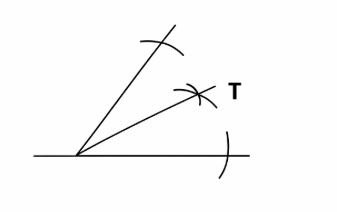
In the diagram above, T represents the construction of angle .....
In geometric construction, the first arc usually defines a 60\(^{\circ}\) angle from the baseline. Point T is located where an arc from the 60\(^{\circ}\) mark and an arc from the 0\(^{\circ}\) mark intersect. This process is the standard method for bisecting an angle. Bisecting 60\(^{\circ}\) results in 30\(^{\circ}\).
Not clear enough?
Question 28
Convert the number 10111.11\(_{two}\) to a mixed number.
Convert the integer part (10111):\[ (1 \times 2^{4}) + (0 \times 2^{3}) + (1 \times 2^{2}) + (1 \times 2^{1}) + (1 \times 2^{0}) \]\[ = 16 + 0 + 4 + 2 + 1 = 23 \]Convert the fractional part (.11):\[ (1 \times 2^{-1}) + (1 \times 2^{-2}) \]\[ = \frac{1}{2} + \frac{1}{4} = \frac{2+1}{4} = \frac{3}{4} \]Combining both parts gives 23\(\frac{3}{4}\).
Not clear enough?
Question 29
Subtract 14256\(_{seven}\) from 20045\(_{seven}\)
\[ \begin{array}{r} \ \ 20045_{7}\\ -14256_{7}\\ \hline \end{array} \] Since \(5 < 6\), borrow \(1\) from the next column (which equals \(7\) in base \(7\)): \[ (7+5)-6 = 6 \] The \(4\) becomes \(3\). Next column: \[ 3 < 5 \] Borrow from the next column. Since the next digit is \(0\), borrowing proceeds from the first non–zero digit \(2\): \[ 2 \rightarrow 1,\quad 0 \rightarrow 7,\quad 0 \rightarrow 6 \] Now compute: \[ (7+3)-5 = 5 \] Next column: \[ 6-2 = 4 \] Next column: \[ 6-4 = 2 \] Final column: \[ 1-1 = 0 \] \[ \therefore\quad 20045_{7} - 14256_{7} = 2456_{7}. \]
Not clear enough?
Question 30
The average age of the four female teachers in a school is 40 and the average age of eight male teachers in the school is 25. Calculate the average age of the teachers in the school.
To find the overall average, calculate the total age and divide by the total number of teachers.
Total age of females = \(4 \times 40 = 160\)
Total age of males = \(8 \times 25 = 200\)
Total age of all teachers = \(160 + 200 = 360\)
Total number of teachers = \(4 + 8 = 12\)
Average age = \(\frac{360}{12} = 30\).