
Physics 2004 Jamb Examination

Question 41
A steady current 2A flows in a coil of e.m.f. 12V for 0.4s. A back e.m.f. of 3V was introduced during this period. The stored energy in the loop that can be utilized is
The energy stored in an inductor can be calculated using the formula:
\[ E = \dfrac{1}{2} LI^2 \]
Where:
- \( E \) is the energy stored,
- \( L \) is the inductance of the coil, and
- \( I \) is the current flowing through the coil.
Given:
- \( I = 2 \) A
- \( \text{Back emf} = 3 \) V
- \( \text{emf} = 12 \) V
- \( t = 0.4 \) s
First, we need to find the inductance of the coil. We know that the back emf is given by:
\[ \text{Back emf} = \text{emf} - L \dfrac{\Delta I}{\Delta t} \]
Substitute the values to find \( L \):
\[ 3 = 12 - L \dfrac{2 - 0}{0.4} \]
\[ 3 = 12 - 5L \]
\[ 5L = 9 \]
\[ L = \dfrac{9}{5} = 1.8 \]
Now, we can find the energy stored:
\[ E = \dfrac{1}{2} \times 1.8 \times 2^2 \]
\[ E = \dfrac{1}{2} \times 1.8 \times 4 \]
\[ E = 3.6 \times 2 \]
\[ E = 7.2 \] J
So, the stored energy in the loop that can be utilized is 7.2 J (Option A).
Not clear enough?
Question 42
If 16mA of current flows through a conductor in one second, the number of electrons transported per second is
[1 electronic charge = 1.6 x 10⁻¹⁹C]
To find the number of electrons transported per second, we can use the formula:
\[ \text{Charge} = \text{Current} \times \text{Time} \]
Given:
- Current = 16 mA = \( 16 \times 10^{-3} \) A
- Time = 1 s
First, let's convert the current to amperes:
\[ 16 \, \text{mA} = 16 \times 10^{-3} \, \text{A} \]
Now, we can find the charge:
\[ \text{Charge} = 16 \times 10^{-3} \times 1 \]
\[ \text{Charge} = 16 \times 10^{-3} \, \text{C} \]
Now, we know that the charge of one electron is \( 1.6 \times 10^{-19} \) C.
To find the number of electrons, we can divide the total charge by the charge of one electron:
\[ \text{Number of electrons} = \dfrac{\text{Charge}}{\text{Charge of one electron}} \]
\[ \text{Number of electrons} = \dfrac{16 \times 10^{-3}}{1.6 \times 10^{-19}} \]
\[ \text{Number of electrons} = \dfrac{16 \times 10^{-3}}{1.6 \times 10^{-19}} \times \dfrac{1}{10^{-19}} \]
\[ \text{Number of electrons} = \dfrac{16}{1.6} \times 10^{16} \]
\[ \text{Number of electrons} = 10 \times 10^{16} \]
\[ \text{Number of electrons} = 10^{17} \]
So, the number of electrons transported per second is \( 10^{17} \), which is equivalent to \( 1.00 \times 10^{17} \), matching option B.
Not clear enough?
Question 43
The difference between x-rays and gamma rays is that
The difference between x-rays and gamma rays is primarily in their origin and how they are produced:
A. X-rays arise from energy changes in the electronic structure of atoms, typically through interactions between high-speed electrons and matter, while gamma rays originate from the nucleus of an atom during certain nuclear processes like radioactive decay.
So, the correct answer is A. X-rays arise from energy changes in the electronic structure of atoms while gamma rays come from the nucleus.
Not clear enough?
Question 44
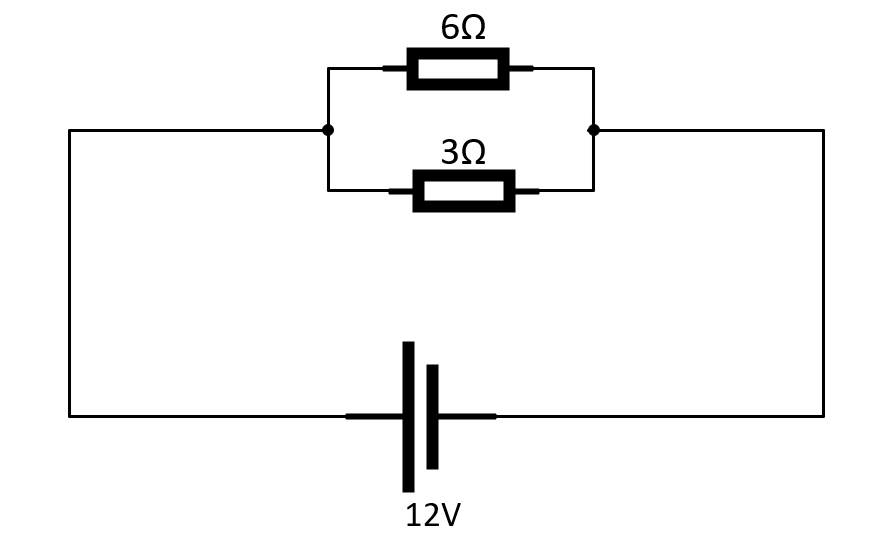
In the diagram above, the ratio of the electric power
dissipated in the 6 Ohms and 3 Ohms resistors
respectively is
To find the ratio of the electric power dissipated in the \(6\Omega\) and \(3\Omega\) resistors, we can use the formula for power:
\[ P = \dfrac{V^2}{R} \]
Where:
- \( P \) is the power dissipated,
- \( V \) is the voltage across the resistor, and
- \( R \) is the resistance.
Given that the resistors are in parallel and connected to a \(12V\) battery:
For the \(6\Omega\) resistor:\[ P_1 = \dfrac{(12V)^2}{6\Omega} = \dfrac{144V^2}{6\Omega} = 24W \]
For the \(3\Omega\) resistor:\[ P_2 = \dfrac{(12V)^2}{3\Omega} = \dfrac{144V^2}{3\Omega} = 48W \]
Now, to find the ratio, \(P_1:P_2\):\[ \text{Ratio} = \dfrac{P_1}{P_2} = \dfrac{24W}{48W} = \dfrac{1}{2} \]
So, the ratio of the electric power dissipated in the \(6\Omega\) and \(3\Omega\) resistors respectively is \(1:2\), which corresponds to option B.
Not clear enough?
Question 45
To protect a material from the influence of an external magnetic field, the material should be kept in a
To protect a material from the influence of an external magnetic field, it should be kept in a material that can easily redirect or absorb magnetic field lines. The material that can do this effectively is soft iron.
So, the correct option is D. Soft iron ring. Soft iron is often used in magnetic shielding because it can easily become magnetized and demagnetized, effectively redirecting the magnetic field lines away from the material it is protecting.
Not clear enough?
Question 46
Which of the following is an electrolyte?
An electrolyte is a substance that conducts electricity when dissolved in water or molten form by producing ions. Among the options provided, the substance that can act as an electrolyte is:
A. Grape juice
Grape juice contains dissolved ions from various compounds, such as acids and salts, which can conduct electricity when dissolved in water. Therefore, grape juice can be considered an electrolyte.
So, the correct option is A. Grape juice.
Not clear enough?
Question 47
Electrical appliance homes are normally earthed so that
Electrical appliances in homes are typically earthed (grounded) primarily for safety reasons, so that:
B. A person touching the appliances is safe from electric shock.
Earthing provides a low-resistance path for current to flow in the event of a fault, ensuring that excess current flows to the ground instead of through a person touching the appliance. This helps prevent electric shocks and reduces the risk of injury or damage due to electrical faults.
So, the correct answer is B. A person touching the appliances is safe from electric shock.
Not clear enough?
Question 48
A cell whose internal resistance is 0.5 Ohms delivers a current of 4A to an external resistor. The lost voltage of the cell is
To find the lost voltage of the cell, we can use Ohm's law:
\( V_{lost} = I \times R_{internal} \)
Given:
- Current, \( I = 4\,A \)
- Internal resistance, \( R_{internal} = 0.5\,\Omega \)
\( V_{lost} = 4 \times 0.5 \)
\( V_{lost} = 2\,V \)
So, the lost voltage of the cell is 2 V, which corresponds to option D.
Not clear enough?
Question 49
Given three capacitors 0.3uF, 0.5 uF, and 0.2 uF, the joint capacitance when arranged to give minimum capacitance is
When capacitors are arranged in parallel, their total capacitance is the sum of their individual capacitances.
To achieve the minimum total capacitance, we should arrange the capacitors in parallel in such a way that the smallest capacitance is utilized.
Given capacitors:
- \(C_1 = 0.3 \, \mu F\)
- \(C_2 = 0.5 \, \mu F\)
- \(C_3 = 0.2 \, \mu F\)
To achieve the minimum capacitance, we should only use the smallest capacitance, \(C_3 = 0.2 \, \mu F\).
So, the joint capacitance when arranged to give minimum capacitance is \(0.2 \, \mu F\), which corresponds to option C.
Not clear enough?
Question 50
A man exerts a pressure of 2.6 x 10³Nm-3 on the ground and has 4 x 10⁻²m3 of his feet in contact with the ground. The weight of the man is
To find the weight of the man, we can use the formula:
\[ \text{Pressure} = \dfrac{\text{Force}}{\text{Area}} \]
Given that the pressure exerted by the man is \(2.6 \times 10^3 \, \text{Nm}^{-3}\) and the area of his feet in contact with the ground is \(4 \times 10^{-2} \, \text{m}^3\), we can rearrange the formula to solve for force:
\[ \text{Force} = \text{Pressure} \times \text{Area} \]
\[ \text{Force} = (2.6 \times 10^3 \, \text{Nm}^{-3}) \times (4 \times 10^{-2} \, \text{m}^3) \]
\[ \text{Force} = (2.6 \times 4) \times (10^3 \times 10^{-2}) \, \text{N} \]
\[ \text{Force} = 10.4 \times 10^1 \, \text{N} \]
\[ \text{Force} = 104 \, \text{N} \]
Therefore, the weight of the man is 104 Newtons.
Not clear enough?
You might like
A permanent memory, which has data and instruction to start up the computer and does not erase data after power off.
An arc subtends an angle of 50º at the center of circle of radius 6cm. Calculate the area of the sector formed
| Dept A | Dept B | |
|---|---|---|
| Sales | 180,000 | 150,000 |
| Cost of sales | 79,000 | 85,000 |
| Expense | 28,000 | 40,000 |
How much is the gross profit for department A?
In cardiovascular physiology, cardiac output (CO) is defined as the product of __________ and __________.