
Physics 2004 Jamb Examination

Question 31
Transverse waves can be distinguished from longitudinal waves using the characteristic of
Transverse waves can be distinguished from longitudinal waves using the characteristic of polarization.
In a transverse wave, the oscillations of the medium are perpendicular to the direction of propagation of the wave. This allows transverse waves to be polarized, meaning that the oscillations occur in a single plane perpendicular to the direction of propagation.
In contrast, longitudinal waves have oscillations parallel to the direction of propagation, making them unable to be polarized.
So, the correct answer is:
B. Polarization.
Not clear enough?
Question 32
When left in a freezer, a bottle full of water cracks on freezing into ice because of the
When water freezes into ice, it expands in volume. This expansion occurs due to the formation of hydrogen bonds between water molecules, causing them to arrange themselves in a crystalline structure with a greater volume than the liquid water.
As a result, when a bottle full of water is left in a freezer and the water inside freezes into ice, the expansion of the water can exert significant pressure on the walls of the bottle. If the pressure becomes too great, it can cause the bottle to crack or even shatter.
So, the correct answer is:
C. Expansion of the bottle.
Not clear enough?
Question 33
The change in volume when 450kg of ice is completely melted is
[density of ice = 900 kgm-3
density of water = 1 000 kgm m-3]
To find the change in volume when 450 kg of ice is completely melted, we need to calculate the volume of the ice and the volume of the resulting water, then find the difference between the two volumes.
Given:
- Mass of ice () =
- Density of ice () =
- Density of water () =
First, we calculate the volume of the ice using its density:
When the ice melts, it turns into water, so the volume of water is the same as the volume of ice.
Now, to find the change in volume, we subtract the initial volume of the ice from the volume of water:
Therefore, the change in volume when 450 kg of ice is completely melted is .
So, the correct answer is:
A.
Not clear enough?
Question 34
If a force of 50N stretches a wire from20mto20.01m, what is the amount of force required to stretch the
samematerialfrom 20mto20.05m?
To find the amount of force required to stretch the same material from 20 m to 20.05 m, we can use Hooke's Law, which states that the force required to stretch or compress a spring (or wire) is directly proportional to the extension or compression of the spring (or wire).
Hooke's Law can be expressed as:
\[ F = k \cdot \Delta L \]
Where:
- \( F \) is the force applied,
- \( k \) is the spring constant (or stiffness constant) of the material, and
- \( \Delta L \) is the change in length of the material.
Given:
- Initial length (\( L_1 \)) = 20 m
- Final length (\( L_2 \)) = 20.01 m
- Force required (\( F_1 \)) = 50 N
First, we calculate the change in length:
\[ \Delta L = L_2 - L_1 = 20.01 \, \text{m} - 20 \, \text{m} = 0.01 \, \text{m} \]
Now, we can use the calculated change in length and the given force to find the spring constant (\( k \)):
\[ k = \dfrac{F}{\Delta L} = \dfrac{50 \, \text{N}}{0.01 \, \text{m}} = 5000 \, \text{N/m} \]
Now that we have the spring constant, we can use it to find the force required to stretch the material from 20 m to 20.05 m:
\[ \Delta L' = 20.05 \, \text{m} - 20 \, \text{m} = 0.05 \, \text{m} \]
\[ F' = k \cdot \Delta L' = 5000 \, \text{N/m} \times 0.05 \, \text{m} = 250 \, \text{N} \]
Therefore, the amount of force required to stretch the same material from 20 m to 20.05 m is \( 250 \, \text{N} \).
So, the correct answer is:
C. \( 250 \, \text{N} \)
Not clear enough?
Question 35
Tea pots are often silver-coated to prevent heat loss by
Tea pots are often silver-coated to prevent heat loss primarily by reflection of thermal radiation. Silver is a highly reflective material, and by coating the tea pot with silver, it can reflect a significant portion of the thermal radiation emitted by the hot contents of the pot back into the pot, reducing heat loss.
So, the correct answer is:
B. Radiation only.
Not clear enough?
Question 36
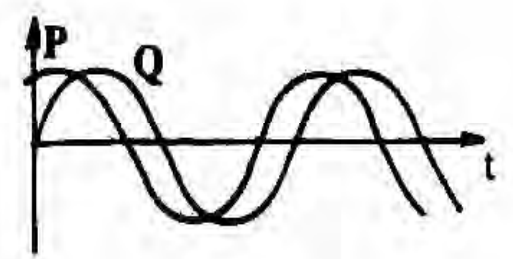
The phase difference between waves P and Q in the diagram above is
From the wave diagram, Wave P began from an angle 90o while Q began from 0.
Thus P = and Q = 0
The difference between Wave P and wave Q is
Not clear enough?
Question 37
Metal rods of length 20cm each are laid end to end to form a bridge at 25oC. What gap will be provided between consecutive rails for the bridge to withstand 75oC?
[Linear expansivity of the material = 2.0 x 10⁻⁵K-1]
To find the gap that needs to be provided between consecutive rails for the bridge to withstand 75°C, we can use the concept of linear expansion.
The formula for linear expansion is:
Where:
- is the change in length,
- is the original length,
- is the coefficient of linear expansion, and
- is the change in temperature.
Given:
- cm = 0.2 m (each rod)
-
-
Plugging these values into the formula, we get:
Since there are two gaps (one on each side of the rod), the total gap needed between consecutive rails is:
So, the correct answer is C. 0.02 m.
Not clear enough?
Question 38
A 50W electric heater is used to heat a metal block of mass 5kg. If in 10 minutes, a temperature rise of 12oC is achieved, the specific heat capacity of the metal is
We can use the formula for heat \( Q \) absorbed or released:
\[ Q = mc\Delta T \]
Where:
- \( Q \) is the heat absorbed or released,
- \( m \) is the mass of the substance,
- \( c \) is the specific heat capacity of the substance, and
- \( \Delta T \) is the change in temperature.
Given:
- \( Q = 50 \) W (power of the heater)
- \( t = 10 \) minutes = 600 s
- \( \Delta T = 12 \) °C
- \( m = 5 \) kg
First, let's convert the power from watts to joules:
\[ \text{Power} = \dfrac{\text{Energy}}{\text{Time}} \]\[ \text{Energy} = \text{Power} \times \text{Time} \]\[ \text{Energy} = 50 \times 600 \]\[ \text{Energy} = 30000 \] J
Now, we can rearrange the formula \( Q = mc\Delta T \) to solve for \( c \):
\[ c = \dfrac{Q}{m\Delta T} \]
\[ c = \dfrac{30000}{5 \times 12} \]
\[ c = \dfrac{30000}{60} \]
\[ c = 500 \] J kg\(^{-1}\) K\(^{-1}\)
So, the specific heat capacity of the metal is 500 J kg\(^{-1}\) K\(^{-1}\), which corresponds to option A.
Not clear enough?
Question 39
I. Wavelength II Medium of propagation
III Wave velocity IV Frequency V. Energy
Which of the above are used for characterizing
waves?
The characteristics used for characterizing waves are:
I. Wavelength
III. Wave velocity
IV. Frequency
V. Energy
So, the correct option is D. I, III, and IV.
Not clear enough?
Question 40
The instrument used for securing a large number of similar charges by induction is called
The instrument used for securing a large number of similar charges by induction is called an "Electrophorus" (Option B).