
Physics 2004 Jamb Examination

Question 1
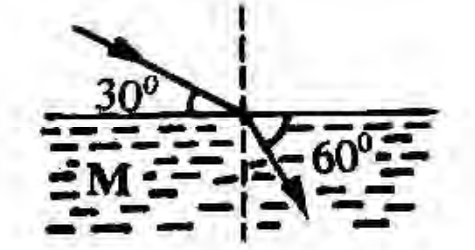
The refractive index of the medium M in the diagram above is
To find the refractive index of the medium given the angles of incidence and refraction, we can use Snell's Law, which relates the angles of incidence and refraction to the refractive indices of the two mediums involved. Snell's Law is expressed as:
\[ n_1 \times \sin(\theta_1) = n_2 \times \sin(\theta_2) \]
Where:
- \( n_1 \) is the refractive index of the first medium (incident medium),
- \( n_2 \) is the refractive index of the second medium (refracted medium),
- \( \theta_1 \) is the angle of incidence,
- \( \theta_2 \) is the angle of refraction.
Given:
- \( \theta_1 = 60^\circ \)
- \( \theta_2 = 30^\circ \)
Assuming light travels from medium 1 (incident medium) to medium 2 (refracted medium), we have:
\[ n_1 \times \sin(60^\circ) = n_2 \times \sin(30^\circ) \]
We can rearrange this equation to solve for \( n_2 \):
\[ n_2 = \dfrac{n_1 \times \sin(60^\circ)}{\sin(30^\circ)} \]
Given that \( \sin(60^\circ) = \dfrac{\sqrt{3}}{2} \) and \( \sin(30^\circ) = 0.5 \), we can substitute these values:
\[ n_2 = \dfrac{n_1 \times \dfrac{\sqrt{3}}{2}}{0.5} \]
\[ n_2 = n_1 \times \sqrt{3} \]
So, the refractive index of the medium is \( \sqrt{3} \) times the refractive index of the incident medium.
Not clear enough?
Question 2
What types of mirrors are capable of producing parallel beams of light such as those arising from the headlamps of a car?
Mirrors capable of producing parallel beams of light, such as those from the headlamps of a car, are typically parabolic mirrors.
Parabolic mirrors
Parabolic mirrors are specifically designed to reflect incoming light rays parallel to the optical axis when the source of light is placed at the focal point of the mirror. This property makes them suitable for applications where parallel beams of light are required, such as in headlamp reflectors, satellite dishes, and telescopes.
Not clear enough?
Question 3
A person can focus an object only when it lies within 200cm from him. Which spectacles should be used to increase his maximum distance of distinct vision to infinity?
A. Concave lens
Concave lenses diverge light rays, making them appear to come from a farther distance than they actually do. By using concave lenses.
Not clear enough?
Question 4
In which of the following material media would sound travel faster?
C. Metal
The speed of sound depends on the medium through which it travels. In general, sound travels fastest through solids, followed by liquids, and then gases.
So, among the options provided:
- Metal: Sound travels fastest in solids, and metals are solid materials. Therefore, sound would travel fastest in metal.
- Water: Sound travels slower in liquids compared to solids, so it would be slower in water than in metal.
- Oil: Similar to water, sound travels slower in liquids, so it would also be slower in oil compared to metal.
- Gas: Sound travels slowest in gases among the three states of matter, so it would be slowest in a gas compared to the other options.
Not clear enough?
Question 5
Calculate the angle of minimum deviation for a ray which is refracted through an equiangular prism
of refractive index 1.4.
To calculate the angle of minimum deviation (\(D_{\text{min}}\)) for a ray passing through an equiangular prism, we can use the relation between the angle of minimum deviation (\(D_{\text{min}}\)) and the refractive index (\(n\)) of the prism:
\[ \sin\left(\dfrac{A+D_{\text{min}}}{2}\right) = n\sin\left(\dfrac{A}{2}\right) \]
Where:
- \( A \) is the angle of the prism (which is equal to the angle of incidence),
- \( n \) is the refractive index of the prism.
Given that the prism is equiangular, \( A = 60^\circ \), and the refractive index \( n = 1.4 \).
Let's calculate the angle of minimum deviation:
\[ \sin\left(\dfrac{60^\circ + D_{\text{min}}}{2}\right) = 1.4\sin\left(\dfrac{60^\circ}{2}\right) \]
\[ \sin\left(\dfrac{60^\circ + D_{\text{min}}}{2}\right) = 1.4\sin(30^\circ) \]
\[ \sin\left(\dfrac{60^\circ + D_{\text{min}}}{2}\right) = 1.4 \times \dfrac{1}{2} \]
\[ \sin\left(\dfrac{60^\circ + D_{\text{min}}}{2}\right) = 0.7 \]
To find \( \dfrac{60^\circ + D_{\text{min}}}{2} \), we need to find the angle whose sine is \( 0.7 \). Using inverse sine (sin⁻¹) function:
\[ \dfrac{60^\circ + D_{\text{min}}}{2} = \sin^{-1}(0.7) \]
\[ \dfrac{60^\circ + D_{\text{min}}}{2} \approx 44.43^\circ \]
Now, solving for \( D_{\text{min}} \):
\[ 60^\circ + D_{\text{min}} = 2 \times 44.43^\circ \]
\[ 60^\circ + D_{\text{min}} = 88.86^\circ \]
\[ D_{\text{min}} = 88.86^\circ - 60^\circ \]
\[ D_{\text{min}} = 28.86^\circ \]
Rounded to the nearest whole number, the angle of minimum deviation for the equiangular prism with a refractive index of 1.4 is approximately \(29^\circ\).
So, the correct answer is:
A. 29°
Not clear enough?
Question 6
What happens to the rays in a parallel beam of light?
They meet at infinity
In a parallel beam of light, the rays travel in the same direction and do not converge or diverge significantly over short distances.
Not clear enough?
Question 7
If u is the object distance and v the image distance, which of the following expressions gives the linear magnification produced by a convex lens of focal lent f?
C. \( \dfrac{v}{f} - 1 \)
The linear magnification (\(M\)) produced by a lens is given by the formula:
\[ M = \dfrac{\text{Image Height}}{\text{Object Height}} = \dfrac{v}{u} \]
Where:
- \( u \) is the object distance,
- \( v \) is the image distance.
For a convex lens, \( v \) is positive (real image) and \( u \) is positive (object on the same side as the incident light), so the linear magnification formula for a convex lens is:
\[ M = \dfrac{v}{u} \]
Now, let's find the expression that corresponds to this formula:
A. \( \dfrac{u}{v} + f \): This expression does not represent linear magnification, and it does not match the correct formula.
B. \( \dfrac{u}{f} - f \): This expression does not represent linear magnification and is not the correct formula.
C. \( \dfrac{v}{f} - 1 \): This expression represents linear magnification (\(M\)), where \(v\) is the image distance and \(f\) is the focal length. So, this expression matches the formula for linear magnification.
D. \( \dfrac{v}{f} + 1 \): This expression does not represent linear magnification and is not the correct formula
Not clear enough?
Question 8
A ray of light make an angle of 35o with a plane mirror. What is the angle of reflection?
The correct answer is: B. 35°
If the ray of light makes an angle of 35° with a plane mirror, according to the law of reflection, the angle of reflection will also be 35°.
Not clear enough?
Question 9
The pitch of a sound note depends on
The pitch of a sound note depends on its frequency.
D. Frequency
Not clear enough?
Question 10
If the angle between two vectors P and Q is 0o the vectors are said to
B. Be parallel
If the angle between two vectors P and Q is 0°, it means they are in the same direction or parallel to each other.