
Physics 2004 Jamb Examination

Question 11
A machine whose efficiency is 60% has a velocity ratio of 5. If a force of 500N is applied to lift a load P, what isthe magnitude of P?
To solve this problem, we can use the formula for mechanical advantage (\(MA\)):
\[ MA = \dfrac{\text{Load (P)}}{\text{Effort (E)}} \]
Given that the efficiency (\( \text{Efficiency} \)) is 60%, which is equivalent to 0.60, and the velocity ratio (\( \text{VR} \)) is 5, we can find the efficiency (\( \text{Efficiency} \)) as:
\[ \text{Efficiency} = \dfrac{\text{Actual mechanical advantage (AMA)}}{\text{Ideal mechanical advantage (IMA)}} \]
\[ 0.60 = \dfrac{MA}{VR} \]
\[ MA = 0.60 \times VR \]
\[ MA = 0.60 \times 5 \]
\[ MA = 3 \]
Now, we can use the formula for mechanical advantage to find the load (\( P \)):
\[ MA = \dfrac{P}{F} \]
Given that the force (\( F \)) applied is 500 N, we can rearrange the formula to solve for \( P \):
\[ P = MA \times F \]
\[ P = 3 \times 500 \]
\[ P = 1500 \, \text{N} \]
So, the magnitude of load (\( P \)) is 1500 N.
Therefore, the correct answer is:
D. 1500 N
Not clear enough?
Question 12
A body of mass 4kg is acted on by a constant force of 12N for 3 seconds. The kinetic energy
gained by the body at the end of the time is
A. 162 J
To find the kinetic energy gained by the body, we can use the formula:
\[ \text{Kinetic energy} = \dfrac{1}{2} m v^2 \]
Where:
- \( m \) is the mass of the body (4 kg),
- \( v \) is the final velocity of the body.
First, let's find the acceleration (\( a \)) using Newton's second law of motion:
\[ F = m \times a \]
\[ 12 \, \text{N} = 4 \, \text{kg} \times a \]
\[ a = \dfrac{12 \, \text{N}}{4 \, \text{kg}} \]
\[ a = 3 \, \text{m/s}^2 \]
Now, we can use the formula for acceleration to find the final velocity (\( v \)):
\[ v = u + a \times t \]
Given that the initial velocity (\( u \)) is 0 m/s (assuming the body starts from rest), and the time (\( t \)) is 3 seconds:
\[ v = 0 + 3 \times 3 \]
\[ v = 9 \, \text{m/s} \]
Now, we can calculate the kinetic energy:
\[ \text{Kinetic energy} = \dfrac{1}{2} \times 4 \times (9)^2 \]
\[ \text{Kinetic energy} = \dfrac{1}{2} \times 4 \times 81 \]
\[ \text{Kinetic energy} = 2 \times 81 \]
\[ \text{Kinetic energy} = 162 \, \text{J} \]
So, the kinetic energy gained by the body at the end of the time is 162 J.
Therefore, the correct answer is:
A. 162 J
Not clear enough?
Question 13
As the pressure of a fluid increase, its viscosity
D. Increase.
Not clear enough?
Question 14
I. Jet-propelled aircraft. II Rocket propulsion
III The recoil of a gun. IV A person walking
Which of the above is based on Newton’s third law of motion?
D. I, II and III only
Newton's third law of motion states: "For every action, there is an equal and opposite reaction."
Now, let's analyze each of the given scenarios:
I. Jet-propelled aircraft:
In a jet-propelled aircraft, the action is the expulsion of high-speed exhaust gases backward from the jet engine. According to Newton's third law, the reaction to this action is the forward motion of the aircraft itself. The thrust generated by the jet engine is a result of the equal and opposite reaction to the expulsion of gases.
II. Rocket propulsion:
Similar to a jet-propelled aircraft, a rocket operates on the principle of Newton's third law. The action is the expulsion of high-speed exhaust gases from the rocket engine. The reaction to this action is the forward motion of the rocket itself.
III. The recoil of a gun:
When a gun is fired, the action is the expulsion of the bullet forward from the barrel. According to Newton's third law, the reaction to this action is the backward recoil of the gun itself. The force that propels the bullet forward is a result of the equal and opposite reaction to the backward recoil of the gun.
IV. A person walking:
While walking, a person exerts a force backward on the ground with their foot. According to Newton's third law, the reaction to this action is the forward motion of the person. This action-reaction pair allows the person to move forward while walking.
Based on the explanation above, options A, B, and C are incorrect because they do not include all the scenarios that are based on Newton's third law of motion. The correct answer is option D, as it includes all the scenarios (I, II, and III) that are based on Newton's third law of motion.
Not clear enough?
Question 15
In a hydraulic press, a force of 40N is applied on the effort piston area 0.4m2. If the force exerted on the load piston is 400N, the area of the large piston is?
The correct answer is:
B. 4 m²
First, let's recall the principle behind a hydraulic press, which is based on Pascal's Law:
"Pascal's Law states that a change in pressure at any point in an enclosed fluid at rest is transmitted undiminished to all points in the fluid."
Using Pascal's Law, we can set up the equation:
\[ \text{Pressure}_\text{effort} = \text{Pressure}_\text{load} \]
Now, pressure (\( P \)) is defined as force (\( F \)) divided by area (\( A \)). So, we can express the equation as:
\[ \dfrac{F_\text{effort}}{A_\text{effort}} = \dfrac{F_\text{load}}{A_\text{load}} \]
Given:
- \( F_\text{effort} = 40 \, \text{N} \)
- \( A_\text{effort} = 0.4 \, \text{m}^2 \)
- \( F_\text{load} = 400 \, \text{N} \)
- \( A_\text{load} = ? \)
We can rearrange the equation to solve for \( A_\text{load} \):
\[ A_\text{load} = \dfrac{F_\text{load} \times A_\text{effort}}{F_\text{effort}} \]
\[ A_\text{load} = \dfrac{400 \, \text{N} \times 0.4 \, \text{m}^2}{40 \, \text{N}} \]
\[ A_\text{load} = \dfrac{160 \, \text{N} \cdot \text{m}^2}{40 \, \text{N}} \]
\[ A_\text{load} = 4 \, \text{m}^2 \]
So, the area of the large piston is \( 4 \, \text{m}^2 \).
Not clear enough?
Question 16
A 100kg box is pushed along a road with a force of 500N. If the box moves with a uniform velocity, the coefficient of friction between the box and the road is?
[g = 10ms-2]
The correct answer is:
A. 0.5
When the box moves with a uniform velocity, it means that the net force acting on the box is zero. This implies that the force of friction (\( F_{\text{friction}} \)) is equal in magnitude and opposite in direction to the applied force (\( F_{\text{applied}} \)).
The force of friction can be calculated using the formula:
\[ F_{\text{friction}} = \mu \times N \]
Where:
- \( \mu \) is the coefficient of friction,
- \( N \) is the normal force (equal to the weight of the box, \( mg \)).
Given:
- Mass of the box (\( m \)) = 100 kg
- Acceleration due to gravity (\( g \)) = 10 m/s²
- Applied force (\( F_{\text{applied}} \)) = 500 N
- Uniform velocity implies no acceleration, so the net force is zero.
Since the box moves with uniform velocity, the force of friction (\( F_{\text{friction}} \)) must balance the applied force (\( F_{\text{applied}} \)):
\[ F_{\text{friction}} = F_{\text{applied}} \]
\[ \mu \times N = F_{\text{applied}} \]
\[ \mu \times (m \times g) = F_{\text{applied}} \]
\[ \mu \times (100 \, \text{kg} \times 10 \, \text{m/s}^2) = 500 \, \text{N} \]
\[ \mu \times 1000 \, \text{N} = 500 \, \text{N} \]
\[ \mu = \dfrac{500 \, \text{N}}{1000 \, \text{N}} \]
\[ \mu = 0.5 \]
So, the coefficient of friction between the box and the road is 0.5.
Therefore, the correct answer is:
A. 0.5
Not clear enough?
Question 17
The earth is four times the size of the moon and the acceleration due to gravity on the earth is 80 times that on the moon. The ratio of the mass of the moon to that of the earth is
Correct Answer is B. 1 : 1280
Given:
1. The Earth is four times the size of the Moon: \( R_E = 4 \times R_M \) (where \( R_E \) is the radius of the Earth and \( R_M \) is the radius of the Moon)
2. The acceleration due to gravity on Earth is 80 times that on the Moon: \( g_E = 80 \times g_M \)
The ratio of the masses of the Moon and Earth can be found using the formula for gravitational acceleration:
\[ g = \dfrac{{G \cdot M}}{{R^2}} \]
Since \( g \) is directly proportional to \( M \) and inversely proportional to \( R^2 \), we can write:
\[ \dfrac{{g_E}}{{g_M}} = \dfrac{{M_E}}{{M_M}} \times \left( \dfrac{{R_M}}{{R_E}} \right)^2 \]
Substituting the given values:
\[ 80 = \dfrac{{M_E}}{{M_M}} \times \left( \dfrac{{R_M}}{{4 \times R_M}} \right)^2 \]
\[ 80 = \dfrac{{M_E}}{{M_M}} \times \left( \dfrac{1}{4} \right)^2 \]
\[ 80 = \dfrac{{M_E}}{{M_M}} \times \dfrac{1}{16} \]
\[ 80 \times 16 = \dfrac{{M_E}}{{M_M}} \]
\[ 1280 = \dfrac{{M_E}}{{M_M}} \]
Therefore, the ratio of the mass of the Moon to the mass of the Earth is 1 : 1280.
So, the correct answer is:
B. 1 : 1280
Not clear enough?
Question 18
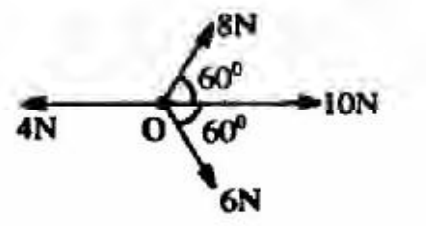
The diagram above showsforces 4N, 6N, 10N and 8N which act at a point O in directions indicated.
The net horizontal force is
Lets denote Fxnet as the net horizontal force. Such that:
Not clear enough?
Question 19
A radioisotope has a decay constant of 10-7s-1. The average life of the radioisotope is
The average life () of a radioactive substance is related to its decay constant () by the formula:
Given that the decay constant () is , we can calculate the average life () as:
Therefore, the average life of the radioisotope is .
So, the correct answer is:
C.
Not clear enough?
Question 20
A moving-coil galvanometer has a full-scale deflection of 3A equivalent to 30o deflection. Then sensitivity of the instrument is
To find the sensitivity of the instrument, we need to determine the deflection per unit current passing through it.
Given:
- Full-scale deflection: \(3 \, \text{A}\) equivalent to \(30^\circ\) deflection.
The sensitivity of the instrument is the ratio of the deflection to the current:
\[ \text{Sensitivity} = \dfrac{\text{Deflection}}{\text{Current}} \]
Since \(30^\circ\) deflection corresponds to \(3 \, \text{A}\), we can express the sensitivity as:
\[ \text{Sensitivity} = \dfrac{30^\circ}{3 \, \text{A}} = 10^\circ/\text{A} \]
Therefore, the sensitivity of the instrument is \(10.0^\circ/\text{A}\).
So, the correct answer is:
A. \(10.0\)