
Physics 2016 Jamb Examination

Question 1
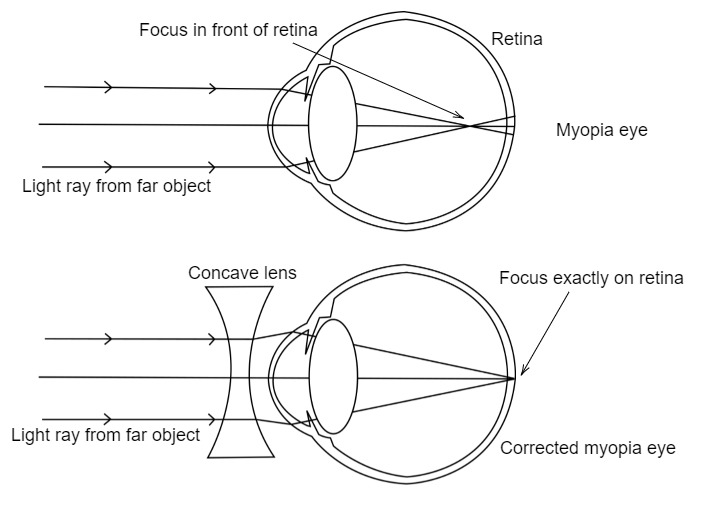
To correct this, a diverging or concave lens is used. The concave lens spreads out the incoming parallel light rays before they enter the eye, effectively pushing the focal point further back so that it falls precisely on the retina, allowing for clear distance vision.
Not clear enough?
Question 2
Not clear enough?
Question 3
Not clear enough?
Question 4
Not clear enough?
Question 5
Which of the above forms of energy can directly be converted to light energy?
Not clear enough?
Question 6
Not clear enough?
Question 7
Initially:
Object distance = 15cm
Image distance behind mirror = 15cm
Total distance between object and image = 15 + 15 = 30cm.
After moving the mirror:
The mirror moves 5cm further away, so the new object distance = 15 + 5 = 20cm.
The new image distance behind the mirror will also be 20cm.
The new total distance between the object and the image is:\[ \text{Total Distance} = 20\text{cm (object to mirror)} + 20\text{cm (mirror to image)} = 40\text{cm} \]
Not clear enough?
Question 8
Not clear enough?
Question 9
Not clear enough?
Question 10
Given:
Focal length of objective \( f_o = 30 \; \text{cm} \)
Focal length of eyepiece \( f_e = 3 \; \text{cm} \)
Using the formula:\[ M = \frac{f_o}{f_e} \]\[ M = \frac{30}{3} = 10 \]The telescope provides an angular magnification of 10, meaning distant objects will appear ten times larger than when viewed with the naked eye.
Not clear enough?
You might like
The Japanese economic model created strong domestic industries through subsidies from its Ministry of Trade and by closing off competitive foreign firms to its domestic market. This strategy promised to help economic growth by incubating domestic industries. New Japanese industries could count on a known local demand and would be protected from competition by tariffs and other barriers. The program could reduce the amount of imports and therefore improve the nation's balance of trade.
Which of the following, based on the passage above, is a weakness in this economic strategy?
If an increase in the p rice of good X leads to an increase in the supply of good Y, X andY are said to
20 men working 8 hours per day can complete a piece of work in 21 days. How many hours per day must 48 men work to complete the same job in 7 days ?
In economic theory, the satisfaction derived from the consumption of the very last unit of a commodity is specifically called __________.