
Physics 2016 Jamb Examination
Physics 2016 Jamb Examination

Question 11
A wire of length 10m is cooled from 50ºC to 10ºC. Calculate the decrease in the length of the wire. [\(\alpha = 3 \times 10^{-5}\text{K}^{-1}\)]
To calculate the decrease in length due to cooling, we use the linear expansivity formula:\[ \Delta L = L_1 \alpha \Delta\theta \]Given:
Initial length \( L_1 = 10 \; \text{m} \)
Linear expansivity \( \alpha = 3 \times 10^{-5} \; \text{K}^{-1} \)
Temperature change \( \Delta\theta = 50 - 10 = 40 \; ^{\circ}\text{C} \) (or K)
Substituting the values:\[ \Delta L = 10 \times (3 \times 10^{-5}) \times 40 \]\[ \Delta L = 10 \times 40 \times 3 \times 10^{-5} \]\[ \Delta L = 1200 \times 10^{-5} \]\[ \Delta L = 1.2 \times 10^{-2} \; \text{m} \]The decrease in length of the wire is 0.012m or 1.2 × 10\(^{-2}\)m.
Not clear enough?
Question 12
When an athlete perspires after running, he loses heat through
Perspiration (sweating) is a primary biological mechanism for thermoregulation. When sweat is produced on the skin, it absorbs thermal energy from the athlete's body to overcome the intermolecular forces holding the liquid together. As this liquid sweat changes phase into water vapour, it carries that heat away into the atmosphere. This process is known as evaporation, and it is highly effective because water has a high latent heat of vaporisation, meaning a small amount of sweat can remove a significant amount of heat from the body.
Not clear enough?
Question 13
The rate of cooling of a heated quantity of liquid in an enclosure depends on the
According to Newton's Law of Cooling, the rate at which an object loses heat is directly proportional to the difference in temperature between the object and its surroundings (the enclosure). If the temperature of the enclosure is significantly lower than that of the liquid, the rate of cooling will be faster. While surface area and the nature of the surface also play roles, among the options provided, the ambient temperature of the environment (enclosure) is the key determining factor for the rate of heat loss.
Not clear enough?
Question 14
The heat required to raise a mass of a substance through 1K is known as
The quantity of heat required to raise the temperature of a whole body or a specific mass of a substance by 1 Kelvin (or 1°C) is called its heat capacity (or thermal capacity). It is mathematically expressed as \( C = \frac{Q}{\Delta\theta} \). If the definition had specified a 'unit mass' (like 1 kg), the answer would have been 'specific heat capacity'. Since it refers to 'a mass' (implying the total mass of the object in question), the correct term is heat capacity. Latent heats (fusion and vaporisation) refer to phase changes where the temperature does not change.
Not clear enough?
Question 15
A boy in a barber's shop sits between two parallel mirrors. The number of images observed by him will be
When two plane mirrors are placed parallel to each other, the angle between them (\( heta \)) is 0 degrees. The formula for the number of images formed by two inclined mirrors is \( n = \frac{360}{\theta} - 1 \). When \( heta = 0 \), the value of \( n \) becomes mathematically undefined, tending towards infinity. In practice, light reflects back and forth between the two surfaces repeatedly, creating a long 'tunnel' of images that only fade away due to the slight absorption of light by the glass and air with each reflection.
Not clear enough?
Question 16
Semiconductor is a class of solid whose conductivity increases with an increase in
In semiconductors, the energy gap between the valence band and the conduction band is relatively small. At low temperatures, few electrons have enough energy to jump this gap, so the material acts as an insulator. As the temperature increases, more thermal energy is provided to the valence electrons, allowing more of them to cross into the conduction band and leave behind 'holes'. Since the number of charge carriers (electrons and holes) increases with heat, the electrical conductivity of the semiconductor increases as temperature rises. This is the opposite of how metallic conductors behave.
Not clear enough?
Question 17
Which of the following statements is NOT correct?
According to the Kinetic Theory of Matter, all matter is composed of tiny particles (atoms or molecules) that are in a state of constant, random motion. This constant motion is what explains phenomena like diffusion, gas pressure, and Brownian motion. Therefore, the statement claiming that molecules of matter are 'not in constant motion' is factually incorrect and contradicts the fundamental principles of molecular physics.
Not clear enough?
Question 18
A dynamo primarily converts
A dynamo (or generator) works on the principle of electromagnetic induction. When a coil of wire is rotated within a magnetic field, the changing magnetic flux induces an electromotive force (e.m.f.), which creates an electric current.
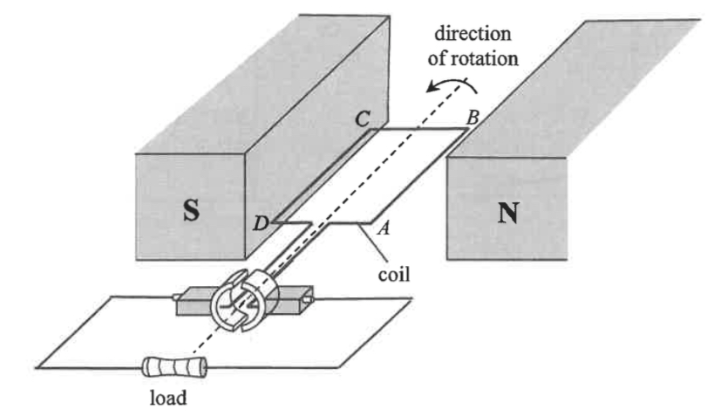
The rotation of the coil requires mechanical work (input), which is then transformed by the machine into electrical energy (output). This makes it the functional opposite of an electric motor, which converts electrical energy into mechanical energy.
The rotation of the coil requires mechanical work (input), which is then transformed by the machine into electrical energy (output). This makes it the functional opposite of an electric motor, which converts electrical energy into mechanical energy.
Not clear enough?
Question 19
A saturated vapour pressure of a liquid increases when the
Saturated vapour pressure (SVP) is the pressure exerted by a vapour in thermodynamic equilibrium with its condensed phases at a given temperature in a closed system. The SVP of any liquid depends solely on the nature of the liquid and its temperature. As the temperature of the liquid increases, the kinetic energy of the molecules increases, allowing more of them to escape into the vapour phase. This increase in the concentration of vapour molecules leads to a higher pressure. SVP is independent of the volume of the liquid or the volume of the container.
Not clear enough?
Question 20
What force has to be exerted on a mass 60kg to give it an acceleration of 10ms\(^{-2}\) vertically upwards? [g = 10ms\(^{-2}\)]
To accelerate an object vertically upwards, the applied force (F) must overcome the object's weight (mg) and provide the additional force required for the desired acceleration (ma).
Using Newton's Second Law (\( F_{net} = ma \)):\[ F_{applied} - mg = ma \]\[ F_{applied} = m(g + a) \]Given:
Mass \( m = 60 \; \text{kg} \)
Acceleration \( a = 10 \; \text{ms}^{-2} \)
Gravity \( g = 10 \; \text{ms}^{-2} \)
Substituting the values:\[ F_{applied} = 60(10 + 10) \]\[ F_{applied} = 60(20) \]\[ F_{applied} = 1200 \; \text{N} \]A total force of 1200N is required to lift the mass with the specified acceleration.
Not clear enough?
You might like
| 1/7/2005 | 30/6/2006 | |
| Drawings | N3 000 | |
| Capital | 25 000 | N42 500 |
| Furniture | 6 500 | N10 200 |
Additional capital during the year amounts to 300% of the drawings. Calculate the net profit or loss made during the year.
A particle of weight 120 N is placed on a plane inclined at 30° to the horizontal. If the plane has an efficiency of 60%, what is the force required to push the weight uniformly up the plane?
Choose the word(s) or phrase(s) which best fill(s) the gap. We saw Ifueko ____________ an egg on the wall