Physics 2016 Jamb Examination

Question 21
Let the unknown distance for the 15N force be \(x\).
Anticlockwise moment = Clockwise moment\[ 10\text{N} \times 30\text{cm} = 15\text{N} \times x \]\[ 300 = 15x \]\[ x = \frac{300}{15} \]\[ x = 20\text{cm} \]Therefore, the 15N force must be placed 20cm from the pivot on the opposite side to achieve horizontal balance.
Not clear enough?
Question 22
The vertical component of initial velocity (\(u_y\)) is given by:\[ u_y = u \sin \theta \]Using the equation of motion \(v = u + at\), where \(v = 0\), \(a = -g\), and \(u = u \sin \theta\):\[ 0 = u \sin \theta - gt \]\[ gt = u \sin \theta \]\[ t = \frac{u \sin \theta}{g} \]Given:
\(u = 300 \text{ ms}^{-1}\)
\(\theta = 30^{\circ}\)
\(g = 10 \text{ ms}^{-2}\)
Calculation:\[ t = \frac{300 \times \sin 30^{\circ}}{10} \]\[ t = \frac{300 \times 0.5}{10} \]\[ t = \frac{150}{10} \]\[ t = 15\text{s} \]
Not clear enough?
Question 23
Initial velocity \(u = 20 \text{ ms}^{-1}\)
Final velocity \(v = 0 \text{ ms}^{-1}\) (since it comes to a complete halt)
Deceleration \(a = -2 \text{ ms}^{-2}\) (acceleration is negative for deceleration)
Substituting the values into the formula:\[ 0 = 20 + (-2)t \]\[ 2t = 20 \]\[ t = \frac{20}{2} \]\[ t = 10\text{s} \]It takes 10 seconds for the train to stop.
Not clear enough?
Question 24
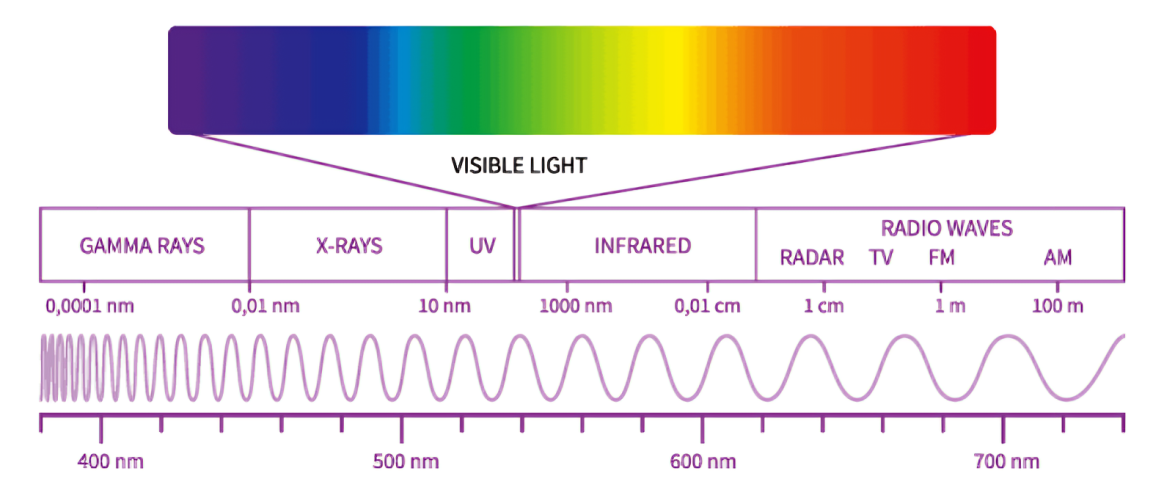
There is an inverse relationship between frequency and wavelength: waves with the highest energy have the highest frequency and the shortest wavelength. In the spectrum, Gamma rays occupy the high-frequency end, possessing more energy and shorter wavelengths than X-rays, ultraviolet, visible light, infrared, microwaves, and radio waves. Therefore, Gamma rays have the shortest wavelength among the listed options.
Not clear enough?
Question 25
Given:
\(\lambda = 10^{-6} \text{ s}^{-1}\)
Calculation:\[ T_{1/2} = \frac{0.693}{10^{-6}} \]\[ T_{1/2} = 0.693 \times 10^6 \]\[ T_{1/2} = 6.93 \times 10^5 \text{s} \]
Not clear enough?
Question 26
Not clear enough?
Question 27
\(P = 7.6 \times 10^6 \text{ Nm}^{-2}\)
\(V = 10^{-3} \text{ m}^3\)
\(n = 6 \text{ moles}\)
\(R = 8.3 \text{ Jmol}^{-1}\text{K}^{-1}\)
Solving for temperature (T) in Kelvin:\[ T = \frac{PV}{nR} \]\[ T = \frac{(7.6 \times 10^6) \times 10^{-3}}{6 \times 8.3} \]\[ T = \frac{7600}{49.8} \]\[ T \approx 152.61 \text{K} \]Wait, the calculation gives roughly 153K. To convert to Celsius (\(^{\circ}\text{C}\)):\[ heta = T - 273 \]\[ heta = 152.6 - 273 = -120.4^{\circ}\text{C} \]Looking at the options provided, they appear to be in Celsius but positive. Re-evaluating the calculation: if the result 153 was intended to be the final answer in Kelvin, but the options are marked Celsius, there might be a data discrepancy in the question paper. However, strictly following the physics, 153K is the absolute temperature result.
Not clear enough?
Question 28
Not clear enough?
Question 29
At absolute zero, theoretically, all molecular motion ceases. If the molecules are not moving, they cannot collide with the container walls, and therefore the pressure of the gas drops to zero. This is reflected in Gay-Lussac's Law (\(P \propto T\)), where pressure is directly proportional to the absolute temperature.
Not clear enough?
Question 30
Not clear enough?
You might like
Select the option that best explains the information conveyed in the sentence.
As debutants in that tournament, the Super Eagles were up against their first opponents by three goals to nil?
In a cross involving a heterozygous red flower plant (Rr) and a white flowered plant (rr). What is the probability that the offspring will be Rr?
On January 1, 2000, a club’s assets and liabilities were as follows
\[
\begin{array}{|l|r|}
\hline
\textbf{Description} & \textbf{₦} \\
\hline
\text{Club house} & 8{,}000 \\
\text{Subscription in arrears} & 300 \\
\text{Cash} & 1{,}000 \\
\text{Wages owed} & 100 \\
\hline
\end{array}
\]
The club has 50 members and annual subscription is N100 per member. Subscription received is ₦4,000 and this includes 1999 arrears of ₦200
Select the option that has the same vowel sound as the one represented by the letter(s) underlined.
patch
The declaration of Africa as the centrepiece of Nigeria's foreign policy could be traced back to the administration of