
Physics 2017 Jamb Examination
Physics 2017 Jamb Examination

Question 11
A block and tackle pulley arrangement has 6 pulleys in which an effort of 50N supports a load of 200N, calculate the efficiency of the machine
In a block and tackle system, the Velocity Ratio (V.R.) is equal to the number of pulleys in the system.
Given:
Number of pulleys (V.R.) = 6
Effort (E) = 50N
Load (L) = 200N
First, calculate the Mechanical Advantage (M.A.):\[ M.A. = \frac{\text{Load}}{\text{Effort}} = \frac{200}{50} = 4 \]
Then, calculate the efficiency (\(\eta\)):\[ \eta = \frac{M.A.}{V.R.} \times 100\% \]\[ \eta = \frac{4}{6} \times 100\% = 0.6667 \times 100\% = 66.7\% \]
Not clear enough?
Question 12
Three 3\(\Omega\) resistance are connected in parallel what is the equivalent resistance?
For resistors connected in parallel, the reciprocal of the equivalent resistance (\(R_p\)) is the sum of the reciprocals of the individual resistances:\[ \frac{1}{R_p} = \frac{1}{R_1} + \frac{1}{R_2} + \frac{1}{R_3} \]Given \(R_1 = R_2 = R_3 = 3\Omega\):\[ \frac{1}{R_p} = \frac{1}{3} + \frac{1}{3} + \frac{1}{3} = \frac{3}{3} = 1 \]\[ R_p = 1\Omega \]
Not clear enough?
Question 13
Which of the following instruments helps to maintain the correct humidity and temperature of a building?
An air conditioner is designed to stabilize the air temperature and humidity within an area. It works by removing heat and moisture from the interior of an occupied space to improve the comfort of occupants. While a refrigerator cools a small enclosed space and a compressor is a component within these systems, only the air conditioner is designed for the environmental control of a whole building.
Not clear enough?
Question 14
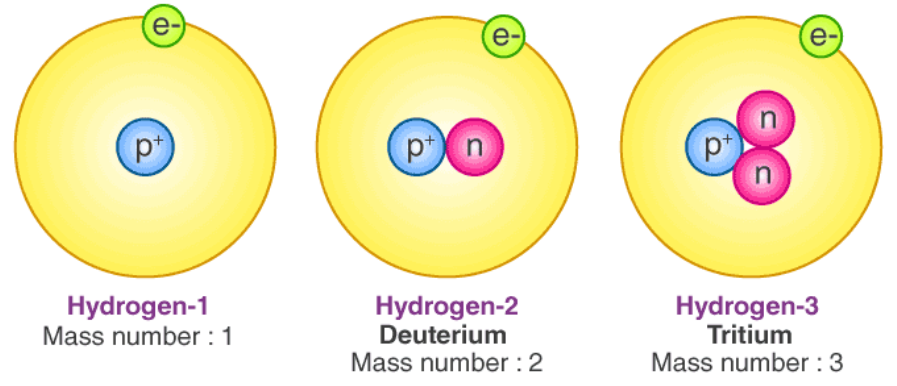
An element and its isotope only differ in the number of
Isotopes are variants of a particular chemical element which differ in neutron number, and consequently in nucleon number. All isotopes of a given element have the same number of protons (atomic number) in each atom but different numbers of neutrons in their nuclei.
Not clear enough?
Question 15
The S.I unit of moment of a force is
The moment of a force (or torque) is defined as the product of the force (F) and the perpendicular distance (d) from the pivot to the line of action of the force. \[ \text{Moment} = F \times d \]The S.I. unit of Force is the Newton (N) and distance is the metre (m). Therefore, the unit for the moment of a force is the Newton-metre (Nm).
Not clear enough?
Question 16
Calculate the height of the image formed by a pinhole camera of length 12cm used to photograph an object 60cm away from the hole and 70cm high
In a pinhole camera, the magnification (m) relates the image height (\(h_i\)), object height (\(h_o\)), image distance (v), and object distance (u):\[ \frac{h_i}{h_o} = \frac{v}{u} \]Given:
Camera length (v) = 12cm
Object distance (u) = 60cm
Object height (\(h_o\)) = 70cm
\[ h_i = \frac{v \times h_o}{u} = \frac{12 \times 70}{60} \]\[ h_i = \frac{840}{60} = 14\text{ cm} \]
Camera length (v) = 12cm
Object distance (u) = 60cm
Object height (\(h_o\)) = 70cm
\[ h_i = \frac{v \times h_o}{u} = \frac{12 \times 70}{60} \]\[ h_i = \frac{840}{60} = 14\text{ cm} \]
Not clear enough?
Question 17
When two objects P and Q are supplied with the same quantity of heat, the temperature change in P is observed to be twice that of Q. The mass of P is half that of Q. The ratio of the specific heat capacity pf P to Q is
Using the heat equation \(Q = mc\Delta\theta\):
For P: \(Q = m_P c_P \Delta\theta_P\)
For Q: \(Q = m_Q c_Q \Delta\theta_Q\)
Given:
\(Q_P = Q_Q\)
\(\Delta\theta_P = 2\Delta\theta_Q\)
\(m_P = 0.5m_Q\)
Equating the heat: \[ 0.5m_Q \cdot c_P \cdot 2\Delta\theta_Q = m_Q \cdot c_Q \cdot \Delta\theta_Q \]\[ m_Q c_P \Delta\theta_Q = m_Q c_Q \Delta\theta_Q \]\[ c_P = c_Q \]The ratio \(c_P:c_Q\) is 1:1.
Not clear enough?
Question 18
When the r.m.s value of a source of electricity supply is given as 240v, it means that the peak value of the supply is
For a sinusoidal voltage, the peak value (\(V_0\)) is related to the root-mean-square value (\(V_{\text{rms}}\)) by:\[ V_0 = V_{\text{rms}} \times \sqrt{2} \]Given \(V_{\text{rms}} = 240\text{V}\) and \(\sqrt{2} \approx 1.414\):\[ V_0 = 240 \times 1.414 = 339.36\text{V} \]This is approximately 340V.
Not clear enough?
Question 19
Which of the following operations can be used to convert an alternative current dynamo into a direct current dynamo
An AC dynamo produces current that changes direction because of the use of slip rings. To convert it to a DC dynamo, slip rings are replaced with a split-ring commutator.
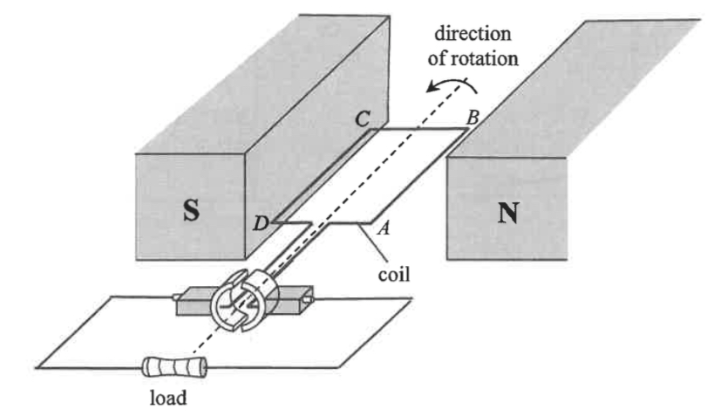
The commutator reverses the connection of the coils to the external circuit every half turn, ensuring that the current flows in only one direction in the external circuit.
The commutator reverses the connection of the coils to the external circuit every half turn, ensuring that the current flows in only one direction in the external circuit.
Not clear enough?
Question 20
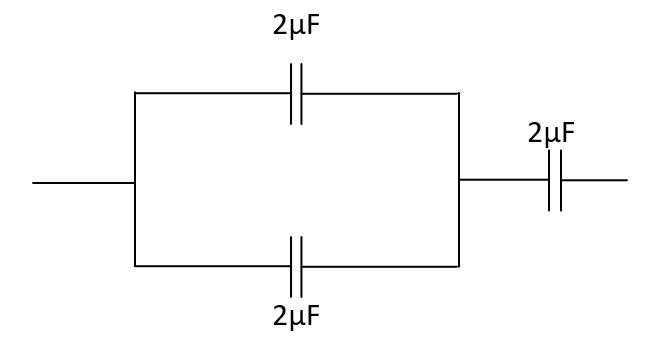 The net capacitance in the circuit above is
Assuming the diagram shows a series arrangement of two capacitors (based on common JAMB problems of this type where results are whole numbers):
For capacitors in series, the reciprocal of the total capacitance (\(C_T\)) is:\[ \frac{1}{C_T} = \frac{1}{C_1} + \frac{1}{C_2} \]If the capacitors are both 4.0\(\mu\)F (common values):\[ \frac{1}{C_T} = \frac{1}{4} + \frac{1}{4} = \frac{2}{4} = \frac{1}{2} \]\[ C_T = 2.0\mu\text{F} \]Alternatively, if they are 12\(\mu\)F and 4\(\mu\)F:\[ \frac{1}{C_T} = \frac{1}{12} + \frac{1}{4} = \frac{1+3}{12} = \frac{4}{12} = \frac{1}{3} \implies 3.0\mu\text{F} \]
For capacitors in series, the reciprocal of the total capacitance (\(C_T\)) is:\[ \frac{1}{C_T} = \frac{1}{C_1} + \frac{1}{C_2} \]If the capacitors are both 4.0\(\mu\)F (common values):\[ \frac{1}{C_T} = \frac{1}{4} + \frac{1}{4} = \frac{2}{4} = \frac{1}{2} \]\[ C_T = 2.0\mu\text{F} \]Alternatively, if they are 12\(\mu\)F and 4\(\mu\)F:\[ \frac{1}{C_T} = \frac{1}{12} + \frac{1}{4} = \frac{1+3}{12} = \frac{4}{12} = \frac{1}{3} \implies 3.0\mu\text{F} \]
Not clear enough?
You might like
Direction: Three of the following four number pairs are alike in a certain way and one is different. Find the odd one out ?
In an examination there were 640 boys and 360 girls. 60% of boys and 80% of girls were successful. The percentage of failure was ?
Select the option that best explains the information conveyed in the sentence.
Kunana is like a bear with a sore head.
The amount 2,100 became 2,352 in 2 years at simple interest. If the interest rate is decreased by 1%, what is the new interest ?
Choose the option nearest in meaning to the underlined word(s).
Kaltume crouched over the papers on her desk?