
Physics 2017 Jamb Examination
Physics 2017 Jamb Examination

Question 21
The instrument used to measure the pressure of a gas is
A manometer is specifically designed to measure gas pressure. A barometer measures atmospheric pressure, a thermometer measures temperature, and a hydrometer measures the relative density of liquids.
Not clear enough?
Question 22
A man of mass 50kg ascends a flight of stairs 5m high in 5 seconds. If acceleration due to gravity is 10ms\(^{-2}\) the power expended is
Power is the rate of doing work. Work done against gravity is \( mgh \).\[ P = \frac{mgh}{t} \]\[ P = \frac{50 \times 10 \times 5}{5} \]\[ P = 500\text{W} \]
Not clear enough?
Question 23
A radio station broadcast at a frequency of 600KHZ. If the speed of light in air is 3 × 10\(^{8}\)ms\(^{-1}\). Calculate the wavelength of the radio wave
Using the wave equation \( v = f\lambda \):
Given:
\( v = 3 \times 10^8 \text{ ms}^{-1} \)
\( f = 600 \text{ kHz} = 600,000 \text{ Hz} = 6 \times 10^5 \text{ Hz} \)\[ \lambda = \frac{v}{f} = \frac{3 \times 10^8}{6 \times 10^5} \]\[ \lambda = 0.5 \times 10^3 = 500\text{m or } 5.0 \times 10^2\text{m} \]
Given:
\( v = 3 \times 10^8 \text{ ms}^{-1} \)
\( f = 600 \text{ kHz} = 600,000 \text{ Hz} = 6 \times 10^5 \text{ Hz} \)\[ \lambda = \frac{v}{f} = \frac{3 \times 10^8}{6 \times 10^5} \]\[ \lambda = 0.5 \times 10^3 = 500\text{m or } 5.0 \times 10^2\text{m} \]
Not clear enough?
Question 24
Which of the following is a scalar quantity?
Scalar quantities have magnitude only, while vector quantities have both magnitude and direction. Tension, weight (a force), and impulse are all vectors because they act in specific directions. Mass is a scalar as it only describes the quantity of matter regardless of direction.
Not clear enough?
Question 25
Determine the focal length of a thin converging lens if the power is 5.0 dioptres
The power (P) of a lens is the reciprocal of its focal length (f) in metres.\[ P = \frac{1}{f} \implies f = \frac{1}{P} \]\[ f = \frac{1}{5.0} = 0.2\text{m} \]
Not clear enough?
Question 26
A string of length 5cm is extended by 0.04m when a load of 0.8kg is suspended at the end. How far will it extend if a force of 16N is applied? [g = 10ms\(^{-2}\)]
According to Hooke's Law, \( F = ke \). First, find the force for the 0.8kg load:
\( F_1 = mg = 0.8 \times 10 = 8\text{N} \).
Since force is proportional to extension (\( F \propto e \)):\[ \frac{F_1}{e_1} = \frac{F_2}{e_2} \implies \frac{8}{0.04} = \frac{16}{e_2} \]\[ e_2 = \frac{16 \times 0.04}{8} = 2 \times 0.04 = 0.08\text{m} \]
\( F_1 = mg = 0.8 \times 10 = 8\text{N} \).
Since force is proportional to extension (\( F \propto e \)):\[ \frac{F_1}{e_1} = \frac{F_2}{e_2} \implies \frac{8}{0.04} = \frac{16}{e_2} \]\[ e_2 = \frac{16 \times 0.04}{8} = 2 \times 0.04 = 0.08\text{m} \]
Not clear enough?
Question 27
How can energy loss be minimized through Eddy-current?
Eddy currents are circulating currents induced in solid conductors by a changing magnetic field. To minimize energy loss (heat) from these currents in transformers or motors, the core is made of thin, insulated laminations (sheets or wires) of soft iron rather than a single solid block. This breaks the large loops of current into much smaller ones, increasing effective resistance and reducing heat loss.
Not clear enough?
Question 28
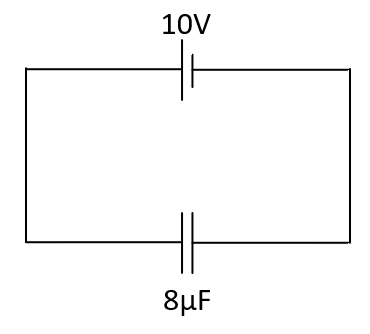 From the diagram above, calculate the energy stored in the capacitor
Assuming standard values from this 2017 problem: C = 4\(\mu\)F (\(4 \times 10^{-6}\)F) and V = 20V.
Energy (W) = \( \frac{1}{2}CV^2 \)\[ W = 0.5 \times (4 \times 10^{-6}) \times 20^2 \]\[ W = 0.5 \times 4 \times 10^{-6} \times 400 \]\[ W = 800 \times 10^{-6} = 8.0 \times 10^{-4}\text{J} \]
Energy (W) = \( \frac{1}{2}CV^2 \)\[ W = 0.5 \times (4 \times 10^{-6}) \times 20^2 \]\[ W = 0.5 \times 4 \times 10^{-6} \times 400 \]\[ W = 800 \times 10^{-6} = 8.0 \times 10^{-4}\text{J} \]
Not clear enough?
Question 29
A constant force of 5N acts for 5 seconds on a mass of 5kg initially at rest. Calculate the final momentum
Impulse is equal to the change in momentum (\( Ft = \Delta p \)).
Since it starts from rest (initial momentum = 0), final momentum equals the impulse.\[ \text{Momentum} = F \times t \]\[ \text{Momentum} = 5\text{N} \times 5\text{s} = 25\text{kgms}^{-1} \]
Since it starts from rest (initial momentum = 0), final momentum equals the impulse.\[ \text{Momentum} = F \times t \]\[ \text{Momentum} = 5\text{N} \times 5\text{s} = 25\text{kgms}^{-1} \]
Not clear enough?
Question 30
I. Refraction II. Interference III. Diffraction Which of the above properties are common to all waves?
Refraction (bending when changing medium), interference (overlapping of waves), and diffraction (spreading around obstacles) are fundamental wave properties shared by all waves, including mechanical waves (sound/water) and electromagnetic waves (light). Polarization is the only property typically restricted to transverse waves.
Not clear enough?
You might like
This question is based on Rubadiri's *An African Thunderstorm*. 'Pregnant clouds / Ride safely on its back' — 'pregnant clouds' implies
The first Nigerian leader to become chairman of the Organisation of African Unity (OAU) was: ________.
Each of the questions below consists of two words that have a certain relationship to each other.
Select the pair of words.
NECROMANCY : GHOSTS
| Units of Quality Consumed | Total Utility | Marginal Utility |
|---|---|---|
| 0 | - | - | 1 | 10 | 10 |
| 2 | 15 | 5 |
| 3 | 17 | 2 |
| 4 | 18 | 1 |
| 5 | 18 | 0 |
This table illustrates the law of _________