
Physics 2019 Jamb Examination
Physics 2019 Jamb Examination

Question 1
The limiting frictional force between two surface depends on
I. the gaseous reaction between the surfaces
II. the nature of the surfaces in contact
III. the relative velocity between the surfaces
I. the gaseous reaction between the surfaces
II. the nature of the surfaces in contact
III. the relative velocity between the surfaces
The limiting frictional force (the maximum static friction) is governed by two main factors: the nature of the surfaces in contact (their roughness or smoothness) and the normal reaction force between them. It is independent of the area of the surfaces in contact and the relative velocity between them (as long as they are at the point of slipping). Since only statement II correctly identifies one of these primary dependencies, it is the correct choice.
Not clear enough?
Question 2
If a body moves with a constant speed and at the same time undergoes an acceleration, its motion is said to be
In uniform circular motion, an object moves along a circular path at a constant speed.However, because the direction of the velocity vector is constantly changing as the object turns, the object is undergoing acceleration. This is known as centripetal acceleration, which is always directed toward the centre of the circle. Rectilinear motion at constant speed would have zero acceleration, and oscillations involve changing speeds.
Not clear enough?
Question 3
When blue and green colours of light are mixed, the resultant colour is
Light follows the additive colour theory. The primary colours of light are Red, Green, and Blue (RGB).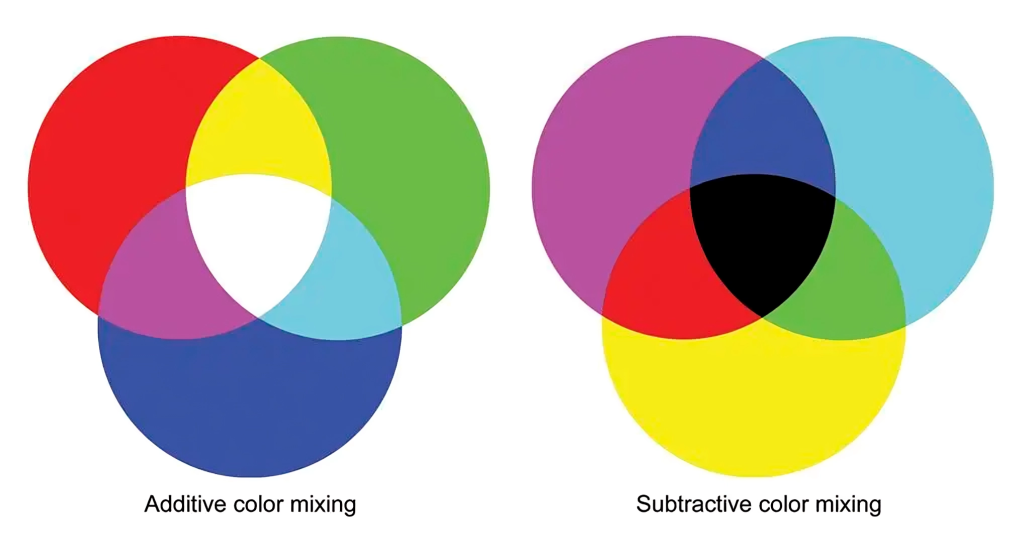
When two primary colours of light are mixed in equal proportions, they produce a secondary colour:
1. Green + Blue = Cyan
2. Red + Blue = Magenta
3. Red + Green = Yellow
Therefore, mixing blue and green results in Cyan.
When two primary colours of light are mixed in equal proportions, they produce a secondary colour:
1. Green + Blue = Cyan
2. Red + Blue = Magenta
3. Red + Green = Yellow
Therefore, mixing blue and green results in Cyan.
Not clear enough?
Question 4
A metal rod has a length of 100cm at 200°C. At what temperature will its length be 99.4cm. If the linear expansivity of the material of the rod is 2 x 10\(^{-5}\) C\(^{-1}\)
We use the formula for linear expansion:\[ L_2 = L_1[1 + \alpha(T_2 - T_1)] \]Given:
\( L_1 = 100 \; \text{cm} \) at \( T_1 = 200^\circ\text{C} \)
\( L_2 = 99.4 \; \text{cm} \)
\( \alpha = 2 \times 10^{-5} \; ^\circ\text{C}^{-1} \)
Calculate the change in length \( \Delta L \):\[ \Delta L = L_2 - L_1 = 99.4 - 100 = -0.6 \; \text{cm} \]Using \( \Delta L = L_1 \alpha \Delta T \):\[ -0.6 = 100 \times (2 \times 10^{-5}) \times (T_2 - 200) \]\[ -0.6 = 0.002 \times (T_2 - 200) \]\[ T_2 - 200 = \frac{-0.6}{0.002} \]\[ T_2 - 200 = -300 \]\[ T_2 = -300 + 200 = -100^\circ\text{C} \]
Not clear enough?
Question 5
According to kinetic molecular model, in gases
The kinetic molecular model describes gases as collections of particles that are in constant, random motion and are separated by distances much larger than the size of the particles themselves. Because the intermolecular forces are negligible, gas molecules move independently and expand to fill whatever volume is available to them. Option C describes solids, and Option D describes crystalline solids specifically.
Not clear enough?
Question 6
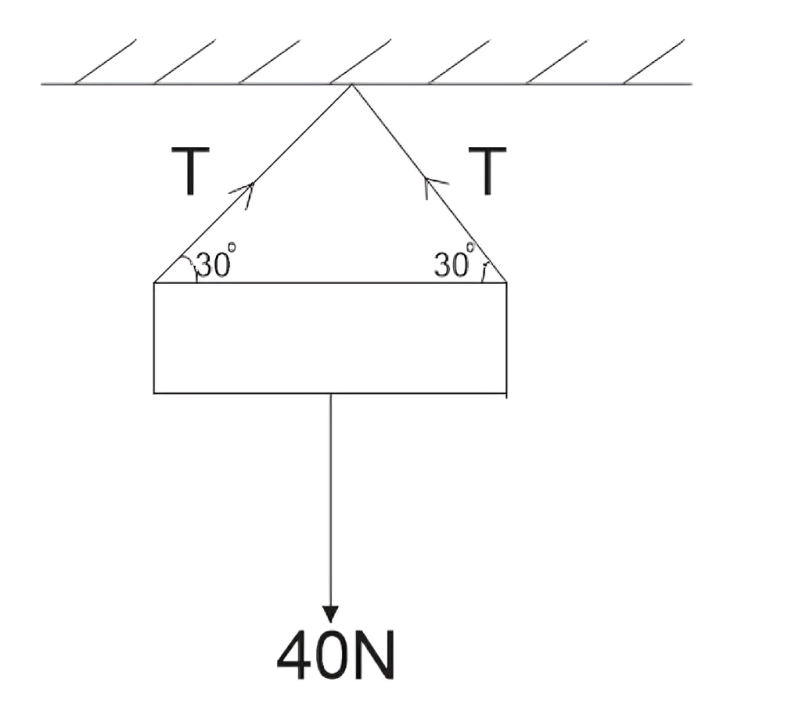
The value of T in the figure above is
Based on the standard 2019 problem diagram involving a pulley system in equilibrium, the tension \( T \) is usually determined by the weight of the load it supports. If the system shows a load of 20N being supported by a single string in a static state, the tension in the string must equal the weight of the load to maintain equilibrium. Therefore, \( T = 20 \; \text{N} \).
Not clear enough?
Question 7
A train has an initial velocity of 44m/s and an acceleration of -4m/s\(^{2}\). Calculate its velocity after 10 seconds
We use the first equation of motion for constant acceleration:\[ v = u + at \]Given:
Initial velocity \( u = 44 \; \text{m/s} \)
Acceleration \( a = -4 \; \text{m/s}^2 \)
Time \( t = 10 \; \text{s} \)
Substituting the values:\[ v = 44 + (-4 \times 10) \]\[ v = 44 - 40 \]\[ v = 4 \; \text{m/s} \]
Initial velocity \( u = 44 \; \text{m/s} \)
Acceleration \( a = -4 \; \text{m/s}^2 \)
Time \( t = 10 \; \text{s} \)
Substituting the values:\[ v = 44 + (-4 \times 10) \]\[ v = 44 - 40 \]\[ v = 4 \; \text{m/s} \]
Not clear enough?
Question 8
Lamps in domestic lightings are usually in
Domestic lighting systems use parallel connections for efficiency and reliability. In a parallel circuit, each lamp is connected directly across the supply voltage, ensuring they all operate at their full brightness. More importantly, if one lamp fails or is switched off, the circuit for the other lamps remains complete, allowing them to stay on. In a series circuit, if one bulb burns out, all the lights in the house would go out.
Not clear enough?
Question 9
During the transformation of matter from the solid to the liquid state, the heat supplied does not produce temperature increase because
This phenomenon involves 'latent heat of fusion'. When a solid reaches its melting point, the added thermal energy is not used to increase the kinetic energy (speed) of the molecules, which would raise the temperature. Instead, the energy is used to overcome the attractive intermolecular forces (bonds) that hold the molecules in a rigid solid lattice. This continues until the entire substance has transitioned into the liquid state.
Not clear enough?
Question 10
In a slide wire bridge, the balance is obtained at a point 25cm from one end of wire 1m long. The resistance to be tested is connected to that end and a standard resistance of 3.6Ω is connected to the other end of the wire. Determine the value of the unknown resistance
The slide wire bridge (metre bridge) operates on the principle of the Wheatstone bridge.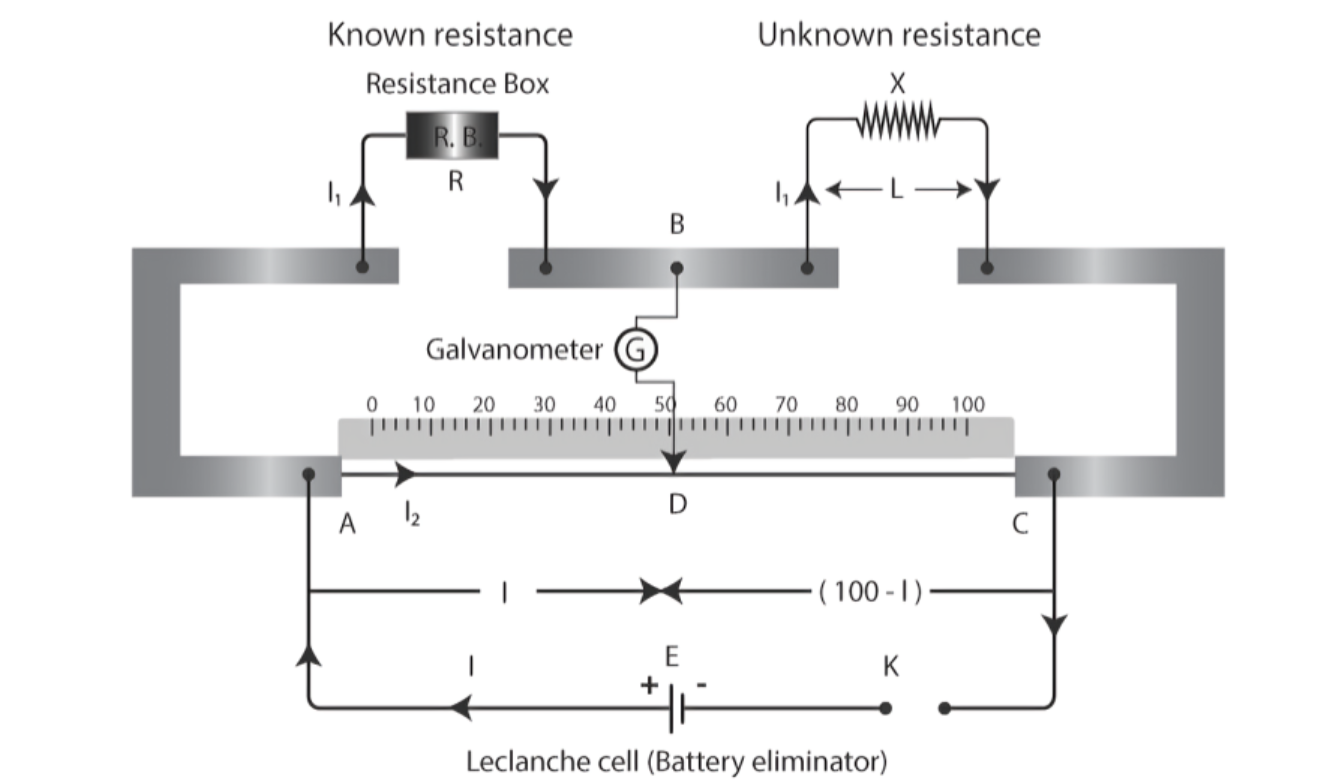
The ratio of the unknown resistance (\( R \)) to the standard resistance (\( S \)) is equal to the ratio of the corresponding lengths of the wire segments.
Given:
Balance length from unknown resistance side \( l_1 = 25 \; \text{cm} \)
Total length of wire = 100 cm (1m)
Length from standard resistance side \( l_2 = 100 - 25 = 75 \; \text{cm} \)
Standard resistance \( S = 3.6 \; \Omega \)
The formula is:\[ \frac{R}{S} = \frac{l_1}{l_2} \]\[ R = S \times \frac{l_1}{l_2} \]\[ R = 3.6 \times \frac{25}{75} \]\[ R = 3.6 \times \frac{1}{3} \]\[ R = 1.2 \; \Omega \]