
Physics 2019 Jamb Examination
Physics 2019 Jamb Examination

Question 21
When the downward current flows in a straight vertical conductor, the direction of its magnetic field at a point due north of the wire is?
To determine the direction of the magnetic field around a straight conductor, we use Maxwell's Right-Hand Grip Rule. Point your thumb downwards (direction of the current); your fingers curl in a clockwise direction when viewed from above. If you are at a point due North of the wire, the clockwise circular field lines will be moving towards the West at that specific location.
Not clear enough?
Question 22
Aluminium is sometimes used as the leaf of an electroscope because it
A gold-leaf electroscope requires leaves that are extremely thin and light so they can easily diverge even with a small amount of electrostatic force.
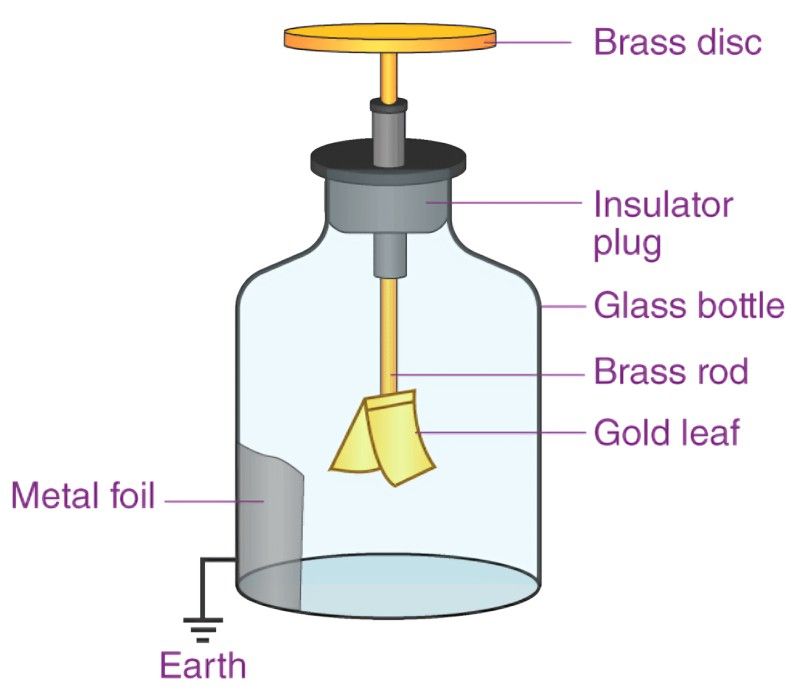
While gold is traditional because it is highly malleable, aluminium is also used because it can be beaten into very thin, lightweight foils (high malleability) while remaining a good conductor of electricity.
While gold is traditional because it is highly malleable, aluminium is also used because it can be beaten into very thin, lightweight foils (high malleability) while remaining a good conductor of electricity.
Not clear enough?
Question 23
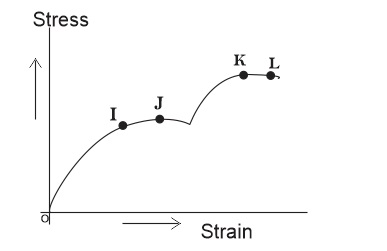
The diagram above represents the stress-strain graph of a loaded wire. Which of these statements is correct?
In a typical stress-strain graph for a metal wire: the initial linear portion (up to a point often labeled J or K) represents the elastic region where Hooke's Law is obeyed. At the elastic limit (J), the material begins to deform plastically. Point K is usually the yield point where the material flows without additional stress, and point L typically represents the breaking (fracture) point.
Not clear enough?
Question 24
A supply of 400V is connected across capacitors of 3μf and 6μf in series. Calculate the charge
1. Find the equivalent capacitance (\( C_T \)) for series capacitors:\[ \frac{1}{C_T} = \frac{1}{C_1} + \frac{1}{C_2} = \frac{1}{3} + \frac{1}{6} = \frac{2+1}{6} = \frac{3}{6} \]\[ C_T = 2\mu\text{F} = 2 \times 10^{-6}\text{F} \]2. Calculate total charge (\( Q \)) using \( Q = CV \):\[ Q = (2 \times 10^{-6}\text{F}) \times 400\text{V} \]\[ Q = 800 \times 10^{-6}\text{C} = 8 \times 10^{-4}\text{C} \]In a series circuit, this charge \( Q \) is the same across all capacitors.
Not clear enough?
Question 25
A vibrator causes water ripples to travel across the surface of a tank. The wave travels 50cm in 2s and the distance between successive crests is 5cm. Calculate the frequency of the vibrator
1. Calculate wave speed (\( v \)):\[ v = \frac{\text{Distance}}{\text{Time}} = \frac{50\text{cm}}{2\text{s}} = 25\text{cm/s} \]2. Identify wavelength (\( \lambda \)): The distance between successive crests is the wavelength, so \( \lambda = 5\text{cm} \).
3. Calculate frequency (\( f \)) using the wave equation:\[ v = f\lambda \implies f = \frac{v}{\lambda} \]\[ f = \frac{25}{5} = 5\text{Hz} \]
3. Calculate frequency (\( f \)) using the wave equation:\[ v = f\lambda \implies f = \frac{v}{\lambda} \]\[ f = \frac{25}{5} = 5\text{Hz} \]
Not clear enough?
Question 26
A thermocouple thermometer is connected to a millivoltmeter which can read up to 10mV. When one junction is in ice at 0°C and the other is steam at 100°C, the millivoltmeter reads 4mV. What is the maximum temperature which this arrangement can measure
A thermocouple operates on the principle that the electromotive force (e.m.f.) produced is directly proportional to the temperature difference between the junctions (for linear ranges).
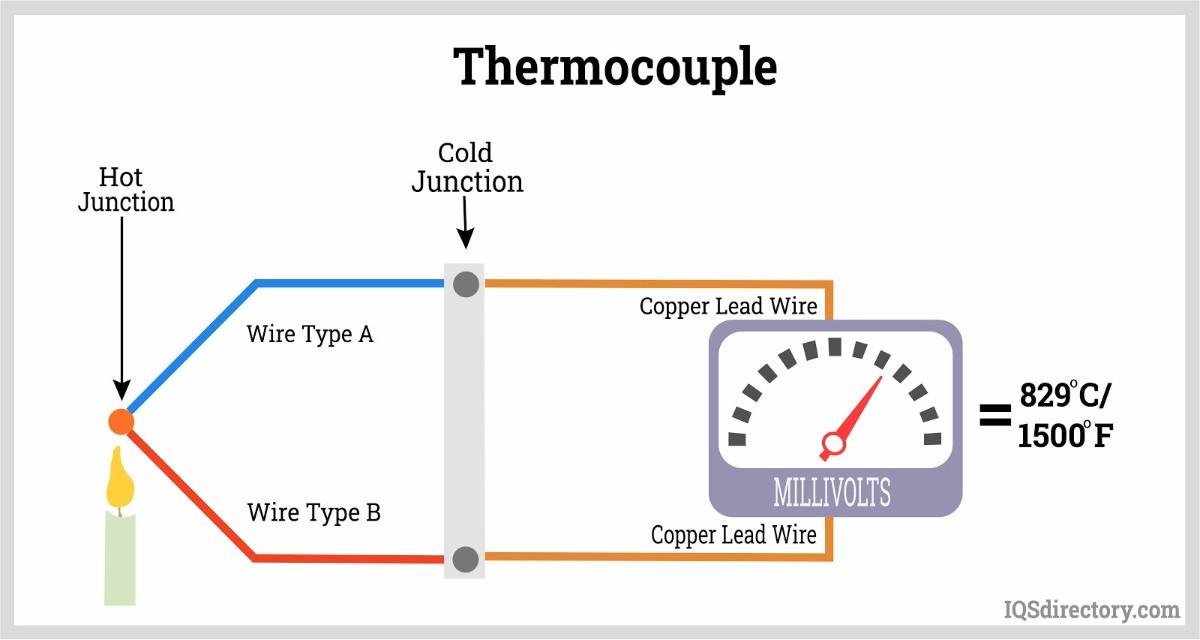
We can use a simple ratio:\[ \frac{V_1}{T_1} = \frac{V_{\text{max}}}{T_{\text{max}}} \]\[ \frac{4\text{mV}}{100^{\circ}\text{C}} = \frac{10\text{mV}}{T_{\text{max}}} \]\[ T_{\text{max}} = \frac{10 \times 100}{4} = 250^{\circ}\text{C} \]
We can use a simple ratio:\[ \frac{V_1}{T_1} = \frac{V_{\text{max}}}{T_{\text{max}}} \]\[ \frac{4\text{mV}}{100^{\circ}\text{C}} = \frac{10\text{mV}}{T_{\text{max}}} \]\[ T_{\text{max}} = \frac{10 \times 100}{4} = 250^{\circ}\text{C} \]
Not clear enough?
Question 27
An alternating current can induce voltage because it has
According to Faraday's Law of Electromagnetic Induction, an electromotive force (e.m.f.) is induced in a circuit whenever there is a change in the magnetic flux linked with the circuit.
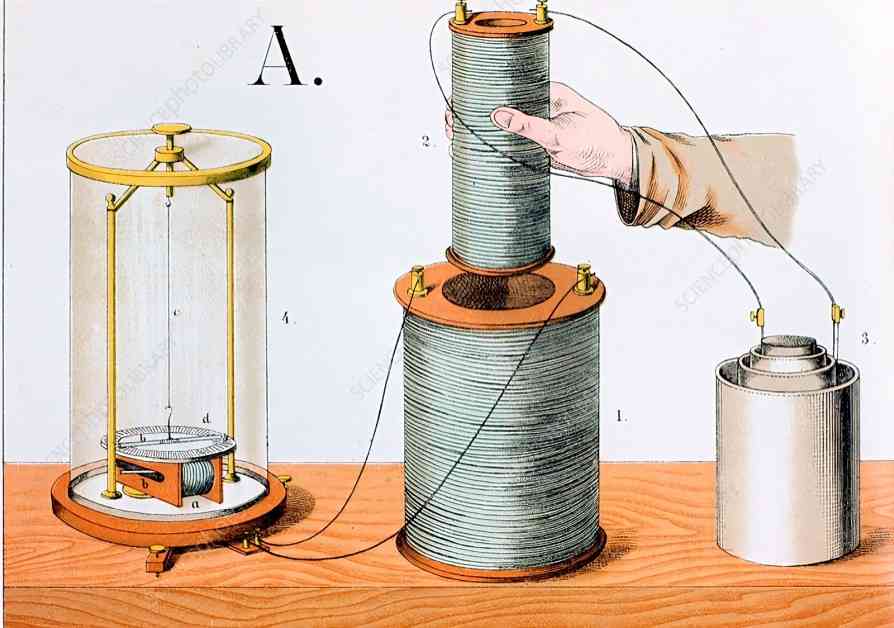
An alternating current (AC) continuously changes its magnitude and direction, which creates a continuously varying magnetic field around the conductor. This varying field ensures a constant change in flux, inducing voltage in nearby conductors.
An alternating current (AC) continuously changes its magnitude and direction, which creates a continuously varying magnetic field around the conductor. This varying field ensures a constant change in flux, inducing voltage in nearby conductors.
Not clear enough?
Question 28
The limiting frictional force between two surfaces depends on
I. the cohesive force of the material
II. the nature of the surfaces in contact
III. the relative velocity between the surfaces
I. the cohesive force of the material
II. the nature of the surfaces in contact
III. the relative velocity between the surfaces
Limiting friction is the maximum static friction that must be overcome to start motion. It depends only on the nature of the surfaces in contact (roughness, materials) and the normal reaction force. It is independent of the surface area and, crucially, independent of the relative velocity (since the surfaces are not yet in relative motion). This matches statement II.
Not clear enough?
Question 29
During the transformation of matter from the solid to the liquid state, the heat supplied does not produce a temperature increase because
During a phase change, such as melting (solid to liquid), the energy provided is 'latent' (hidden). Instead of increasing the kinetic energy of the molecules (which would increase the temperature), the energy is consumed to break the intermolecular bonds and overcome the attractive forces that maintain the rigid structure of the solid.
Not clear enough?
Question 30
The statement 'Heat lost by the hot body equals that gained by the cold one' is assumed when determining specific that heat capacity by the method of mixtures. Which of the following validates the assumption?
The assumption 'Heat lost = Heat gained' relies on the system being thermally isolated so that no heat is lost to the surroundings. Lagging the calorimeter (I) with an insulating material prevents heat exchange with the environment, making the assumption valid. Weighing the equipment (III) is necessary for the calculation itself but doesn't validate the physical assumption of zero heat loss.
Not clear enough?
You might like
Choose the most appropriate option for the gap labelled [....15.....] in the passage.
It may happen that the boxers are not well ...15... one being much stronger than the other...
The fact that the office of the Chairman is rotational in ECOWAS makes it a perfect example of a/an ........
In the preparation of oxygen by heating KClO₃ in the presence of MnO₂, only moderate heat is needed because the catalyst acts by
Simplify \( \dfrac{25^{\frac{2}{3}} \div 25^{\frac{1}{6}}}{(\frac{1}{5})^{\frac{7}{6}} \div (\frac{1}{5})^{\frac{1}{6}}} \)