
Physics 2019 Jamb Examination
Physics 2019 Jamb Examination

Question 31
In the molecular explanation of conduction, heat is transferred by the
Conduction in solids, especially metals, occurs via two mechanisms: the vibration of atoms/molecules in the lattice and the movement of free electrons. In metals, the kinetic energy is rapidly transferred through the material primarily by these highly mobile free electrons, which collide with other electrons and ions, making metals excellent thermal conductors.
Not clear enough?
Question 32
The conductivity of gases at low pressure can be termed as
I. hot cathode emission
II. thermo ionic emission
III. cold cathode emission
IV. Field emission
I. hot cathode emission
II. thermo ionic emission
III. cold cathode emission
IV. Field emission
Gas conductivity at low pressure is often observed in discharge tubes. When the emission of electrons from the cathode occurs due to a high electric field rather than heat, it is termed cold cathode emission (III). If the electric field itself is the primary driver for extracting electrons from the metal surface, it is called field emission (IV). Hot cathode and thermionic emission refer to electron release due to high temperatures.
Not clear enough?
Question 33
Which of the following media allow the transmission of sound waves through them?
I. air
II. liquid
III. solids
I. air
II. liquid
III. solids
Sound is a mechanical longitudinal wave that requires a material medium for propagation. It travels by causing oscillations in the particles of the medium. Because air (gas), liquids (like water), and solids (like steel) all consist of particles that can transmit these vibrations, sound can pass through all three media.
Not clear enough?
Question 34
The earth's gravitational field intensity at its surface is about
(G = 6.7 × 10\(^{-11}\) Nm\(^{2}\)/kg\(^{2}\), mass of the earth is 6 × 10\(^{24}\) kg, radius of the earth is 6.4 × 10\(^{6}\) m, g on the earth = 9.8m/s\(^{2}\))
(G = 6.7 × 10\(^{-11}\) Nm\(^{2}\)/kg\(^{2}\), mass of the earth is 6 × 10\(^{24}\) kg, radius of the earth is 6.4 × 10\(^{6}\) m, g on the earth = 9.8m/s\(^{2}\))
Gravitational field intensity (g) is defined as the gravitational force per unit mass. At the surface of the Earth, this is numerically equivalent to the acceleration due to gravity. Using the formula:\[ g = \frac{GM}{R^2} \]Using the provided constants:\[ g = \frac{(6.7 \times 10^{-11}) \times (6 \times 10^{24})}{(6.4 \times 10^6)^2} \approx 9.8 \; \text{N/kg} \]Since the value of 'g' is explicitly given as 9.8 m/s² in the prompt, the intensity is 9.8 N/kg.
Not clear enough?
Question 35
The following are parts of the eye:
I. Retina
II. Pupil
III. Iris
The correct equivalent in the camera in the same order are
I. Retina
II. Pupil
III. Iris
The correct equivalent in the camera in the same order are
Comparing the human eye to a camera: [Image comparing anatomy of human eye and camera]
1. The Retina is the light-sensitive surface where the image forms, equivalent to the Film (or sensor).
2. The Pupil is the opening through which light enters, equivalent to the Aperture.
3. The Iris regulates the size of the pupil, equivalent to the Diaphragm which regulates the aperture size.
1. The Retina is the light-sensitive surface where the image forms, equivalent to the Film (or sensor).
2. The Pupil is the opening through which light enters, equivalent to the Aperture.
3. The Iris regulates the size of the pupil, equivalent to the Diaphragm which regulates the aperture size.
Not clear enough?
Question 36
According to kinetic molecular model, in gases
In the kinetic theory of gases, molecules are described as being in constant random motion and are separated by distances that are very large compared to their own size. Because of this, they have negligible intermolecular forces and will expand to fill any container they occupy.
Not clear enough?
Question 37
A force of 6N acts horizontally on a stationary mass of 2kg for 4s. The kinetic energy gained by the mass is _________
1. Find acceleration (\( a \)):\[ a = \frac{F}{m} = \frac{6}{2} = 3 \; \text{ms}^{-2} \]2. Find final velocity (\( v \)) after 4s (starting from rest, \( u=0 \)):\[ v = u + at = 0 + (3 \times 4) = 12 \; \text{ms}^{-1} \]3. Calculate Kinetic Energy (\( K.E. \)):\[ K.E. = \frac{1}{2}mv^2 = \frac{1}{2} \times 2 \times 12^2 = 144 \; \text{J} \]
Not clear enough?
Question 38
The momentum of a car moving at a constant speed in a circular track
Momentum (\( p = mv \)) is a vector quantity, meaning it has both magnitude and direction. Even if the speed is constant, the direction of the car's velocity is constantly changing as it moves around the track. Therefore, the momentum vector is also constantly changing. Depending on the chosen coordinate system, the components of momentum can be positive or negative.
Not clear enough?
Question 39
A metal rod has a length of 100cm at 200°C. At what temperature will its length be 99.4cm. If the linear expansivity of the material of the rod is 2 × 10\(^{-5}\) C\(^{-1}\)
Using the linear expansion formula:\[ L_2 = L_1 [1 + \alpha(T_2 - T_1)] \]\[ 99.4 = 100 [1 + (2 \times 10^{-5})(T_2 - 200)] \]\[ 0.994 = 1 + 0.00002(T_2 - 200) \]\[ -0.006 = 0.00002(T_2 - 200) \]\[ T_2 - 200 = \frac{-0.006}{0.00002} = -300 \]\[ T_2 = -300 + 200 = -100^{\circ}\text{C} \]
Not clear enough?
Question 40
The lead-acid accumulator consists of
A lead-acid battery (accumulator) consists of a lead(IV) oxide (\(\text{PbO}_2\)) positive plate and a lead (\(\text{Pb}\)) negative plate.
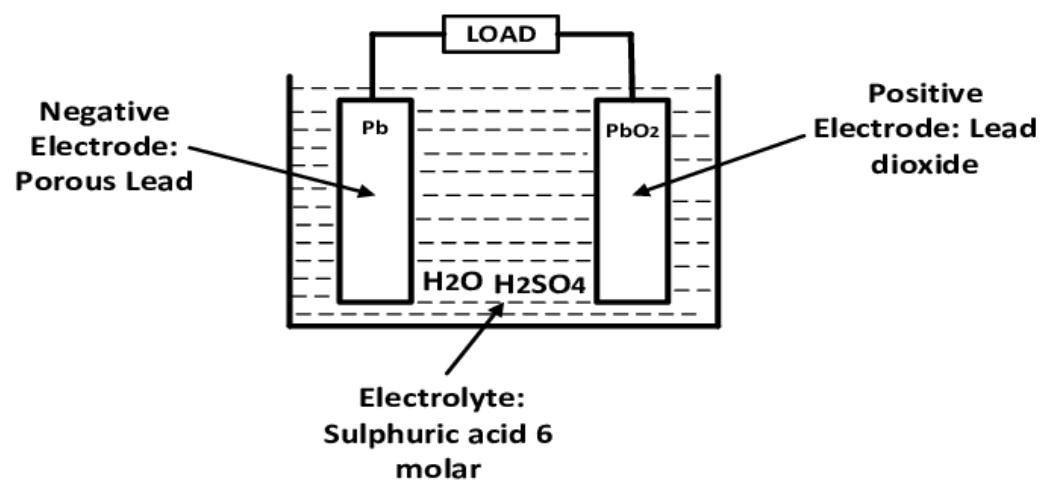
The electrolyte used is a dilute solution of tetraoxosulphate(VI) acid, commonly known as sulphuric acid (\(\text{H}_2\text{SO}_4\)).
The electrolyte used is a dilute solution of tetraoxosulphate(VI) acid, commonly known as sulphuric acid (\(\text{H}_2\text{SO}_4\)).
Not clear enough?
You might like
Three times a certain number (x), minus 2 is less than the number minus 6. Find the possible values of x.
The efficiency of a cell with internal resistance of 2\(\Omega\) supply current to a 6\(\Omega\) resistor is
According to Paul's teaching concerning the second coming of Jesus, the believers will meet the Lord when he is_________
The two political parties created by the Federal Government towards 1992 transition to civil rule are:
Choose the word or phrase which is most nearly opposite in meaning to the word in capitals.
BALEFUL :