Physics 2019 Jamb Examination
Physics 2019 Jamb Examination

Question 51
Any line or section taken through an advancing wave in which all the particles are in the same phase is called the
A wavefront is defined as the locus of points having the same phase: a line or surface on which the disturbance has the same value at all points. For example, the circular ripples on a pond represent wavefronts where all water particles at the crest are in the same phase of motion.
Not clear enough?
Question 52

In which of the points labelled A, B, C, D and E on the conductor shown would electric charge tend to concentrate most
On a charged conductor, the surface charge density is highest at areas with the greatest curvature (the sharpest points). Point E is the sharpest point of the conductor.
Not clear enough?
Question 53
The point at which the molecules of a loaded wire begin to slide across each other resulting in a rapid increase in extension is
The yield point is the stage in a stress-strain graph where the material transitions from elastic behavior to plastic behavior. At this point, the internal molecular structure begins to shift permanently, leading to a significant increase in extension even if the load is not increased substantially.
Not clear enough?
Question 54
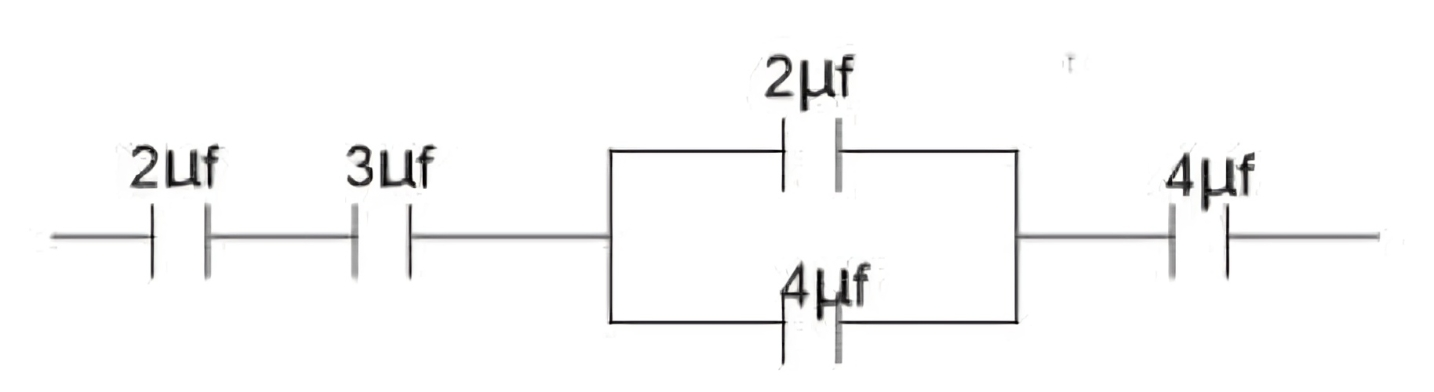
The resultant capacitance in the figure above is (2 x 2uf in series with (2uf and 4uf in parallel) in series with 4uf)
We solve this step-by-step from the middle out:
1. The parallel branch (2μF and 3μF): \( C_p = 2 + 4 = 6\mu\text{F} \).
2. Now we have four capacitors in series: 2μF, 3μF, 6μF (from step 1), and 4μF.
3. Use the series formula: \( \frac{1}{C_T} = \frac{1}{2} + \frac{1}{3} + \frac{1}{6} + \frac{1}{4} \).
4. Find a common denominator (12): \( \frac{1}{C_T} = \frac{6 + 4 + 2 + 3}{12} = \frac{15}{12} \).
5. \( C_T = \frac{4}{5} = 0.8 \mu\text{F} \).
Not clear enough?
Question 55
The lower fixed part of a faulty thermometer reads 2°C while the upper fixed point is 100°C. What is the true temperature when the thermometer reads 51°C?
We use the linear interpolation formula for thermometers:\[ \frac{\theta - 0}{100 - 0} = \frac{\text{Reading} - \text{LFP}}{\text{UFP} - \text{LFP}} \]\[ \frac{\theta}{100} = \frac{51 - 2}{100 - 2} \]\[ \frac{\theta}{100} = \frac{49}{98} \]\[ \frac{\theta}{100} = \frac{1}{2} \]\[ \theta = 50^\circ\text{C} \]
Not clear enough?
Question 56
If a body moves with a constant speed and at the same time undergoes an acceleration, its motion is said to be
In uniform circular motion, the speed remains constant, but the velocity is constantly changing because the direction of motion is constantly changing. This change in direction constitutes an acceleration (centripetal acceleration) directed towards the center of the path.
Not clear enough?
Question 57
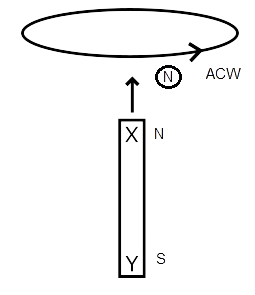
A coil X is moved quickly away from the end Y of a stationary metal bar and a current then flows in X as shown above. Then
According to Lenz's Law, the induced current will create a magnetic field that opposes the change causing it. If moving the coil *away* induces a current that creates a North pole facing the bar (to try and pull it back), and we look at the direction of current in the diagram (Right-Hand Grip Rule), we can determine the polarity. If the induced current creates an attraction to oppose the 'moving away,' and the bar is stationary, Y must be the opposite pole of what X produces. Based on standard physics problems of this type, Y is identified as a North pole.
Not clear enough?
Question 58
A boy pushes a 500kg box along a floor with a force of 2000N. If the velocity of the box is uniform, the co-efficient of friction between the box and the floor is
Uniform velocity means the net force is zero, so the Pushing Force = Frictional Force (\( F_f \)).\[ F_f = 2000 \; \text{N} \]The Normal Reaction (\( R \)) equals the weight of the box:\[ R = mg = 500 \times 10 = 5000 \; \text{N} \] (using \( g=10 \; \text{m/s}^2 \))
The coefficient of friction \( \mu \) is:\[ \mu = \frac{F_f}{R} = \frac{2000}{5000} = 0.4 \]
The coefficient of friction \( \mu \) is:\[ \mu = \frac{F_f}{R} = \frac{2000}{5000} = 0.4 \]
Not clear enough?
Question 59
What are the units of latent heat?
Specific latent heat (\( L \)) is defined as the heat energy (\( Q \)) per unit mass (\( m \)) required to change the state of a substance without a change in temperature:\[ L = \frac{Q}{m} \]The SI unit for energy is the Joule (J) and for mass is the Kilogram (kg). Therefore, the unit is Joules per kilogram (\( \text{JKg}^{-1} \)).
Not clear enough?
Question 60
When two objects A and B are supplied with the same quantity of heat, the temperature change in A is obtained to be twice that of B. The mass of A is half that of B. The ratio of the specific heat capacity of A to B is
Using the formula \( Q = mc\Delta\theta \), since \( Q \) is the same for both:\[ m_A c_A \Delta\theta_A = m_B c_B \Delta\theta_B \]Given:
\( \Delta\theta_A = 2\Delta\theta_B \)
\( m_A = \frac{1}{2}m_B \)
Substitute these into the equation:\[ (\frac{1}{2}m_B) c_A (2\Delta\theta_B) = m_B c_B \Delta\theta_B \]\[ (1) \cdot m_B c_A \Delta\theta_B = m_B c_B \Delta\theta_B \]Dividing both sides by \( m_B \Delta\theta_B \):\[ c_A = c_B \]The ratio is 1 : 1.