
Physics 2019 Jamb Examination
Physics 2019 Jamb Examination

Question 71
A safety precaution designed to prolong the life of a lead acid accumulator is
Maintaining the specific gravity of the electrolyte (sulphuric acid) is crucial for the health of a lead-acid battery. It should typically be around 1.25 for a fully charged battery. Option A is dangerous (only distilled water should be added to top up), Option B is a fire hazard due to hydrogen gas emission, and Option D causes short-circuiting.
Not clear enough?
Question 72
The mass of water vapour in a given volume of air is 0.05g at 20°C, while the mass of water vapour required to saturate it at the same temperature is 0.15g. Calculate the relative humidity of the air.
Relative Humidity (R.H.) is the ratio of the mass of water vapour present to the mass required for saturation at the same temperature, expressed as a percentage:\[ \text{R.H.} = \frac{\text{Actual mass}}{\text{Saturated mass}} \times 100 \]\[ \text{R.H.} = \frac{0.05}{0.15} \times 100 = \frac{1}{3} \times 100 = 33.33\% \]
Not clear enough?
Question 73
The angular dispersion of a prism depends on
Angular dispersion is the difference in the angles of deviation for two different colors (usually red and violet). Since the deviation produced by a prism depends on the angle of incidence and the refractive index (which varies for different wavelengths), the dispersion is affected by both.
Not clear enough?
Question 74
Which of the following statements are correct of the production and propagation of waves?
I. vibration produces waves
II. waves transmit energy along the medium
III. the medium through which the wave travels does not travel with the wave
IV. waves do not require any medium for transmission
I. vibration produces waves
II. waves transmit energy along the medium
III. the medium through which the wave travels does not travel with the wave
IV. waves do not require any medium for transmission
Statements I, II, and III are fundamental properties of mechanical waves. Statement IV is only true for electromagnetic waves; mechanical waves (like sound or water waves) *do* require a medium. Since the question asks generally about waves, and IV is not universally applicable, D is the best choice.
Not clear enough?
Question 75
A rectangular solid block has length 10cm, breadth 5cm and height 2cm. If it lies on a horizontal surface, and has density 100kg/m\(^{3}\), calculate the pressure it exerts on the surface.
1. Volume \( V = 0.1 \times 0.05 \times 0.02 = 0.0001 \; \text{m}^3 \).
2. Mass \( m = \text{Density} \times V = 100 \times 0.0001 = 0.01 \; \text{kg} \).
3. Weight (Force) \( F = mg = 0.01 \times 10 = 0.1 \; \text{N} \).
4. Area (max pressure is on smallest side, but typically assumed to be resting on largest face unless specified). Area \( A = 0.1 \times 0.05 = 0.005 \; \text{m}^2 \).
5. Pressure \( P = \frac{F}{A} = \frac{0.1}{0.005} = 20 \; \text{N/m}^2 \).
Not clear enough?
Question 76
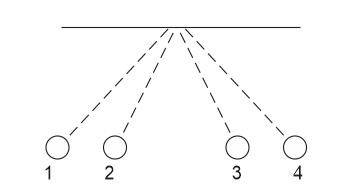
The diagram shows four positions of the bob of a simple pendulum. At which of these positions does the bob have maximum kinetic energy and minimum potential energy
In a simple pendulum, potential energy is maximum at the extreme positions (highest points) and minimum at the equilibrium (lowest) position. Conversely, kinetic energy is maximum at the lowest point (mean position) because that is where the bob travels fastest. In the standard labeling for this diagram, the mean position is usually the center point.
Not clear enough?
Question 77
An object is acted upon by a system of parallel forces causing the object to be in state equilibrium. Which of the following statement is not correct
For equilibrium, two conditions must be met: the resultant force must be zero and the resultant moment must be zero. Options A, B, and D are correct descriptions of these conditions. Option C is 'not correct' because while forces don't *have* to be equal, the statement itself is not a condition for equilibrium; it's a general observation.
Not clear enough?
Question 78
Which of the following statements is/are correct for a freely falling body?
I. the total is entirely kinetic
II. the ratio of potential energy to kinetic energy is constant
III. the sum of potential and kinetic energy is constant
I. the total is entirely kinetic
II. the ratio of potential energy to kinetic energy is constant
III. the sum of potential and kinetic energy is constant
According to the Law of Conservation of Mechanical Energy, in the absence of air resistance, the total mechanical energy (Sum of P.E. and K.E.) remains constant throughout the fall. As the body falls, P.E. decreases while K.E. increases, but their sum is invariant.
Not clear enough?
Question 79
Efficiency of conduction in liquids and gases compared to solids is
Conduction relies on molecular collisions and free electrons. In solids, particles are closely packed, allowing for efficient energy transfer. In liquids and especially gases, particles are farther apart, making conduction much less efficient. Heat transfer in fluids is primarily achieved through convection.
Not clear enough?
Question 80
A well 1km deep is filled with a liquid of density 950kg/m\(^{3}\) and g = 10m/s\(^{2}\), the pressure at the bottom of the well is
Pressure in a liquid (hydrostatic pressure) is given by:
\[ P = h \rho g \]
Given:
\( h = 1 \, \text{km} = 1000 \, \text{m} \)
\( \rho = 950 \, \text{kg/m}^3 \)
\( g = 10 \, \text{m/s}^2 \)
\[ P = 1000 \times 950 \times 10 = 9,500,000 \, \text{N/m}^2 = 9.5 \times 10^6 \, \text{N/m}^2 \]
