
Physics 2019 Jamb Examination
Physics 2019 Jamb Examination

Question 81
"Sum of all forces acting on a body is zero." This condition represents equilibrium'
For a body to be in mechanical equilibrium, two conditions must be met. The First Condition is translational equilibrium, which states that the vector sum of all external forces acting on the body must be zero (\( \sum F = 0 \)). The Second Condition is rotational equilibrium, where the sum of all torques (moments) must be zero.
Not clear enough?
Question 82
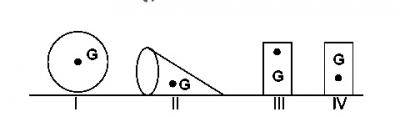
Which of the following bodies, each with centre of gravity G, lying on a horizontal table, is/are in unstable equilibrium?
Unstable equilibrium occurs when a slight displacement causes the center of gravity (CG) to lower, creating a moment that tips the object further away from its original position. Typically, a cone resting on its apex (pointy end) is the classic example of unstable equilibrium (II). A cone on its side is in neutral equilibrium (III), and one on its base is stable (I).
Not clear enough?
Question 83
The volume of a stone having an irregular shape can be determined using?
Because an irregular stone doesn't have standard dimensions (length, width, radius), we use the displacement method. The stone is submerged in a liquid within a measuring cylinder; the increase in the liquid level (or the volume of water overflow in a Eureka can) equals the volume of the stone.
Not clear enough?
Question 84
In Sunlight, a blue flower looks blue because we see the flower by the light it
The color of an opaque object is determined by the wavelengths of light it reflects. When white sunlight (which contains all colors) hits a blue flower, the pigments in the flower absorb most colors (red, orange, yellow, green, violet) and reflect blue light back to our eyes.
Not clear enough?
Question 85
A body moves in SHM between two point 20m on the straight line Joining the points. If the angular speed of the body is 5 rad/s. Calculate its speed when it is 6m from the center of the motion.
1. Find the amplitude (\( A \)): The distance between the two extreme points is 20m, so the amplitude (distance from center to extreme) is \( A = 10 \; \text{m} \).
2. Identify variables: Angular speed \( \omega = 5 \; \text{rad/s} \) and displacement from center \( x = 6 \; \text{m} \).
3. Use the SHM velocity formula:\[ v = \omega \sqrt{A^2 - x^2} \]\[ v = 5 \sqrt{10^2 - 6^2} = 5 \sqrt{100 - 36} \]\[ v = 5 \sqrt{64} = 5 \times 8 = 40 \; \text{m/s} \]
2. Identify variables: Angular speed \( \omega = 5 \; \text{rad/s} \) and displacement from center \( x = 6 \; \text{m} \).
3. Use the SHM velocity formula:\[ v = \omega \sqrt{A^2 - x^2} \]\[ v = 5 \sqrt{10^2 - 6^2} = 5 \sqrt{100 - 36} \]\[ v = 5 \sqrt{64} = 5 \times 8 = 40 \; \text{m/s} \]
Not clear enough?
Question 86
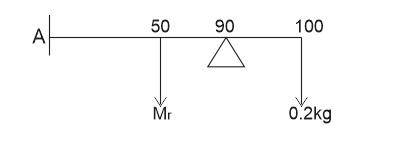
The diagram shows a uniform meter rule AB which balances horizontally at the 90cm mark when a mass of 0.2kg is suspended from B. Calculate the mass of the meter rule.
A uniform meter rule has its center of gravity at the 50cm mark. Using the Principle of Moments about the pivot (90cm mark):
Clockwise Moment = Counter-clockwise Moment\[ (0.2 \; \text{kg}) \times (100 \; \text{cm} - 90 \; \text{cm}) = M \times (90 \; \text{cm} - 50 \; \text{cm}) \]\[ 0.2 \times 10 = M \times 40 \]\[ 2 = 40M \implies M = \frac{2}{40} = 0.05 \; \text{kg} \]
Clockwise Moment = Counter-clockwise Moment\[ (0.2 \; \text{kg}) \times (100 \; \text{cm} - 90 \; \text{cm}) = M \times (90 \; \text{cm} - 50 \; \text{cm}) \]\[ 0.2 \times 10 = M \times 40 \]\[ 2 = 40M \implies M = \frac{2}{40} = 0.05 \; \text{kg} \]
Not clear enough?
Question 87
The equilibrium position of objects in any field corresponds to situation of
In physics, systems naturally evolve toward their state of lowest energy to achieve stability. A state of stable equilibrium corresponds to a position where the potential energy of the object is at a local minimum.
Not clear enough?
Question 88
The height at which the atmosphere ceases to exist is about 80km. If the atmospheric pressure on the ground level is 760mmHg, the pressure at a height of 20km above the ground level is (\( \rho_m = 13.6 \text{g/cm}^3 \), \( \rho_{air} = 0.00013 \text{g/cm}^3 \))
The change in pressure (\( \Delta P \)) for a height change (\( h \)) is \( \Delta P = \rho_{air} g h \). We can convert this change into equivalent height of mercury (\( h_m \)):\[ \rho_m g h_m = \rho_{air} g h \implies h_m = \frac{\rho_{air} \times h}{\rho_m} \]Given \( h = 20 \; \text{km} = 2,000,000 \; \text{cm} \):\[ h_m = \frac{0.00013 \times 2,000,000}{13.6} = \frac{260}{13.6} \approx 19.12 \; \text{cmHg} = 191.2 \; \text{mmHg} \]Pressure at height = Ground Pressure - \( \Delta P \):\[ 760 \; \text{mmHg} - 191.2 \; \text{mmHg} \approx 568.8 \; \text{mmHg} \approx 570 \; \text{mmHg} \]
Not clear enough?
Question 89
A cone is in unstable equilibrium, has its potential energy
When an object in unstable equilibrium is slightly disturbed, its center of gravity moves downward. Since Potential Energy is proportional to height (\( P.E. = mgh \)), a lowering of the center of gravity means the potential energy decreases as it falls away from the equilibrium point.
Not clear enough?
Question 90
A mass of 0.5kg is whirled in a vertical circle of radius 2m at a steady rate of 2 rev/s. Calculate the centripetal force
1. Find angular velocity (\( \omega \)): \( \omega = 2\pi f \). With \( f = 2 \; \text{rev/s} \), \( \omega = 4\pi \; \text{rad/s} \).
2. Calculate centripetal force (\( F_c \)):\[ F_c = m\omega^2r \]\[ F_c = 0.5 \times (4\pi)^2 \times 2 \]\[ F_c = 1 \times 16\pi^2 = 16 \times (3.14159)^2 \approx 16 \times 9.87 = 157.9 \; \text{N} \]Rounding to the nearest whole number gives 158N.
2. Calculate centripetal force (\( F_c \)):\[ F_c = m\omega^2r \]\[ F_c = 0.5 \times (4\pi)^2 \times 2 \]\[ F_c = 1 \times 16\pi^2 = 16 \times (3.14159)^2 \approx 16 \times 9.87 = 157.9 \; \text{N} \]Rounding to the nearest whole number gives 158N.
Not clear enough?
You might like
If Aboki Holdings Limited issued 120, 000 ordinary share of N2.00 each at market value of 5.50k each, the share premium would?
In the system of capitalistic farming, the land and the means of production are typically owned by __________.
Choose the option nearest in meaning to the word or phrase in italics
This event was a watershed in the company