Physics 2023 Jamb Examination

Physics 2023 Jamb Examination

Available Sections
2. Career
4. Job
1...4567

Question 51

What is the name of the model of the atom that describes electrons as orbiting the nucleus in specific energy levels?
Show explanation Expand Question
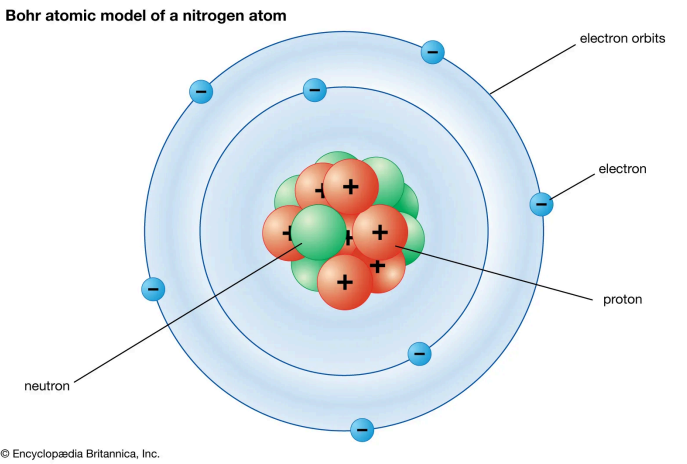
The Bohr model, proposed by Niels Bohr in 1913, was the first to suggest that electrons move in fixed, circular orbits (shells) around the nucleus, each with a specific energy level.
Image of the Bohr model of the atom
Unlike the Rutherford model, which suggested electrons could be anywhere outside the nucleus, the Bohr model quantised the orbits, meaning electrons can only exist in these specific levels and must gain or lose energy to move between them.
Not clear enough?

Question 52

The electrolyte used in the Nickel-Iron (NiFe) accumulator is
Show explanation Expand Question
The Nickel-Iron (NiFe) accumulator, also known as the Edison battery, is an alkaline storage battery. It uses potassium hydroxide (KOH) solution as the electrolyte. Unlike lead-acid batteries that use sulphuric acid, the NiFe battery is very robust and can withstand overcharging or being left discharged for long periods without significant damage.
Not clear enough?

Question 53

Which of the following materials is a good insulator?
Show explanation Expand Question
Insulators are materials that do not allow electric current to flow through them easily because their electrons are tightly bound to their atoms. Rubber is a classic example of an insulator used to coat electrical wires for safety. Silver and copper are excellent conductors, while water (unless exceptionally pure) usually contains ions that allow it to conduct electricity.
Not clear enough?

Question 54

Which of the following is an example of a couple?
Show explanation Expand Question
In physics, a couple consists of two parallel forces that are equal in magnitude, opposite in direction, and do not share the same line of action. A couple produces a turning effect or torque without translation. Turning a steering wheel with both hands, using a cross-wrench for lug nuts, and twisting a screwdriver all involve applying two equal and opposite forces to create rotation, making all the listed options valid examples.
Not clear enough?

Question 55

A positively charged particle is placed near a negatively charged particle. What is the direction of the electric force between the two particles?
Show explanation Expand Question
According to the fundamental law of electrostatics, opposite charges attract each other. This means the positively charged particle will experience a force pulling it toward the negative particle, and the negative particle will experience a force pulling it toward the positive particle. Therefore, the force acting on the positive particle is directed toward the negative one.
Not clear enough?

Question 56

When a water droplet is placed on a freshly cut piece of wood, it spreads out to form a thin layer because the wood is
Show explanation Expand Question
This phenomenon is explained by the relationship between adhesion and cohesion. Adhesion is the force of attraction between different types of molecules (water and wood), while cohesion is the attraction between similar molecules (water and water). When water spreads out to 'wet' a surface, it indicates that the adhesive forces between the water and the surface are stronger than the cohesive forces holding the water droplet together.
Not clear enough?

Question 57

Which of the following statements is correct about the angle of dip at various points on Earth?
Show explanation Expand Question
The angle of dip (or magnetic inclination) is the angle that the Earth's magnetic field lines make with the horizontal plane. At the magnetic equator, the magnetic field lines are perfectly horizontal, so the angle of dip is \(0^{\circ}\). At the magnetic poles, the field lines are vertical, pointing straight into or out of the Earth, making the angle of dip \(90^{\circ}\).
Not clear enough?

Question 58

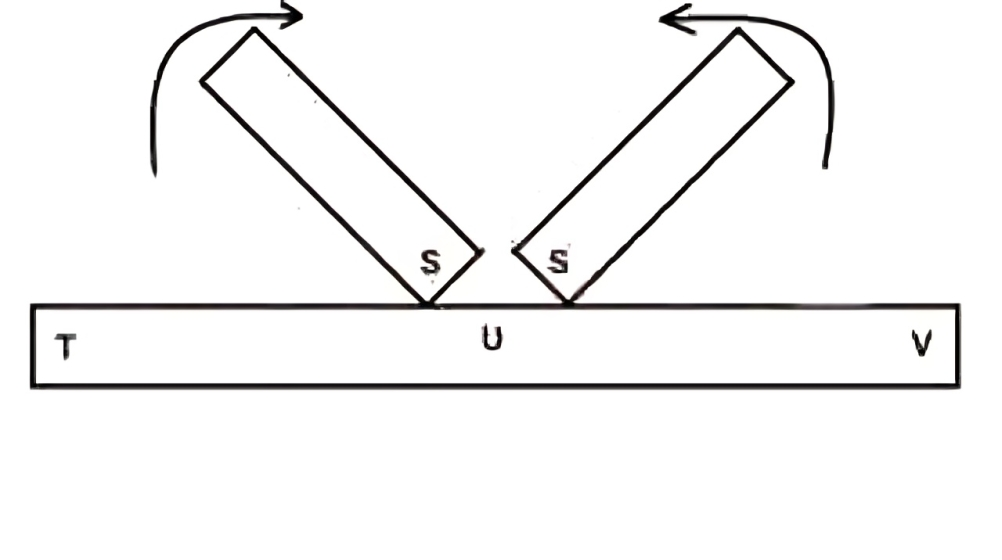
south-poles of two magnets strokes steel bar, the polarities at T and V
In the diagram above, if the south-poles of two magnets stroke steel bar, the polarities at T and V will respectively be
Show explanation Expand Question
In the 'Divided Touch' method of magnetisation, two magnets stroke a steel bar starting from the centre and moving outwards to the ends. The end of the bar where the magnet leaves will always acquire a polarity opposite to the stroking pole. Since the south-poles (S) of both magnets are being used to stroke outwards toward T and V, both ends T and V will acquire the opposite polarity, which is North (N).
Not clear enough?

Question 59

A generator manufacturing company accidentally made an AC generator instead of a DC generator. To fix this error,
Show explanation Expand Question
The primary difference between an AC generator and a DC generator is the method of connecting the rotating armature to the external circuit. [Image comparing slip rings and split rings in generators] An AC generator uses slip rings, which allow the current to alternate. A DC generator uses a split-ring commutator, which reverses the connection to the external circuit every half-turn to ensure the current flows in only one direction. To convert an AC generator to DC, you must replace the slip rings with split rings.
Not clear enough?

Question 60

Which of the following is NOT an example of elementary modern physics?
Show explanation Expand Question
Modern physics refers to concepts developed from the early 20th century onwards, including Quantum mechanics, Special relativity, and Nuclear physics. Classical mechanics (also known as Newtonian mechanics) deals with the motion of macroscopic objects at speeds much slower than the speed of light and was developed primarily by Isaac Newton and his predecessors, making it 'Classical' rather than 'Modern'.
Not clear enough?

1...4567
In this page
Physics 2023 Jamb Examination
Open Model!