
Physics 2023 Jamb Examination
Physics 2023 Jamb Examination

Question 41
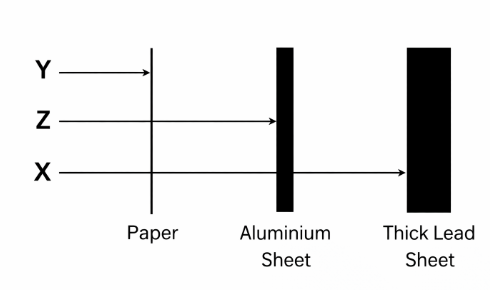
The diagram above illustrates the penetrating power of some types of radiation. X, Y and Z are likely
The penetrating power of radioactive emissions is determined by their mass, charge, and velocity.
1. Alpha particles (X): These are heavy, positively charged helium nuclei. They interact strongly with matter and are easily stopped by a thin sheet of paper or even a few centimetres of air.
2. Beta particles (Y): These are high-speed electrons. They are much smaller and lighter than alpha particles, allowing them to penetrate paper but they are typically stopped by a few millimetres of aluminium.
3. Gamma rays (Z): These are high-energy electromagnetic waves with no mass or charge. They have the highest penetrating power and require several centimetres of lead or thick concrete to be significantly attenuated. This sequence matches the diagram showing X being stopped earliest and Z penetrating the most.
Not clear enough?
Question 42
An explosion occurs at an altitude of 312 m above the ground. If the air temperature is -10.00°C, how long does it take the sound to reach the ground?
[velocity of sound at 0 °C = 331 ms-1]
[velocity of sound at 0 °C = 331 ms-1]
The velocity of sound in air varies with temperature according to the formula:\[v_T = v_0 \sqrt{\frac{T}{273}}\]Where:
\(v_0 = 331\,\text{ms}^{-1}\)
\(T\) is the absolute temperature in Kelvins.
\(T = -10 + 273 = 263\,\text{K}\)
First, calculate the velocity at \(-10\,^{\circ}\text{C}\):\[v_{-10} = 331 \sqrt{\frac{263}{273}} \approx 331 \times \sqrt{0.9634} \approx 331 \times 0.9815 \approx 324.88\,\text{ms}^{-1}\]Now, find the time (\(t\)) taken to travel the distance (\(s = 312\,\text{m}\)):\[t = \frac{s}{v} = \frac{312}{324.88} \approx 0.9603\,\text{s}\]Rounding to two decimal places, we get 0.96s.
Not clear enough?
Question 43
A charge of 4.6×10⁻⁵ C is placed in an electric field of intensity 3.2×10⁴ Vm−1. What is the force acting on the charge?
The relationship between electric field intensity (\(E\)), the charge (\(q\)), and the electric force (\(F\)) experienced by that charge is defined by the formula:\[F = qE\]Given:
\(q = 4.6 \times 10^{-5}\,\text{C}\)
\(E = 3.2 \times 10^4\,\text{Vm}^{-1}\)
Calculating the force:\[F = (4.6 \times 10^{-5}) \times (3.2 \times 10^4)\]\[F = 4.6 \times 3.2 \times 10^{-5+4}\]\[F = 14.72 \times 10^{-1} = 1.472\,\text{N}\]The value is approximately 1.5 N.
\(q = 4.6 \times 10^{-5}\,\text{C}\)
\(E = 3.2 \times 10^4\,\text{Vm}^{-1}\)
Calculating the force:\[F = (4.6 \times 10^{-5}) \times (3.2 \times 10^4)\]\[F = 4.6 \times 3.2 \times 10^{-5+4}\]\[F = 14.72 \times 10^{-1} = 1.472\,\text{N}\]The value is approximately 1.5 N.
Not clear enough?
Question 44
The branch of physics that deals with the motion of objects and the forces acting on them is called:
Mechanics is the area of physics concerned with the relationships between force, matter, and motion among physical objects. It is generally divided into kinematics (describing motion without considering forces) and dynamics (dealing with the effects of forces on motion). Thermodynamics deals with heat and energy, electromagnetism with electric and magnetic fields, and quantum mechanics with subatomic particles.
Not clear enough?
Question 45
The working of the beam balance is based on the principle of
A beam balance consists of a horizontal lever with a central pivot (fulcrum) and two pans of equal mass suspended at equal distances from the pivot. It operates on the principle of moments, which states that for a body to be in equilibrium, the sum of clockwise moments about the pivot must equal the sum of anticlockwise moments. When equal masses are placed in the pans, they exert equal downward forces at equal distances, keeping the beam horizontal.
Not clear enough?
Question 46
Which of the following is a type of incandescent light source?
Incandescence is the emission of light caused by heating a solid substance to a high temperature. In a tungsten filament lamp, an electric current passes through the thin wire filament, heating it until it glows brightly. In contrast, fluorescent and neon lamps rely on gas discharge and luminescence, while LEDs (Light Emitting Diodes) rely on electroluminescence in a semiconductor, neither of which involves the heating of a filament to glow.
Not clear enough?
Question 47
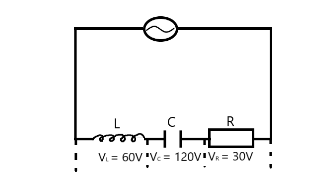
From the diagram above, if the potential differences across the resistor, capacitor, and inductor are 30V, 120V, and 60V, respectively, the effective potential difference is
In an AC series RLC circuit, the potential differences across the components are not simply added algebraically because they are out of phase with each other.
The voltage across the inductor (\(V_L\)) leads the current by 90°, while the voltage across the capacitor (\(V_C\)) lags the current by 90°. The voltage across the resistor (\(V_R\)) is in phase with the current. The effective (resultant) potential difference (\(V\)) is calculated using the vector sum (phasor sum):\[V = \sqrt{V_R^2 + (V_C - V_L)^2}\]Given:
\(V_R = 30\,\text{V}\)
\(V_C = 120\,\text{V}\)
\(V_L = 60\,\text{V}\)
\[V = \sqrt{30^2 + (120 - 60)^2}\]\[V = \sqrt{30^2 + 60^2}\]\[V = \sqrt{900 + 3600}\]\[V = \sqrt{4500} \approx 67.08\,\text{V}\]
Not clear enough?
Question 48
When light of a certain frequency is incident on a metal surface, no photoelectrons are emitted. If the frequency of the light is increased, what happens to the stopping potential?
According to Einstein's photoelectric equation, the maximum kinetic energy of an emitted photoelectron (\(K.E._{max}\)) is given by:\[h f = W_0 + K.E._{max}\]Where \(h f\) is the energy of the incident photon and \(W_0\) is the work function of the metal. The stopping potential (\(V_s\)) is directly related to the maximum kinetic energy by \(K.E._{max} = eV_s\).
Therefore:\[V_s = \frac{hf - W_0}{e}\]As the frequency (\(f\)) of the incident light increases (assuming it surpasses the threshold frequency), the energy of the photons increases, leading to a higher maximum kinetic energy for the photoelectrons. Consequently, a higher (more negative) stopping potential is required to halt them.
Therefore:\[V_s = \frac{hf - W_0}{e}\]As the frequency (\(f\)) of the incident light increases (assuming it surpasses the threshold frequency), the energy of the photons increases, leading to a higher maximum kinetic energy for the photoelectrons. Consequently, a higher (more negative) stopping potential is required to halt them.
Not clear enough?
Question 49
Which of the following is NOT a limitation of experimental measurements?
Experimental measurements are always subject to uncertainties. Systematic errors (like poorly calibrated equipment) and random errors (unpredictable fluctuations) are inherent limitations in any experiment. Instrument resolution (the smallest change an instrument can detect) also defines a boundary for how precise a measurement can be. While human error can certainly occur, it is generally considered a mistake rather than a fundamental limitation of the scientific measurement process itself, as it can be theoretically eliminated through better training or automation, unlike the other three factors.
Not clear enough?
Question 50
Which of the following liquids has the highest surface tension?
Surface tension is caused by cohesive forces between molecules at the surface of a liquid. Mercury has exceptionally strong metallic bonding between its atoms, which results in a very high surface tension compared to most other liquids. Water has high surface tension due to hydrogen bonding, but it is much lower than that of mercury. Soap is a surfactant that specifically acts to reduce the surface tension of water, and oils typically have lower intermolecular attractions than water.
Not clear enough?
You might like
This question is based on Literary Appreciation
'Be him English Be him African Be him Nigerian'
The lines above are an example of
Select the option that best explains the information conveyed in the sentence.
The investigators stated clearly that they had reached a dead end in their scrutiny of suspects in the murder case.
The process by which citizens get involved in the political activities and decision-making of their country is