Physics 2024 Jamb Examination

Physics 2024 Jamb Examination

Available Sections
2. Career
4. Job
1...10111213

Question 111

A boy standing 408m from a wall blew a trumpet and heard the echo 2.4s later. Calculate the speed of the sound
Show explanation Expand Question
An echo is formed when sound waves travel to a reflecting surface and return to the source. Because the sound must travel to the wall and back, the total distance covered by the sound wave is twice the distance between the observer and the wall. The relationship for speed in an echo scenario is: \[ v = \frac{2d}{t} \] Where: \(v\) is the speed of sound.
\(d\) is the distance to the wall (408 m).
\(t\) is the total time taken for the echo to return (2.4 s).
Substituting the values into the formula: \[ v = \frac{2 \times 408}{2.4} \] \[ v = \frac{816}{2.4} \] \[ v = 340 \text{ m/s} \] This calculation assumes that the air temperature and wind conditions are uniform along the path of the sound wave.
Not clear enough?

Question 112

A red shirt under a red light appears pale because red
Show explanation Expand Question
The color of an object is determined by the wavelengths of light it reflects. A red shirt appears red because it absorbs all other colors of white light and reflects red. When placed under pure red light, there is only red light available to be reflected. Since the shirt is highly efficient at reflecting red, it reflects almost all the incident light, appearing very bright or 'pale' (washed out) because no other colors are being absorbed to provide contrast.
Not clear enough?

Question 113

An electron falls from an energy level of -5.44eV to another energy level, E. If the emitted photon is of wavelength 5.68 x 10\(^{-6}\)m, calculate the energy change. [ Plank's constant = 6.63 x 10\(^{-34}\)Js, emitted radiation speed = 3.0 x 10\(^8\)ms\(^{-1}\) ]
Show explanation Expand Question
The energy of the emitted photon (which represents the energy change \( \Delta E \)) is given by: \[ E = \frac{hc}{\lambda} \] Given: \( h = 6.63 \times 10^{-34} \, Js \) \( c = 3.0 \times 10^8 \, ms^{-1} \) \( \lambda = 5.68 \times 10^{-6} \, m \) \[ \Delta E = \frac{6.63 \times 10^{-34} \times 3.0 \times 10^8}{5.68 \times 10^{-6}} \] \[ \Delta E = \frac{19.89 \times 10^{-26}}{5.68 \times 10^{-6}} \] \[ \Delta E = 3.501 \times 10^{-20} \, J \] Matching the closest option, we get 3.49 x 10\(^{-20}\)J.
Not clear enough?

Question 114

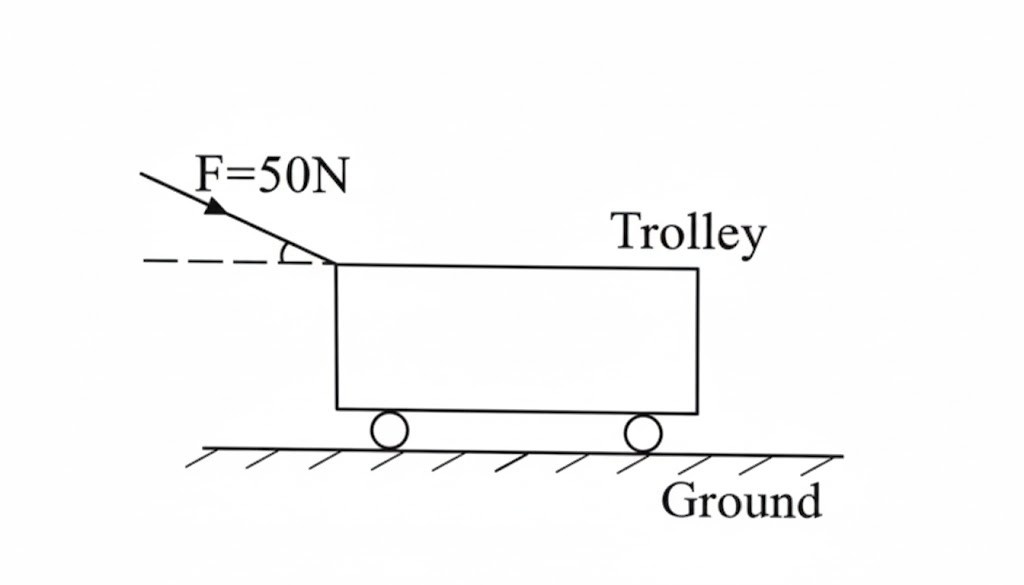
Using the diagram above, the effective force pushing it forward at an angle 60º is
Show explanation Expand Question
The 'forward' or horizontal component of a force (\( F \)) applied at an angle (\( \theta \)) is given by: \[ F_x = F \cos \theta \] Assuming the applied force \( F \) in the diagram is 50N (a common value in this JAMB diagram set): \[ F_x = 50 \times \cos 60^\circ \] \[ F_x = 50 \times 0.5 = 25.00\,N \]
Not clear enough?

Question 115

The gravitational force between two objects is 10N, what is the new value of the force if the distance between them is halved?
Show explanation Expand Question
Newton's Law of Universal Gravitation states that the force (\( F \)) is inversely proportional to the square of the distance (\( r \)): \[ F \propto \frac{1}{r^2} \] If the distance is halved (\( r_{new} = r/2 \)): \[ F_{new} \propto \frac{1}{(r/2)^2} = \frac{1}{r^2/4} = 4 \times \frac{1}{r^2} \] Thus, the new force is 4 times the original force: \[ F_{new} = 4 \times 10\,N = 40\,N \]
Not clear enough?

Question 116

An ideal transformer has
Show explanation Expand Question
An ideal transformer is a theoretical model that assumes 100% efficiency. This means it has: 1. No resistance in the coils (no \( I^2R \) loss). 2. No flux leakage (all magnetic flux produced by the primary coil passes through the secondary). 3. No hysteresis loss or eddy current loss in the core.
Not clear enough?

Question 117

Calculate the depth of a swimming pool if the apparent depth is 10cm. ( Refractive index of water = 1.33 )
Show explanation Expand Question
Refractive index (\( n \)) can be calculated using real depth and apparent depth: \[ n = \frac{\text{Real Depth}}{\text{Apparent Depth}} \] Given: \( n = 1.33 \) \( \text{Apparent Depth} = 10\,cm \) \[ \text{Real Depth} = n \times \text{Apparent Depth} = 1.33 \times 10 = 13.3\,cm \]
Not clear enough?

Question 118

Calculate the quantity of heat for copper rod whose thermal capacity is 400Jk\(^{-1}\) for a temperature change of 60ºC to 80ºC
Show explanation Expand Question
The quantity of heat (\(Q\)) absorbed or released by a body is directly proportional to its thermal capacity (\(C\)) and the resulting change in temperature (\(\Delta T\)). Thermal capacity is defined as the amount of heat energy required to raise the temperature of the entire body by one Kelvin (or one degree Celsius).
The relationship is expressed by the formula: \[ Q = C \Delta T \] Given the parameters in the problem: Thermal capacity (\(C\)) = 400 J K\(^{-1}\)
Initial temperature (\(T_1\)) = 60\(^\circ\)C
Final temperature (\(T_2\)) = 80\(^\circ\)C
First, calculate the change in temperature: \[ \Delta T = T_2 - T_1 = 80 - 60 = 20\, \text{K} \] Now, substitute the values into the heat equation: \[ Q = 400 \times 20 \] \[ Q = 8000\, \text{J} \] Since the options are provided in kilojoules (kJ), we convert the result by dividing by 1000: \[ Q = \frac{8000}{1000} = 8\, \text{kJ} \] This represents the total thermal energy required to increase the temperature of the copper rod through the specified range.
Not clear enough?

Question 119

The thermometer whose thermometric property is change in volume with temperature is
Show explanation Expand Question
A thermometric property is a physical property that changes measurably and continuously with temperature. In a liquid-in-glass thermometer, such as a mercury or alcohol thermometer, the liquid is contained in a bulb connected to a narrow capillary tube. As the temperature rises, the liquid expands, and its volume increases. Because the glass expansion is negligible compared to the liquid, this increase in volume forces the liquid further up the tube. The height of the liquid column is directly proportional to its volume, making the change in volume the primary property used to measure temperature. Other thermometers use different properties: resistance thermometers use electrical resistance, thermocouples use electromotive force (e.m.f.), and bimetallic thermometers use the differential linear expansion of two fused metals.
Not clear enough?

Question 120

In a series resonant circuit, the current flowing in the circuit is
Show explanation Expand Question
Resonance in a series RLC circuit occurs when the inductive reactance \(X_L\) and the capacitive reactance \(X_C\) are equal in magnitude but opposite in phase. This leads to their effects cancelling each other out completely. The total impedance \(Z\) of the circuit is given by: \[ Z = \sqrt{R^2 + (X_L - X_C)^2} \] At resonance, since \(X_L = X_C\), the formula simplifies to \(Z = R\). This represents the minimum possible impedance the circuit can have. According to Ohm's Law for AC circuits, \(I = V/Z\); when the impedance is at its minimum, the current flowing through the circuit reaches its maximum value. This principle is widely used in radio tuning to select specific frequencies.
Not clear enough?

1...10111213
In this page
Physics 2024 Jamb Examination
Open Model!