
Physics 2024 Jamb Examination
Physics 2024 Jamb Examination

Question 101
The velocity ratio of an inclined plane at 60º to the horizontal is
The velocity ratio (V.R.) of an inclined plane is defined as the ratio of the distance moved by the effort to the distance moved by the load. For an inclined plane at an angle \(\theta\) to the horizontal, this is given by:
\[
V.R. = \frac{1}{\sin \theta}
\]
Given \(\theta = 60^\circ\):
\[
V.R. = \frac{1}{\sin 60^\circ} = \frac{1}{0.8660} \approx 1.1547
\]
Rounding to three decimal places gives 1.155.
Not clear enough?
Question 102
The bursting of water pipes during very cold weather, when the water in the pipes form ice could be attributed to
Most substances contract when they cool and freeze, but water exhibits 'anomalous expansion'. When water cools from \(4^\circ C\) down to \(0^\circ C\), it actually expands and becomes less dense. Upon freezing at \(0^\circ C\), the crystalline structure of ice takes up more volume than the liquid water. If this water is trapped inside a rigid pipe, the pressure exerted by the expanding ice exceeds the structural strength of the pipe, causing it to burst.
Not clear enough?
Question 103
One of these is not the use of an electroscope
A gold-leaf electroscope is an instrument used primarily for detecting and identifying electrostatic charges. It can determine if a body is charged, identify the nature of the charge (positive or negative) by induction, and test the insulating properties of materials. However, an electroscope is a passive detection device; it does not 'produce' or generate an electric charge itself. Charging a body is typically done through friction, conduction, or induction using other sources.
Not clear enough?
Question 104
As per Faraday's laws of electromagnetic induction, an e.m.f is induced in a conductor whenever
Faraday's First Law of Electromagnetic Induction states that an electromotive force (e.m.f.) is induced in a circuit whenever there is a change in the magnetic flux linked with that circuit.
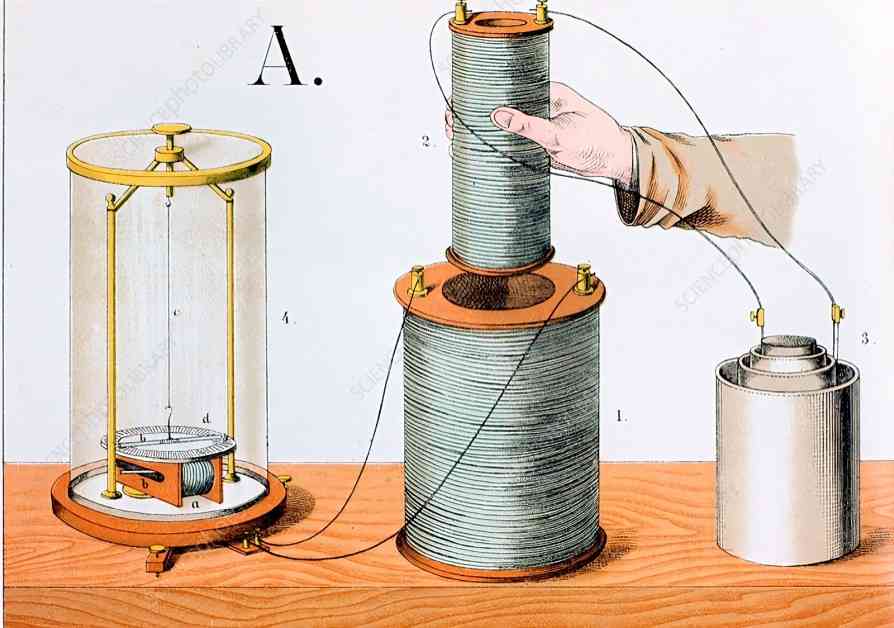
For a conductor moving within a magnetic field, this occurs when the conductor 'cuts' across the magnetic flux lines. If the conductor stays stationary in a uniform field or lies parallel to the lines (where it doesn't cross them), no change in flux occurs, and therefore no e.m.f. is induced.
For a conductor moving within a magnetic field, this occurs when the conductor 'cuts' across the magnetic flux lines. If the conductor stays stationary in a uniform field or lies parallel to the lines (where it doesn't cross them), no change in flux occurs, and therefore no e.m.f. is induced.
Not clear enough?
Question 105
Photometer is used to measure
A photometer is an instrument used to measure the strength or intensity of electromagnetic radiation in the range from ultraviolet to infrared, most commonly within the visible spectrum. It typically works by comparing the illuminance of a surface from an unknown source with that of a standard source. It is fundamental in fields like photography and astronomy to determine the brightness or luminous flux of light sources.
Not clear enough?
Question 106
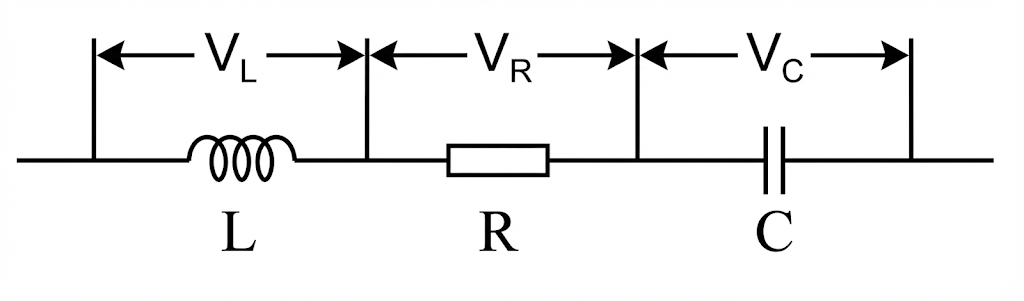
Using the circuit above, at resonance
In an RLC series circuit, electrical resonance occurs when the inductive reactance (\(X_L\)) becomes equal to the capacitive reactance (\(X_C\)). Since the same current (\(I\)) flows through all components in a series circuit, the voltages across the inductor and capacitor are given by \(V_L = I X_L\) and \(V_C = I X_C\). Therefore, at the resonant frequency:
\[
X_L = X_C \implies I X_L = I X_C \implies V_L = V_C
\]
At this point, the two voltages are \(180^\circ\) out of phase and cancel each other out, making the total circuit impedance purely resistive.
Not clear enough?
Question 107

Find the amount of current required to deposit 0.02kg of metal in a given electrolysis for 120 seconds. [electro chemical equivalent of the metal = 1.3 x 10\(^{-7}\)kgC\(^{-1}\)]
To solve this problem, we apply Faraday's first law of electrolysis, which states that the mass of a substance deposited at an electrode is directly proportional to the quantity of electricity passed through the electrolyte.
The mathematical expression for this law is: \[ m = zIt \] Where: \(m\) is the mass of the metal deposited in kilograms (0.02 kg).
\(z\) is the electrochemical equivalent of the metal (\(1.3 \times 10^{-7} \text{ kgC}^{-1}\)).
\(I\) is the current required in Amperes.
\(t\) is the time in seconds (120 s).
Rearranging the formula to solve for current \(I\): \[ I = \frac{m}{zt} \] Substituting the given values: \[ I = \frac{0.02}{1.3 \times 10^{-7} \times 120} \] \[ I = \frac{0.02}{0.0000156} \] \[ I \approx 1282.05 \text{ A} \] Expressing this in scientific notation, we get approximately \(1.3 \times 10^3 \text{ A}\). This indicates that a very high current is necessary to deposit that mass within such a short timeframe given the very small electrochemical equivalent of the metal.
Not clear enough?
Question 108
The acceleration of a free fall due to gravity is not a constant everywhere on the Earth's surface because
The acceleration due to gravity, \(g\), is determined by the distance between the centre of the Earth and the object on its surface, as per Newton's law of universal gravitation. The Earth is not a perfect sphere; it is an oblate spheroid, meaning it is flattened at the poles and bulges at the equator. This elliptical shape means that the distance from the centre of the Earth to the surface (the radius) is shorter at the poles than it is at the equator. Since gravity follows an inverse-square law with distance, the gravitational pull is stronger at the poles (where the distance to the centre is least) and weaker at the equator (where the distance is greatest). This variation in radius is the primary reason why \(g\) varies across different latitudes on the Earth's surface.
Not clear enough?
Question 109
An example of a non-rechargeable cell is
Electrochemical cells are categorised as either primary or secondary cells. A primary cell is one in which the chemical reactions are irreversible; once the active chemicals are exhausted, the cell cannot be recharged and must be discarded. The dry Leclanché cell, commonly used in flashlights and remote controls, is a classic example of a primary cell. In contrast, secondary cells like nickel-iron, mercury-cadmium, and lead-acid batteries involve reversible chemical reactions, allowing them to be recharged by passing an electric current through them in the opposite direction to the discharge current.
Not clear enough?
Question 110
The dimension of power is
Dimensional analysis allows us to express physical quantities in terms of the fundamental dimensions: Mass [M], Length [L], and Time [T].
Power is defined as the rate of doing work or the rate of energy transfer: \[ \text{Power} = \frac{\text{Work}}{\text{Time}} \] Work is defined as Force multiplied by Distance: \[ \text{Work} = \text{Force} \times \text{Distance} = (\text{Mass} \times \text{Acceleration}) \times \text{Distance} \] Breaking this down into fundamental units: \[ \text{Dimensions of Force} = [M] \times [LT^{-2}] = [MLT^{-2}] \] \[ \text{Dimensions of Work} = [MLT^{-2}] \times [L] = [ML^2T^{-2}] \] Finally, the dimensions of power are: \[ \text{Power} = \frac{[ML^2T^{-2}]}{[T]} = [ML^2T^{-3}] \] This corresponds to the units of kilograms square metres per cubic second.
Power is defined as the rate of doing work or the rate of energy transfer: \[ \text{Power} = \frac{\text{Work}}{\text{Time}} \] Work is defined as Force multiplied by Distance: \[ \text{Work} = \text{Force} \times \text{Distance} = (\text{Mass} \times \text{Acceleration}) \times \text{Distance} \] Breaking this down into fundamental units: \[ \text{Dimensions of Force} = [M] \times [LT^{-2}] = [MLT^{-2}] \] \[ \text{Dimensions of Work} = [MLT^{-2}] \times [L] = [ML^2T^{-2}] \] Finally, the dimensions of power are: \[ \text{Power} = \frac{[ML^2T^{-2}]}{[T]} = [ML^2T^{-3}] \] This corresponds to the units of kilograms square metres per cubic second.