
Physics 2024 Jamb Examination
Physics 2024 Jamb Examination

Question 81
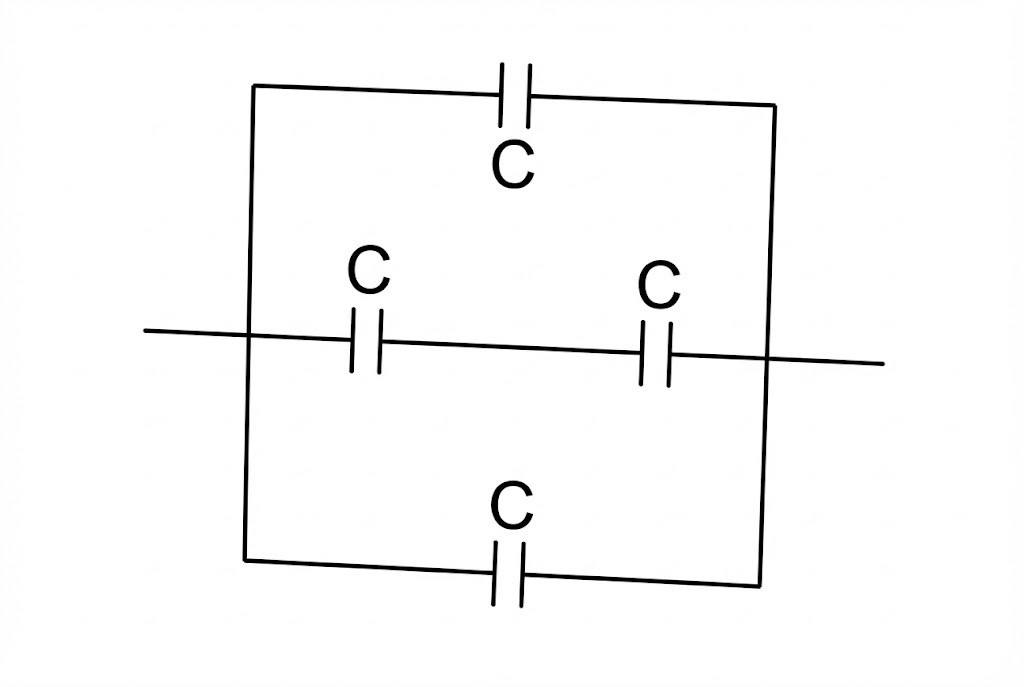
The equivalent capacitance of the capacitors in the circuit above
In capacitor circuits, the rules for combining values are the opposite of resistors. For capacitors in parallel, the capacitances are added directly: \(C_p = C_1 + C_2 + ...\). For capacitors in series, the reciprocal of the total capacitance is the sum of the reciprocals: \(\frac{1}{C_s} = \frac{1}{C_1} + \frac{1}{C_2} + ...\). In the provided diagram, two capacitors of value \(C\) are in series, and this combination is in parallel with another capacitor \(C\).
1. Series branch: \(\frac{1}{C_{series}} = \frac{1}{C} + \frac{1}{C} = \frac{2}{C} \Rightarrow C_{series} = \frac{C}{2}\).
2. Total parallel combination: \(C_{total} = C_{series} + C + C = \frac{C}{2} + 2C = \frac{5}{2}C\).
1. Series branch: \(\frac{1}{C_{series}} = \frac{1}{C} + \frac{1}{C} = \frac{2}{C} \Rightarrow C_{series} = \frac{C}{2}\).
2. Total parallel combination: \(C_{total} = C_{series} + C + C = \frac{C}{2} + 2C = \frac{5}{2}C\).
Not clear enough?
Question 82
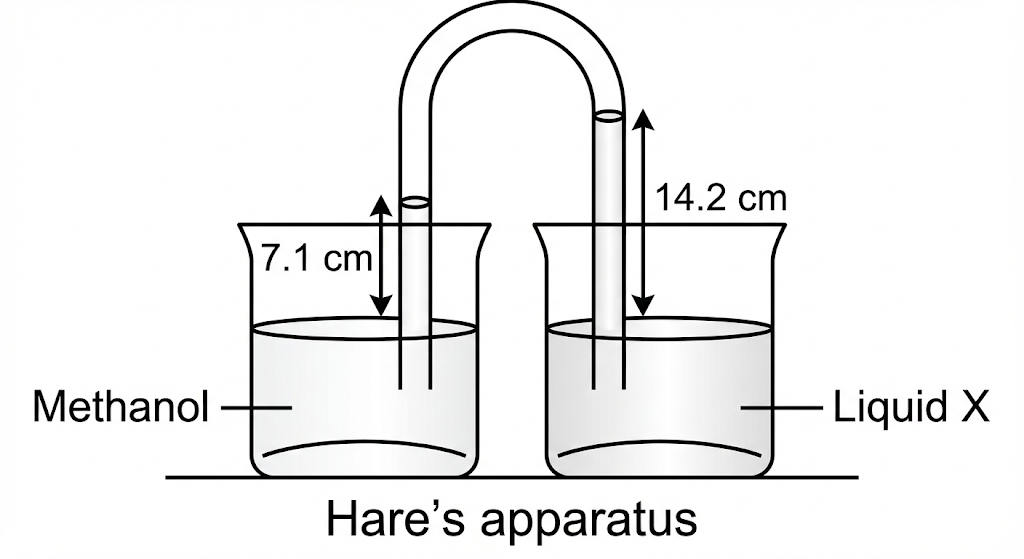
Using the diagram above, calculate the relative density of x, if the density of methanol is 800kgm\(^{-3}\)
Density of methanol = $800\,\text{kgm}^{-3} \rightarrow 0.8\,\text{gcm}^{-3}$
At equilibrium, the pressure of the methanol column equals the pressure of liquid $x$:\[ \rho_m \times h_m \times g = \rho_x \times h_x \times g \] Substituting the given values:\[ 0.8 \times 7.1 = \rho_x \times 14.2 \]\[ \rho_x = \frac{0.8 \times 7.1}{14.2} \]\[ \rho_x = 0.4\,\text{gcm}^{-3} \] $\therefore$ The density of liquid $x$ is $0.4\,\text{gcm}^{-3}$.
Relative density of $X$ (relative to methanol):\[ \text{Relative density} = \frac{\text{density of liquid } x}{\text{density of methanol}} \]\[ \text{Relative density} = \frac{0.4}{0.8} = 0.5 \]
Not clear enough?
Question 83
The force of attraction between molecules of the same substance is
Intermolecular forces are categorised into two main types: cohesion and adhesion. Cohesion is the force of attraction between molecules of the same kind (e.g., water molecule to water molecule). This force is responsible for phenomena like the surface tension of liquids and the formation of droplets. Adhesion, on the other hand, is the attraction between molecules of different substances (e.g., water to glass). Capillarity is a result of both these forces, and surface tension is a specific property caused by cohesive forces at the surface of a liquid.
Not clear enough?
Question 84
If the pressure on an enclosed gas is doubled and its temperature rises from 27ºC to 127ºC, then its volume will
We use the General Gas Law: \(\frac{P_1V_1}{T_1} = \frac{P_2V_2}{T_2}\). Temperatures must be in Kelvin (K).
Initial conditions:
\(P_1 = P\)
\(T_1 = 27 + 273 = 300\, \text{K}\)
\(V_1 = V\)
Final conditions:
\(P_2 = 2P\) (pressure is doubled)
\(T_2 = 127 + 273 = 400\, \text{K}\)
\[ \frac{PV}{300} = \frac{2P \times V_2}{400} \]
\[ \frac{V}{300} = \frac{2V_2}{400} \Rightarrow \frac{V}{3} = \frac{2V_2}{4} \Rightarrow \frac{V}{3} = \frac{V_2}{2} \]
\[ V_2 = \frac{2}{3}V \]
The change in volume is \(\Delta V = V_2 - V_1 = \frac{2}{3}V - V = -\frac{1}{3}V\).
The negative sign indicates a decrease. Therefore, the volume decreases by \(\frac{1}{3}\)rd of its original value.
Not clear enough?
Question 85
The simple form of the lead acid accumulator often has a negative pole of
A lead-acid accumulator consists of several cells connected together. Each cell contains plates of lead and lead dioxide immersed in an electrolyte of dilute sulphuric acid. In the discharged state, both plates become lead sulphate. However, in its standard charged form:
1. The positive electrode (anode during discharge) is made of Lead Dioxide (\(PbO_2\)).
2. The negative electrode (cathode during discharge) is made of spongy Lead (\(Pb\)) or a simple lead plate.
Zinc peroxide is not used in lead-acid batteries, and sulphuric acid is the electrolyte, not the electrode material.
Not clear enough?
Question 86
A monochromatic light is one that
The term 'monochromatic' is derived from the Greek words 'mono' (meaning single) and 'chroma' (meaning colour). In physics, light of a single colour is light that consists of only one specific wavelength or frequency. White light, for example, is polychromatic because it consists of a spectrum of many wavelengths (colours). When monochromatic light passes through a prism, it is refracted but cannot be dispersed into other colours because it only contains one wavelength. Therefore, having a single wavelength is the defining characteristic.
Not clear enough?
Question 87
Bifocal lens is used to correct the eye defect of
Presbyopia is an age-related condition where the eye's lens loses its flexibility and the ciliary muscles weaken, making it difficult to focus on both near and distant objects. To correct this, a bifocal lens is used; the upper portion of the lens is typically designed for distance vision, while the lower portion helps with near vision tasks like reading. This allows a person with presbyopia to see clearly at different distances without switching between multiple pairs of glasses.
Not clear enough?
Question 88
A force of 10N extends a spring of natural length 1m by 0.02m, calculate the length of the spring when the applied force is 40N.
According to Hooke's Law, the extension (\(e\)) of an elastic material is directly proportional to the applied force (\(F\)), provided the elastic limit is not exceeded.
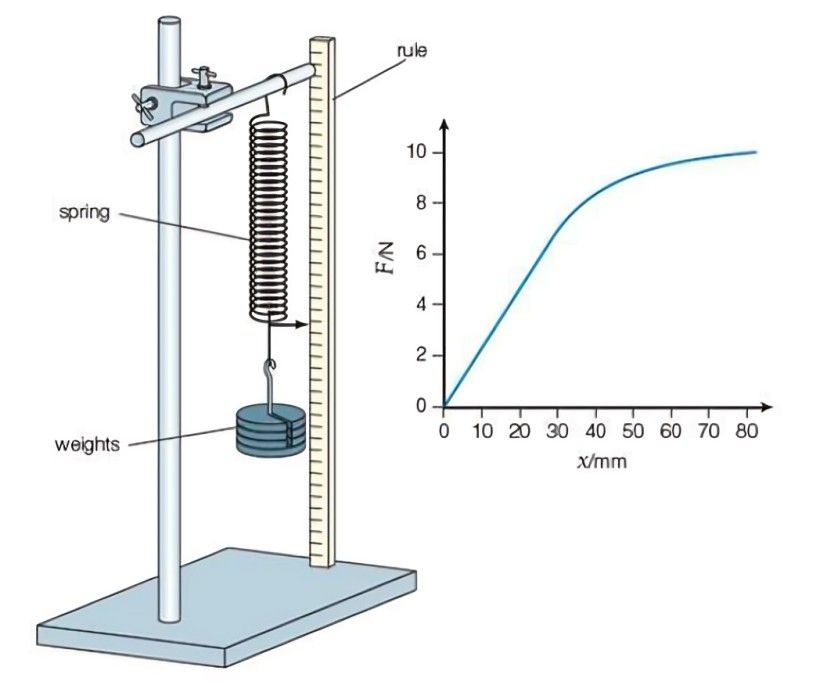
The relationship is given by: \[ F = ke \] First, calculate the force constant (\(k\)): \[ k = \frac{F_1}{e_1} = \frac{10}{0.02} = 500 \, \text{N/m} \] Now, find the new extension (\(e_2\)) for a force of 40N: \[ e_2 = \frac{F_2}{k} = \frac{40}{500} = 0.08 \, \text{m} \] The new length of the spring is the sum of the natural length and the new extension: \[ \text{New Length} = \text{Natural Length} + e_2 \] \[ \text{New Length} = 1 + 0.08 = 1.08 \, \text{m} \]
The relationship is given by: \[ F = ke \] First, calculate the force constant (\(k\)): \[ k = \frac{F_1}{e_1} = \frac{10}{0.02} = 500 \, \text{N/m} \] Now, find the new extension (\(e_2\)) for a force of 40N: \[ e_2 = \frac{F_2}{k} = \frac{40}{500} = 0.08 \, \text{m} \] The new length of the spring is the sum of the natural length and the new extension: \[ \text{New Length} = \text{Natural Length} + e_2 \] \[ \text{New Length} = 1 + 0.08 = 1.08 \, \text{m} \]
Not clear enough?
Question 89
Infra-red thermometers work by detecting the
Every object with a temperature above absolute zero emits electromagnetic radiation in the form of infra-red rays. An infra-red thermometer uses a lens to focus the infra-red light emitted from an object onto a detector called a thermopile. The thermopile absorbs the infra-red radiation and turns it into heat, which is then converted into an electrical signal. This signal is processed to determine the temperature of the object without requiring physical contact, which differentiates it from conduction-based thermometers.
Not clear enough?
Question 90
The efficiency of a cell with internal resistance of 2\(\Omega\) supply current to a 6\(\Omega\) resistor is
The efficiency (\(\eta\)) of a cell or battery circuit is the ratio of the useful power delivered to the external load to the total power produced by the cell.
Efficiency can be calculated using the formula: \[ \eta = \frac{R}{R + r} \times 100\% \] Where: \(R = \text{External resistance} = 6\Omega\) \(r = \text{Internal resistance} = 2\Omega\) \[ \eta = \frac{6}{6 + 2} \times 100\% \] \[ \eta = \frac{6}{8} \times 100\% = 0.75 \times 100\% = 75\% \] This means 75% of the electrical energy is used by the external resistor, while the remaining 25% is lost as heat within the cell itself due to internal resistance.
Efficiency can be calculated using the formula: \[ \eta = \frac{R}{R + r} \times 100\% \] Where: \(R = \text{External resistance} = 6\Omega\) \(r = \text{Internal resistance} = 2\Omega\) \[ \eta = \frac{6}{6 + 2} \times 100\% \] \[ \eta = \frac{6}{8} \times 100\% = 0.75 \times 100\% = 75\% \] This means 75% of the electrical energy is used by the external resistor, while the remaining 25% is lost as heat within the cell itself due to internal resistance.
Not clear enough?
You might like
The Nigerian National Anthem 'Nigeria, we hail thee...' was replaced by a new anthem 'Arise, O compatriots' on ________.
Which of the following in the Sokoto Caliphate performed functions similar to that of the Bashorun in Oyo Kingdom
A man who is heterozygous for the disease haemophilia marries a woman who is double recessive for haemophilia. What percentage of their offspring would have the disease?
When the angular measurements of a traverse are more precise than the linear measurements, the balancing of a traverse is done by ?
