
Physics 2025 Jamb Examination
Physics 2025 Jamb Examination

Question 51
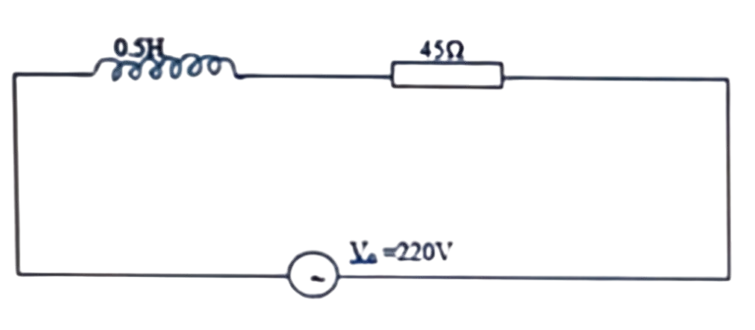
From the above circuit, calculate the impedance (\(\pi = \frac{22}{7}\), f = 50Hz)
Given:
L = 0.5H, R = 45\(\Omega\), f = 50Hz\[
X_L = 2\pi f L = 2 \times \frac{22}{7} \times 50 \times 0.5 = \frac{1100}{7} \approx 157.14\Omega \] Impedance (Z):\[
Z = \sqrt{R^2 + X_L^2} \] \[
Z = \sqrt{(45)^2 + (157.14)^2} \] \[
Z = \sqrt{2025 + 24692.98} \approx \sqrt{26717.98} \] \[
Z \approx 163.46\Omega \]
Not clear enough?
Question 52
What pressure would a 5000N weight of water exert at the bottom of a reservoir containing it if its length and breadth are 10m and 5m, respectively
Pressure is defined as Force divided by Area. The weight of the water acts as the force (F = 5000 N). The area (A) is the base of the reservoir: \[A = \text{length} \times \text{breadth} = 10 \times 5 = 50\, \text{m}^2\] \[P = \frac{F}{A} = \frac{5000}{50} = 100\, \text{Pa}\]
Not clear enough?
Question 53
Standing waves are produced by
A standing wave (or stationary wave) is formed when two waves of the same frequency and amplitude travel in opposite directions and interfere. This typically happens when a wave is reflected back from a boundary and meets the incident wave. The result is a pattern of stationary nodes (zero amplitude) and antinodes (maximum amplitude).
Not clear enough?
Question 54
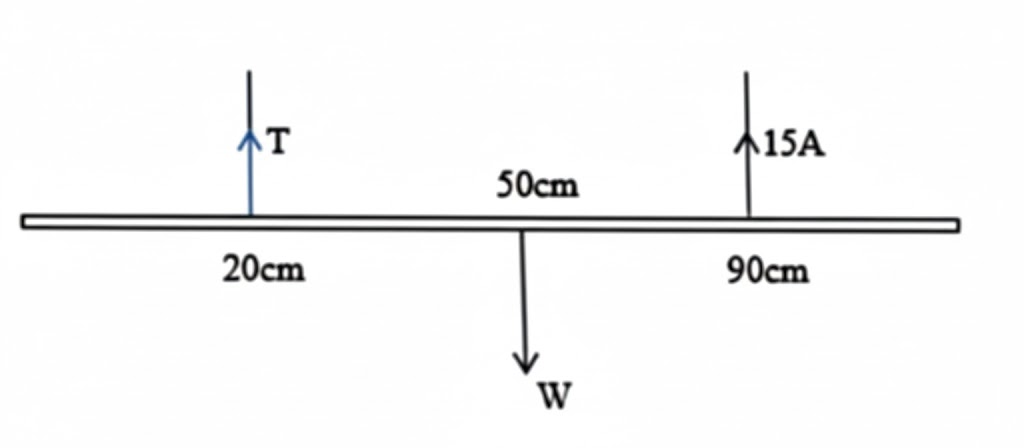
From the above figure, a uniform meter rule is suspended by two cords from a height. Calculate T?
T x 80 + 15 x 10 = W x 50
80T + 150 = 50W - - -- - - - - -(1)
T + 15 = W - - - - - - - - - - - (2)
80T + 150 = 50(T + 15)
80T + 150 = 50T + 750
30T = 750 - 150
30T = 600
T = 20N
The closest option is 19.2N
Not clear enough?
Question 55
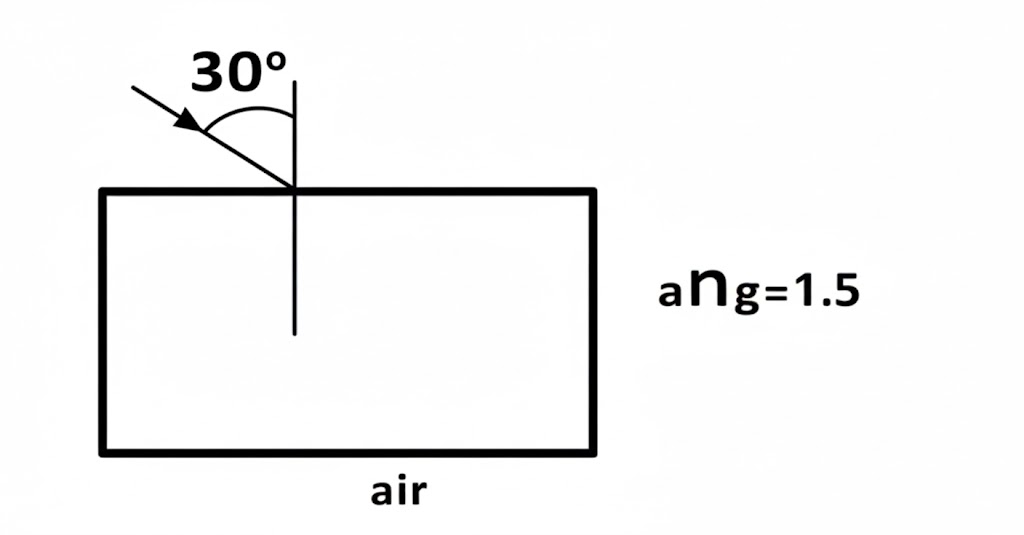
From the diagram above, the sine of the angle of refraction in glass is
The refractive index from air to glass is given by Snell's law:\[ {}^a\eta_g = \frac{\sin i}{\sin r} \] To find the angle of refraction:\[ \sin r = \frac{\sin i}{{}^a\eta_g} \] Substituting the given values:\[ \sin r = \frac{0.5}{1.5} \]\[ \sin r = 0.3333... \]\[ \sin r \approx 0.3 \]
Not clear enough?
Question 56
What happens to the speed of sound in air when the pressure increases at a constant temperature
The speed of sound in an ideal gas is given by the formula \(v = \sqrt{\frac{\gamma P}{\rho}}\). According to Boyle's Law, at a constant temperature, if the pressure (P) increases, the density (\(\rho\)) increases proportionally. Because the ratio \(P/\rho\) remains constant at a fixed temperature, the speed of sound remains unchanged by variations in pressure.
Not clear enough?
Question 57
The operation of a photovoltaic cell is possible by the action of
A photovoltaic cell (solar cell) is made from semiconductor materials, typically silicon. When photons of light hit the semiconductor, they knock electrons loose from their atoms. If the semiconductor is structured with a p-n junction, these electrons flow through the material to produce an electric current.
Not clear enough?
Question 58
A concave mirror of focal length 20cm produces an erect image that is four times the object, the object distance from the mirror is
For a concave mirror to produce an erect image, the image must be virtual. This only occurs when the object is placed between the focal point (F) and the pole (P). Since the focal length is 20 cm, the object distance must be less than 20 cm.
Not clear enough?
Question 59
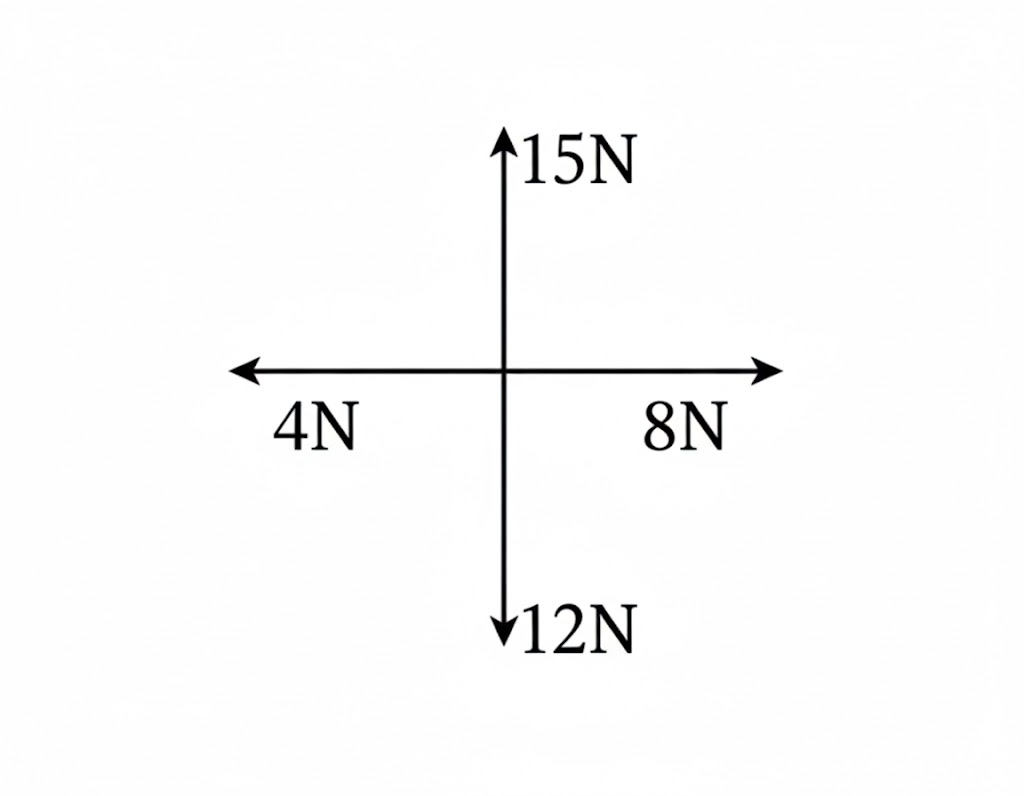
The resultant of the force shown above is
To find the resultant, we resolve forces into horizontal and vertical components.
Net horizontal (\(F_x\)) = \(8\, \text{N} - 4\, \text{N} = 4\, \text{N}\).
Net vertical (\(F_y\)) = \(15\, \text{N} - 12\, \text{N} = 3\, \text{N}\).
Using Pythagoras: \(R = \sqrt{F_x^2 + F_y^2} = \sqrt{4^2 + 3^2} = \sqrt{25} = 5\, \text{N}\).
Not clear enough?
Question 60
A circular parallel plate capacitor with radius 6cm is separated by 0.12cm. Calculate the capacitance of the capacitor [\(\pi\) = 3.142, \(\epsilon_0\) = 8.85 x 10\(^{-12}\) Nm\(^2\)C\(^2\)]
The capacitance is \(C = \frac{\epsilon_0 A}{d}\).
First, calculate the area \(A = \pi r^2 = 3.142 \times (0.06)^2 \approx 0.01131 \, \text{m}^2\).
The separation \(d = 0.0012 \, \text{m}\).
\[ C = \frac{8.85 \times 10^{-12} \times 0.01131}{0.0012} \approx 8.34 \times 10^{-11} \, \text{F} \]