
Physics 2025 Jamb Examination
Physics 2025 Jamb Examination

Question 61
Calculate the specific heat capacity of a metal rod of mass 0.025kg whose temperature was raised by 15ºC when 1000J of heat energy was added to the rod
Using the formula \(Q = mc\Delta\theta\):
\[ c = \frac{Q}{m\Delta\theta} \]
\[ c = \frac{1000}{0.025 \times 15} \]
\[ c = \frac{1000}{0.375} = 2666.67 \, \text{Jkg}^{-1}\text{K}^{-1} \]
Not clear enough?
Question 62
The speed of sound in air is 60 m/s. How far from the centre of a storm is an observer who hears a thunder clap 4s after the flash of the lightning?
Assuming the speed of sound given in the question (60 m/s) is to be used (though the physical speed is usually ~340 m/s), distance is calculated as speed multiplied by time.
\[ \text{Distance} = \text{Speed} \times \text{Time} = 60 \, \text{m/s} \times 4 \, \text{s} = 240 \, \text{m} \]
Not clear enough?
Question 63
Which of the following thermometer types best responds to a change in temperature
A gas thermometer is the most sensitive because gases have a high volume expansion coefficient and low heat capacity. This allows them to respond to very small changes in temperature more readily than liquid-in-glass or resistance thermometers.
Not clear enough?
Question 64
A 25cm long pinhole camera produces a one-fifth of an object's size. Calculate the object distance
Magnification (M) is given by \(M = \frac{\text{image distance (v)}}{\text{object distance (u)}}\).
Given \(M = 1/5\) and \(v = 25 \, \text{cm} = 0.25 \, \text{m}\):
\[ \frac{1}{5} = \frac{0.25}{u} \]
\[ u = 0.25 \times 5 = 1.25 \, \text{m} \]
Not clear enough?
Question 65
What is the mass of a particle with speed 2.7 x 10\(^8\) m/s and wavelength 4.0 x 10\(^{-7}\) mm? (h = 6.63 x 10\(^{-34}\) Js)
We use the de Broglie wavelength formula: \(\lambda = \frac{h}{mv}\).
First, convert wavelength to metres: \(4.0 \times 10^{-7} \, \text{mm} = 4.0 \times 10^{-10} \, \text{m}\).
\[ m = \frac{h}{\lambda v} \]
\[ m = \frac{6.63 \times 10^{-34}}{(4.0 \times 10^{-10}) \times (2.7 \times 10^8)} \]
\[ m = \frac{6.63 \times 10^{-34}}{1.08 \times 10^{-1}} \approx 6.14 \times 10^{-33} \, \text{kg} \] (Note: Based on typical question variations, double-check the wavelength power for specific option matching).
Not clear enough?
Question 66
At what distance from a 1.2 x 10\(^{-7}\)C point charge will the electric field intensity be equal to 4.8 x 10\(^{-4}\)NC\(^{-1}\) [ Take \( \frac{1}{4\pi\epsilon_0} \) = 9.0 x 10\(^{9}\)]
The electric field intensity (E) at a distance (r) from a point charge (q) is given by the formula: \[ E = \frac{kq}{r^2} \] Where \(k = 9.0 \times 10^9\, \text{Nm}^2\text{C}^{-2}\).
Rearranging to solve for \(r^2\):
\[ r^2 = \frac{kq}{E} \]
\[ r^2 = \frac{(9.0 \times 10^9) \times (1.2 \times 10^{-7})}{4.8 \times 10^{-4}} \]
\[ r^2 = \frac{1080}{4.8 \times 10^{-4}} = 225 \times 10^4 = 2,250,000 \]
\[ r = \sqrt{2,250,000} = 1500\, \text{m} \]
Since \(1000\, \text{m} = 1\, \text{km}\), the distance is 1.5 km.
Not clear enough?
Question 67
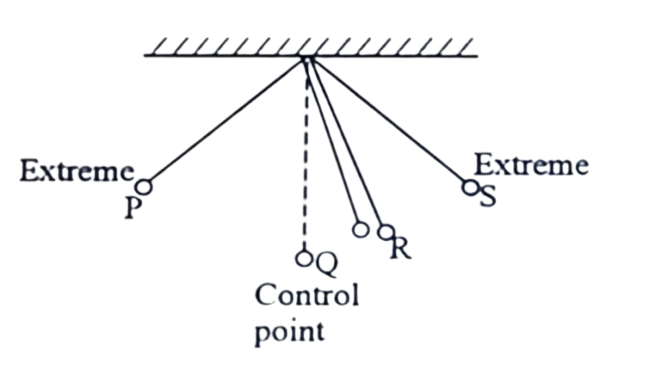
Using the oscillating simple pendulum above, the maximum kinetic energy is obtained at
In an oscillating simple pendulum, energy is continuously transformed between potential energy (PE) and kinetic energy (KE). At the maximum displacements (extremes P and S), the bob momentarily stops, so its KE is zero and its PE is at a maximum. As it moves toward the equilibrium position (Q), PE is converted into KE. At point Q, the bob is at its lowest vertical height (minimum PE) and traveling at its maximum speed. Therefore, the maximum kinetic energy is obtained at the mean position, Q.
Not clear enough?
Question 68
A collection of condensed suspended dust particles in the air constitute
Dust, smoke, and salt particles in the atmosphere act as 'condensation nuclei'. When water vapor in the air cools, it condenses around these suspended particles. When this happens at high altitudes, it forms clouds. When it occurs near the ground, it is called fog or mist. However, the term for the general collection of these condensed particles suspended in the atmosphere is a cloud.
Not clear enough?
Question 69
A body is moving initially at 4m/s. If its impulse after accelerating at 5m/s\(^{2}\) for 2s is 60Kgms\(^{-1}\). What is its mass?
Impulse (I) is equal to the change in momentum: \[ I = m(v - u) \] First, find the final velocity (v) using: \[ v = u + at \] \[ v = 4 + (5 \times 2) = 14\, \text{m/s} \]
Now substitute into the impulse equation:
\[ 60 = m(14 - 4) \]
\[ 60 = 10m \]
\[ m = 6\, \text{kg} \]
Not clear enough?
Question 70
A bore made in an aluminium block at 34ºC is 3.48cm\(^{3}\). What is the new bore when the temperature was raised to 340ºC [\(\alpha_a\) = 24 x 10\(^{-6}\) K\(^{-1}\)]
A 'bore' or hole in a material expands at the same rate as the material itself (as if the hole were filled with that material). Since the bore is given in units of volume (cm\(^{3}\)), we use the cubic expansivity (\(\gamma\)), where \(\gamma = 3\alpha\).
\[ \gamma = 3 \times (24 \times 10^{-6}) = 72 \times 10^{-6}\, \text{K}^{-1} \]
Temperature change \(\Delta\theta = 340 - 34 = 306\, ^\circ\text{C} \).
New Volume \(V_2 = V_1(1 + \gamma\Delta\theta)\):
\[ V_2 = 3.48(1 + (72 \times 10^{-6} \times 306)) \]
\[ V_2 = 3.48(1 + 0.022032) \]
\[ V_2 = 3.48 \times 1.022032 \approx 3.5566\, \text{cm}^3 \]
Rounding gives 3.56 cm\(^{3}\).