Biology 2024 Jamb Examination
Biology 2024 Jamb Examination

Question 41
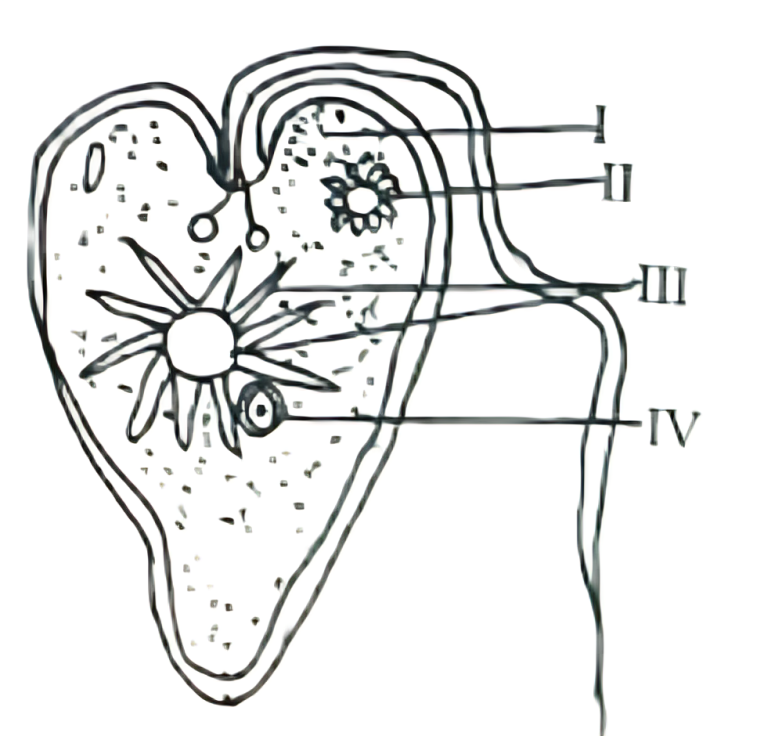
Use the diagram above to answer the question that follows
The organelle that shows the organism has plant characteristics is
I – Paramylum granules
II – Contractile vacuole
III – Chloroplasts
IV – Nucleus
The chloroplasts represent the plant-like characteristic of Euglena, allowing it to perform photosynthesis and produce its own food.
Not clear enough?
Question 42
Reproduction in paramecium is by
Paramecium reproduces asexually by binary fission, where the single-celled organism duplicates its organelles and genetic material and then divides into two genetically similar daughter cells. Although conjugation (a form of sexual exchange) also occurs in paramecium, the primary asexual method is binary fission.
Not clear enough?
Question 43
A community with a population of two million three hundred and ten thousand people living in an area of two thousand three hundred and ten square kilometres has a population density of
Population density is calculated as population divided by area.$$D_p = \dfrac{N}{A}$$$$D_p = \dfrac{ 2,310,000}{2,310 } = 1,000 $$
Thus 1000 people per square kilometre.
Not clear enough?
Question 44
A succession that occurs in an area where there are no pre-existing community is called
Primary succession occurs on newly formed or exposed surfaces where no soil or prior community exists (for example, on bare rock after a volcanic eruption or on newly exposed glacial till). Pioneer species colonize, alter the environment, and enable subsequent communities to establish.
Not clear enough?
Question 45
Which of the following processes releases oxygen to the atmosphere?
Photosynthesis releases oxygen as a by-product when plants, algae, and some bacteria convert carbon dioxide and water into glucose using light energy. Respiration, combustion, and decomposition consume oxygen or release carbon dioxide rather than releasing oxygen.
Not clear enough?
Question 46
The depressed side of paramecium which is lined with cilia leads to a tube-like structure called
- Oral groove:
This is the shallow depression on the paramecium's body lined with cilia, where food particles are collected. - Gullet:
This is the tube-like structure that follows the oral groove, where the food is transported further into the cell.
Not clear enough?
Question 47
The rhizoid of liverwort is
Liverwort rhizoids are unicellular and unbranched structures that anchor the plant to the substrate and help in absorption of water and minerals. Unlike mosses, which have multicellular branched rhizoids, liverworts have simpler rhizoids.
Not clear enough?
Question 48
In glycolysis, glucose is broken down through series of reactions in the presence of enzyme and absence of oxygen to produce
Glycolysis is the anaerobic breakdown of glucose into pyruvic acid, producing a net gain of 2 ATP molecules. This process occurs in the cytoplasm with the help of enzymes and does not require oxygen.
Not clear enough?
Question 49
Gaseous exchange takes place through the plasma membrane in
In unicellular organisms like paramecium, gases diffuse directly through the plasma membrane because their high surface-area-to-volume ratio allows efficient exchange of oxygen and carbon dioxide. Hydra also exchanges gases through diffusion, but paramecium is the classic single-celled example.
Not clear enough?
Question 50
One of the characteristics of secondary succession is that it
Secondary succession occurs on surfaces where a community has previously existed and been disturbed, such as abandoned farmland or cleared forest. It starts on an already colonized surface and generally progresses faster than primary succession.
Not clear enough?
You might like
In the anatomy of the brachial plexus, the upper and middle trunks combine to form which specific cord?
The population of a town is 9000. It the number of females increases by 5% and the males by 7.5%, what will be the total population after increase. The number of females currently is 3000 ?
Choose the word or phrase which is most nearly opposite in meaning to the word in capitals.
SQUALID :
According to Paul's teaching concerning the second coming of Jesus, the believers will meet the Lord when he is_________