
Chemistry 2024 Jamb Examination
Chemistry 2024 Jamb Examination

Question 11

The table above shows the formulae of some ions. In which of these compounds is the formula not correct?
The correct formula for iron(III) bromide should be FeBr3, since Fe3+ combines with three Br- ions to balance charges.
The given formula Fe3Br is incorrect because it implies an unbalanced compound where the charges do not cancel out.
All other compounds have correct formulae with balanced charges between their cations and anions.
The given formula Fe3Br is incorrect because it implies an unbalanced compound where the charges do not cancel out.
All other compounds have correct formulae with balanced charges between their cations and anions.
Not clear enough?
Question 12
The pH of a 0.001 mol dm−3 of H2SO4 is
[Log102 = 0.3]
[Log102 = 0.3]
H2SO4 ionises completely to give 2H+ per molecule.
For 0.001 mol dm−3 solution, \([H^+] = 2 \times 0.001 = 0.002\).
pH = - log10(0.002) = -(-2.7) = 2.7
Therefore, the pH is 2.7.
For 0.001 mol dm−3 solution, \([H^+] = 2 \times 0.001 = 0.002\).
pH = - log10(0.002) = -(-2.7) = 2.7
Therefore, the pH is 2.7.
Not clear enough?
Question 13
Strong acids can be distinguished from weak acids by any of the following methods, EXCEPT
Litmus paper only indicates whether a solution is acidic or basic, not the strength of the acid.
Strong acids completely ionise in water and show higher conductivity, lower pH, and larger heats of reaction than weak acids.
Therefore, litmus paper cannot be used to differentiate between strong and weak acids.
Strong acids completely ionise in water and show higher conductivity, lower pH, and larger heats of reaction than weak acids.
Therefore, litmus paper cannot be used to differentiate between strong and weak acids.
Not clear enough?
Question 14
The chemical formula for potassiumhexacyanoferrate(II) is
The iron in hexacyanoferrate(II) has an oxidation state of +2. The complex ion [Fe(CN)6]4− requires four K+ ions to neutralise it.
Hence, the correct formula is K4[Fe(CN)6], representing potassiumhexacyanoferrate(II).
Hence, the correct formula is K4[Fe(CN)6], representing potassiumhexacyanoferrate(II).
Not clear enough?
Question 15
For a chemical reaction to be spontaneous, ∆G must be
The spontaneity of a reaction is determined by the Gibbs free energy change (∆G).
\( \Delta G = \Delta H - T\Delta S \).
When ∆G is negative, the reaction occurs spontaneously because the process results in a decrease in free energy.
Therefore, ∆G must be negative for a reaction to be spontaneous.
\( \Delta G = \Delta H - T\Delta S \).
When ∆G is negative, the reaction occurs spontaneously because the process results in a decrease in free energy.
Therefore, ∆G must be negative for a reaction to be spontaneous.
Not clear enough?
Question 16
How many moles of CO2 are produced when ethanol is burnt with 6 g of oxygen?
The combustion of ethanol is given by:\[ C_2H_5OH + 3O_2 \rightarrow 2CO_2 + 3H_2O \]Moles of O2 = \( \dfrac{6}{32} = 0.1875 \).
From the equation, 3 mol O2 produce 2 mol CO2.
Therefore, \( 0.1875 \times \dfrac{2}{3} = 0.125 \; mol \) CO2 are produced.
From the equation, 3 mol O2 produce 2 mol CO2.
Therefore, \( 0.1875 \times \dfrac{2}{3} = 0.125 \; mol \) CO2 are produced.
Not clear enough?
Question 17
Which of these is the most preferred separation technique for the isolation of solutes where the purity of the constituent is of utmost importance?
Recrystallisation is the best method for obtaining highly pure solids.
It involves dissolving the impure solid in a hot solvent and then allowing it to cool slowly so that pure crystals form while impurities remain in solution.
Therefore, it ensures maximum purity of the isolated substance.
It involves dissolving the impure solid in a hot solvent and then allowing it to cool slowly so that pure crystals form while impurities remain in solution.
Therefore, it ensures maximum purity of the isolated substance.
Not clear enough?
Question 18
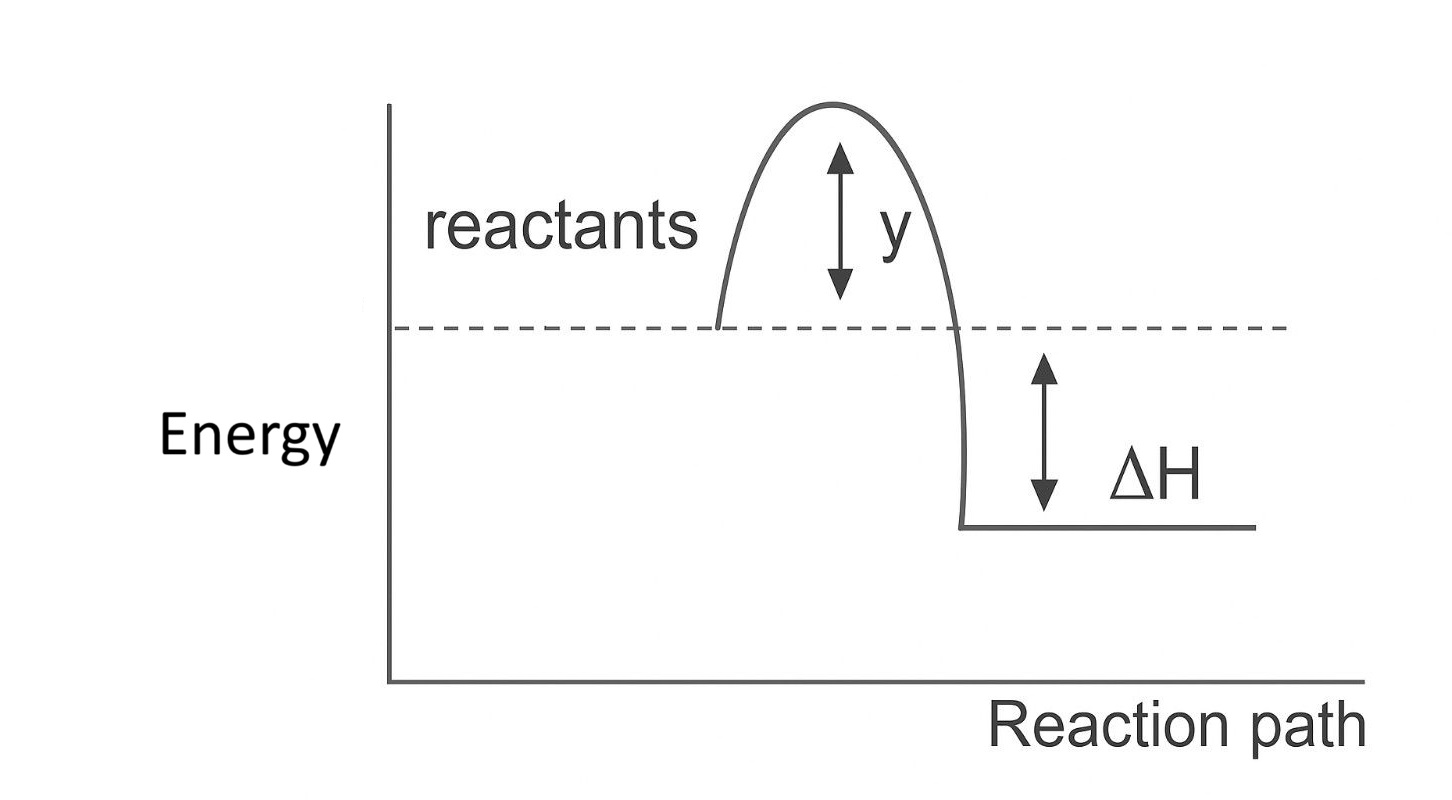
In the graph above, y represents
In an energy profile diagram, the curve showing the energy barrier that reactants must overcome before forming products represents the activation energy.
It is the minimum energy required to start a chemical reaction by breaking existing bonds.
Hence, y represents activation energy.
It is the minimum energy required to start a chemical reaction by breaking existing bonds.
Hence, y represents activation energy.
Not clear enough?
Question 19
The ions responsible for permanent hardness in water are sulphates of
Permanent hardness in water is caused by the presence of soluble calcium and magnesium salts, especially their sulphates (CaSO4 and MgSO4).
These do not precipitate on boiling and thus require chemical treatment to remove.
These do not precipitate on boiling and thus require chemical treatment to remove.
Not clear enough?
Question 20
One of the following is not a water pollutant?
Oxygen gas is naturally present in water and supports aquatic life, hence it is not a pollutant.
Inorganic fertilisers, warm water effluents, and biodegradable waste introduce harmful substances or disrupt aquatic balance, making them pollutants.
Inorganic fertilisers, warm water effluents, and biodegradable waste introduce harmful substances or disrupt aquatic balance, making them pollutants.
Not clear enough?
You might like
An amount of \(\text{\text{₦}} 600,000.00\) was realized when a principal \(y\) was saved for 5% simple interest for 4 years, find the value of \(y\)
choose the option nearest in meaning to the italicized words or expressions.
The police later discovered that Audu feigned death.
In a graphical representation of demand, 'Perfect Elasticity' (where consumers are willing to buy any amount at a fixed price but nothing above it) is shown by a __________.