
Chemistry 2024 Jamb Examination
Chemistry 2024 Jamb Examination

Question 31
The molecular formula of a hydrocarbon with an empirical formula of CH\(_3\) and a molar mass of 30 is
Empirical formula mass = (12 × 1) + (1 × 3) = 15 g/mol.
Given molar mass = 30 g/mol.
\( n = \dfrac{30}{15} = 2 \).
Therefore, molecular formula = (CH\(_3\)) × 2 = C\(_2\)H\(_6\).
This corresponds to ethane, a saturated hydrocarbon (alkane).
Given molar mass = 30 g/mol.
\( n = \dfrac{30}{15} = 2 \).
Therefore, molecular formula = (CH\(_3\)) × 2 = C\(_2\)H\(_6\).
This corresponds to ethane, a saturated hydrocarbon (alkane).
Not clear enough?
Question 32
The empirical formula of an organic liquid hydrocarbon is XY. If the relative molar masses of X and Y are 72 and 6 respectively, its vapour density is likely to be
The empirical formula mass = 72 + 6 = 78.
Since the empirical formula is the simplest ratio, the molecular mass is likely a multiple of it. For hydrocarbons, vapour density (VD) = \( \dfrac{\text{Molecular mass}}{2} \).
If molecular mass = 78, then \( VD = \dfrac{78}{2} = 39 \).
Therefore, the vapour density is 39.
Since the empirical formula is the simplest ratio, the molecular mass is likely a multiple of it. For hydrocarbons, vapour density (VD) = \( \dfrac{\text{Molecular mass}}{2} \).
If molecular mass = 78, then \( VD = \dfrac{78}{2} = 39 \).
Therefore, the vapour density is 39.
Not clear enough?
Question 33
Biuret test is a chemical test used for detecting the presence of
The Biuret test identifies compounds containing peptide bonds. When proteins are treated with Biuret reagent (a solution of copper(II) sulfate in an alkaline medium), a violet or purple colour appears.
This colour change confirms the presence of peptide linkages found only in proteins.
This colour change confirms the presence of peptide linkages found only in proteins.
Not clear enough?
Question 34
A gas when mixed with oxygen produces a very hot and easily controllable flame. What is the name of the flame and where is it used?
When ethyne (acetylene) is burnt with oxygen, it forms the oxy-acetylene flame, which reaches about 3200°C and is easily controlled.
This flame is used for cutting and welding metals due to its high temperature and clean combustion.
This flame is used for cutting and welding metals due to its high temperature and clean combustion.
Not clear enough?
Question 35
The number of geometrical isomers of butene are
Butene (C\(_4\)H\(_8\)) exists as two geometrical isomers: cis-but-2-ene and trans-but-2-ene. These arise from restricted rotation around the C=C bond.
Therefore, the number of geometrical isomers of butene is 2.
Therefore, the number of geometrical isomers of butene is 2.
Not clear enough?
Question 36
How many isomers has the organic compound represented by the formula C\(_3\)H\(_8\)O?
C\(_3\)H\(_8\)O can exist as two structural isomers: propan-1-ol and propan-2-ol (both alcohols).
It can also exist as methoxyethane (an ether).
Hence, there are three possible isomers in total.
It can also exist as methoxyethane (an ether).
Hence, there are three possible isomers in total.
Not clear enough?
Question 37
When a few drops of Millon reagent are added to egg-white solution in a test tube, the white precipitate changes to
Millon reagent detects phenolic compounds like tyrosine in proteins. When added to an egg-white solution, it produces a white precipitate that turns reddish brown upon heating.
This colour confirms the presence of tyrosine-containing proteins.
This colour confirms the presence of tyrosine-containing proteins.
Not clear enough?
Question 38
If the solubility of KNO\(_3\) at 30°C is 3.10 mol/dm\(^3\), a solution containing 303 g/dm\(^3\) KNO\(_3\) is likely to be
Molar mass of KNO\(_3\) = 101 g/mol.
\( 303 \; g/dm^3 \Rightarrow \dfrac{303}{101} = 3.0 \; mol/dm^3 \).
Since the solubility is 3.10 mol/dm\(^3\), the given concentration (3.0 mol/dm\(^3\)) is slightly less than the solubility.
Hence, the solution is unsaturated.
\( 303 \; g/dm^3 \Rightarrow \dfrac{303}{101} = 3.0 \; mol/dm^3 \).
Since the solubility is 3.10 mol/dm\(^3\), the given concentration (3.0 mol/dm\(^3\)) is slightly less than the solubility.
Hence, the solution is unsaturated.
Not clear enough?
Question 39
127 g of sodium chloride was dissolved in 1.0 dm\(^3\) of distilled water at 25°C. Determine the solubility in mol/dm\(^3\) of sodium chloride at that temperature. [Na = 23, Cl = 35.5]
Molar mass of NaCl = 23 + 35.5 = 58.5 g/mol.
\( \text{Moles} = \dfrac{127}{58.5} = 2.17 \; mol \).
Since it is dissolved in 1.0 dm\(^3\) of solution, solubility = 2.17 mol/dm\(^3\) ≈ 2.2 mol/dm\(^3\).
\( \text{Moles} = \dfrac{127}{58.5} = 2.17 \; mol \).
Since it is dissolved in 1.0 dm\(^3\) of solution, solubility = 2.17 mol/dm\(^3\) ≈ 2.2 mol/dm\(^3\).
Not clear enough?
Question 40
The quantity of electricity required to deposit 180 g of Ag from a molten silver trioxonitrate(V) is [Ag = 108]
From Faraday’s law: \( m = \dfrac{EIt}{96500} \) or \( Q = nF \).
For Ag, \( \text{Molar mass} = 108, \; n = 1 \).
180 g corresponds to \( \dfrac{180}{108} = 1.67 \) mol of Ag.
Therefore, electricity required = 1.67F.
For Ag, \( \text{Molar mass} = 108, \; n = 1 \).
180 g corresponds to \( \dfrac{180}{108} = 1.67 \) mol of Ag.
Therefore, electricity required = 1.67F.
Not clear enough?
You might like
Each question consist of two words which have a certain relationship to each other followed by four pairs of related words, Select the pair which has the same relationship. PAIN : SEDATIVE
The name of programming technique which emphasizes breaking large and complex task into successively smaller sections is _____?
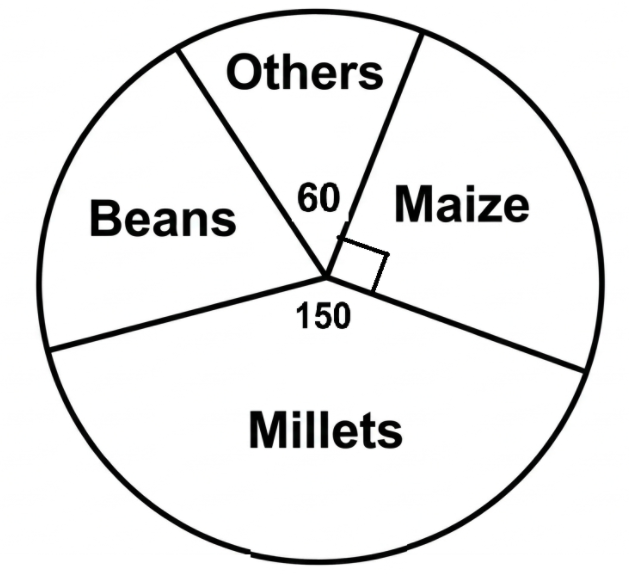
The pie chart above shows the distribution of the crops harvested from a farmland in a year. If 3000 tonnes of millet is harvested, what amount of beans is harvested?
Select the word-pair in which the two words are related in the same way as are the two words in the given word-pair. Surgeon : Scalpel :: ?