Physics 2020 Jamb Examination

Physics 2020 Jamb Examination

Available Sections
2. Career
4. Job
1234

Question 1

A few grains of table salt were put in a cup of cold water, kept at constant temperature and left undisturbed. Eventually all the water tested salty. This action is due to?
Show explanation Expand Question
This phenomenon is a classic example of diffusion in liquids. Diffusion is the net movement of particles from a region of higher concentration to a region of lower concentration as a result of their random thermal motion. Even though the water was left undisturbed (without stirring), the kinetic energy of the water and salt molecules causes them to collide and spread out uniformly until a homogeneous mixture is formed. Convection involves the bulk movement of fluids due to density differences, osmosis specifically refers to the movement of solvent through a semi-permeable membrane, and capillarity relates to the rise or fall of liquids in narrow tubes due to surface tension. Since the salt particles spread throughout the static volume of water, diffusion is the governing process.
Not clear enough?

Question 2

The force required to make an object of mass m, travelling with velocity v, turn in a circle of radius r is
Show explanation Expand Question
When an object moves in a circular path, it experiences a centripetal acceleration directed towards the centre of the circle. According to Newton's second law, a net force must act in the direction of this acceleration to maintain the circular motion. This is known as the centripetal force. The magnitude of this force is determined by the mass of the object, the square of its linear velocity, and the inverse of the radius of the path. The mathematical expression is derived as: \[ F = ma_c \] Given that the centripetal acceleration \( a_c \) is defined as: \[ a_c = \frac{v^2}{r} \] Substituting the acceleration into the force equation yields: \[ F = \frac{mv^2}{r} \] Therefore, the required force is proportional to the square of the velocity and inversely proportional to the radius.
Not clear enough?

Question 3

A machine gun with a mass of 5kg fires a 50g bullet at a speed of 100 ms\(^{-1}\).
The recoil speed of the machine gun is
Show explanation Expand Question
This problem is solved using the principle of conservation of linear momentum, which states that in an isolated system, the total momentum before an event is equal to the total momentum after the event. Initially, both the gun and the bullet are at rest, so the initial momentum is zero.
Let:
Mass of gun \( M_g = 5 \, \text{kg} \)
Mass of bullet \( m_b = 50 \, \text{g} = 0.05 \, \text{kg} \)
Velocity of bullet \( v_b = 100 \, \text{ms}^{-1} \)
Recoil velocity of gun \( V_g = ? \) \[ \text{Total initial momentum} = \text{Total final momentum} \] \[ 0 = (M_g \times V_g) + (m_b \times v_b) \] \[ 0 = (5 \times V_g) + (0.05 \times 100) \] \[ 0 = 5V_g + 5 \] \[ 5V_g = -5 \] \[ V_g = -\frac{5}{5} \] \[ V_g = -1 \, \text{ms}^{-1} \] The negative sign indicates that the gun moves in the opposite direction to the bullet. The magnitude of the recoil speed is 1 \( \text{ms}^{-1} \).
Not clear enough?

Question 4

If in a simple pendulum experiment the length of the inextensible string is increased by a factor of four, its period is increased by a factor of?
Show explanation Expand Question
The period of a simple pendulum is the time taken for one complete oscillation. For small angles of displacement, the relationship between the period and the length of the pendulum is given by the formula: \[ T = 2\pi \sqrt{\frac{L}{g}} \] From this formula, we can see that the period \( T \) is directly proportional to the square root of the length \( L \): \[ T \propto \sqrt{L} \] If the new length \( L_2 \) is four times the original length \( L_1 \) (i.e., \( L_2 = 4L_1 \)), we can determine the new period \( T_2 \) using the ratio: \[ \frac{T_2}{T_1} = \sqrt{\frac{L_2}{L_1}} \] \[ \frac{T_2}{T_1} = \sqrt{\frac{4L_1}{L_1}} \] \[ \frac{T_2}{T_1} = \sqrt{4} \] \[ T_2 = 2T_1 \] Consequently, increasing the length of the string by a factor of four results in the period increasing by a factor of two.
Not clear enough?

Question 5

In what range of temperature is the expansion of water anomalous?
Show explanation Expand Question
Normally, substances expand when heated and contract when cooled because the kinetic energy of the molecules increases, causing them to occupy more space. However, water exhibits a unique property known as anomalous expansion between the temperatures of 0°C and 4°C. When ice at 0°C melts into water at 0°C and is then heated towards 4°C, it actually contracts instead of expanding. This means its volume decreases and its density increases, reaching its maximum density exactly at 4°C. Above 4°C, water begins to behave normally and expands as the temperature increases. This anomalous behaviour is vital for aquatic life, as it ensures that the densest water (at 4°C) sinks to the bottom of lakes and rivers, preventing them from freezing solid from the bottom up during winter.
Not clear enough?

Question 6

Which of the following statements about radioactivity is true?
(i) Alpha particle is positively charged
(ii) Beta particle is negatively charged
(iii) Gamma ray is neutral
(iv) Beta particle has the same mass as helium atom
(v) Gamma ray is charged.
Show explanation Expand Question
Radioactivity involves the spontaneous disintegration of unstable atomic nuclei, resulting in the emission of three primary types of radiation. Alpha particles (α) consist of two protons and two neutrons, making them identical to helium nuclei; they carry a positive charge of +2e. Beta particles (β) are high-speed electrons emitted from the nucleus, carrying a negative charge of -1e. Gamma rays (γ) are high-energy electromagnetic waves (photons) and, unlike alpha and beta particles, they possess no mass and no electrical charge, making them neutral. Statement (iv) is incorrect because it is the alpha particle, not the beta particle, that has the same mass as a helium atom. Statement (v) is incorrect because gamma rays are not charged. Therefore, only statements (i), (ii), and (iii) are scientifically accurate.
Not clear enough?

Question 7

In the study of Physics, temperature and heat are often confused with each other. Which of the following statements correctly defines these two elements?
Show explanation Expand Question
Temperature and heat are related thermal concepts but represent different physical quantities. Temperature is a scalar quantity that describes the degree of hotness or coldness of a body; microscopically, it is directly proportional to the average kinetic energy of the constituent particles. Heat, on the other hand, refers to the total thermal energy transferred between systems due to a temperature gradient. Statement (B) refers to internal energy or total thermal energy in transit, which characterizes heat in a system. Statement (C) describes the principle of specific heat capacity, noting that the molecular structure of different substances dictates how much energy is needed to raise their temperature by a specific amount. Since all these statements provide valid physical descriptions of temperature, heat, and their interaction, the most comprehensive choice is that all of the above are correct.
Not clear enough?

Question 8

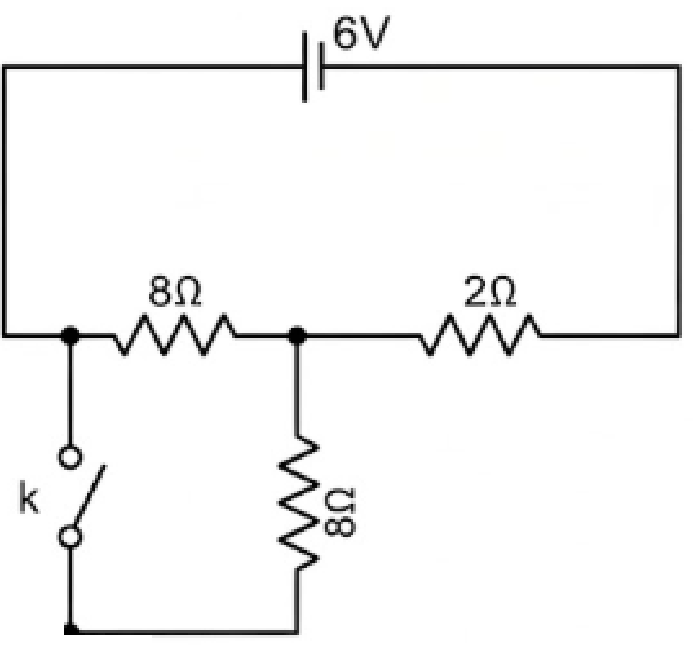
The effect of closing the key K
The effect of closing the key K in the circuit shown in the figure above would be to?
Show explanation Expand Question
To determine the change in current, we must calculate the total current flowing in the circuit before and after the key K is closed. We assume the cell has an electromotive force (e.m.f) of 2V and internal resistance is negligible based on the provided options. \[ \text{When the key K is open:} \] The resistors of \( 2\Omega \) and \( 3\Omega \) are in series. \[ R_{\text{total1}} = 2\Omega + 3\Omega = 5\Omega \] Using Ohm's law, the initial current \( I_1 \) is: \[ I_1 = \frac{V}{R_{\text{total1}}} = \frac{2}{5} = 0.4\, \text{A} \] \[ \text{When the key K is closed:} \] The \( 3\Omega \) resistor is short-circuited because the current takes the path of least resistance through the closed key. The only resistance remaining in the circuit is the \( 2\Omega \) resistor. \[ R_{\text{total2}} = 2\Omega \] The new current \( I_2 \) is: \[ I_2 = \frac{V}{R_{\text{total2}}} = \frac{2}{2} = 1.0\, \text{A} \] \[ \text{Change in current} = I_2 - I_1 \] \[ \Delta I = 1.0\, \text{A} - 0.4\, \text{A} = 0.6\, \text{A} \] Closing the key effectively reduces the total resistance, thereby increasing the current by 0.6A.
Not clear enough?

Question 9

Which of the following statements on the use of X-rays is incorrect? X-rays are used
Show explanation Expand Question
X-rays are high-frequency electromagnetic waves with significant penetrating power, leading to various applications in medicine and industry. They are used in radiography to image internal body structures like bones because bones absorb X-rays more than soft tissue (Statement A). In radiotherapy, controlled high-energy X-ray beams are used to destroy cancerous cells (Statement B). In engineering and art conservation, X-rays are used to perform non-destructive testing to find internal cracks or flaws in materials (Statement D). However, X-rays are not used for detecting fingerprints at a crime scene. Fingerprint detection usually involves the use of fine powders, chemical reagents like ninhydrin, or ultraviolet (UV) light, which causes certain substances to fluoresce. Therefore, Statement C is the incorrect application.
Not clear enough?

Question 10

Natural radioactivity consists of emission?
Show explanation Expand Question
Natural radioactivity is the spontaneous process by which an unstable atomic nucleus loses energy by emitting radiation. This process occurs in heavy elements found in nature, such as uranium, thorium, and radium. The emissions primarily consist of three distinct types: alpha particles (positively charged helium nuclei), beta particles (high-speed electrons or positrons), and gamma rays (neutral, high-energy electromagnetic radiation). While X-rays are also electromagnetic radiation, they are generally produced by transitions of electrons in the outer shells of atoms or by rapid deceleration of charged particles (bremsstrahlung), rather than by the natural decay of the nucleus itself. Thus, the full suite of natural radioactive emissions includes alpha, beta, and gamma radiation.
Not clear enough?

1234
In this page
Physics 2020 Jamb Examination
Open Model!