
Physics 2020 Jamb Examination
Physics 2020 Jamb Examination

Question 31
Which of the following statements about defects of vision is/are CORRECT?
I. For a long sighted person, close objects appear blurred
II. For a short sighted person, distant objects appear blurred
III. Short sight is corrected by using a pair of converging lenses
I. For a long sighted person, close objects appear blurred
II. For a short sighted person, distant objects appear blurred
III. Short sight is corrected by using a pair of converging lenses
Human vision defects occur when the eye's lens system cannot properly focus light onto the retina. Long-sightedness (hypermetropia) occurs when the eyeball is too short or the lens is too thin, causing the image of near objects to form behind the retina; thus, near objects appear blurred while distant ones are clear. Short-sightedness (myopia) occurs when the eyeball is too long or the lens is too thick, causing the image of distant objects to form in front of the retina; thus, distant objects appear blurred. To correct myopia, a diverging (concave) lens is required to spread the light rays before they enter the eye, ensuring they focus exactly on the retina. Statement III is incorrect because a converging lens is used to correct long-sightedness, not short-sightedness.
Not clear enough?
Question 32
Which of the following conditions are necessary and sufficient for total internal reflection to take place at the boundary between two optical media?
I. Light is passing from optical denser medium to optically less dense medium
II. Light is passing from optically less dense medium to optically denser medium
III. Angle of incidence is greater than a certain critical value
IV. Angle of incidence is lesser than a certain critical value
I. Light is passing from optical denser medium to optically less dense medium
II. Light is passing from optically less dense medium to optically denser medium
III. Angle of incidence is greater than a certain critical value
IV. Angle of incidence is lesser than a certain critical value
Total internal reflection (TIR) is a phenomenon where light is completely reflected back into a medium at the boundary with another medium. For this to occur, two specific conditions must be met simultaneously. First, the light must be travelling from an optically denser medium (higher refractive index) toward an optically less dense medium (lower refractive index), such as from glass to air. Second, the angle of incidence within the denser medium must be greater than the critical angle (\( c \)) for that specific pair of media. If the angle is less than the critical angle, refraction occurs; if it equals the critical angle, the light travels along the boundary. Only when the angle exceeds the critical value does the boundary behave like a perfect mirror.
Not clear enough?
Question 33
The linear expansivity of brass is \( 2 \times 10^{-5} \, ^\circ\text{C}^{-1} \). If the volume of piece of brass is \( 10 \, \text{cm}^3 \) at \( 0 \, ^\circ\text{C} \). What will be its volume at \( 100 \, ^\circ\text{C} \)?
To calculate the new volume, we must account for the cubic (volumetric) expansivity of the material. The relationship between linear expansivity (\( \alpha \)) and cubic expansivity (\( \gamma \)) for an isotropic solid is given by:
\[ \gamma = 3\alpha \]
Given:
\( \alpha = 2 \times 10^{-5} \, ^\circ\text{C}^{-1} \)
\( V_0 = 10 \, \text{cm}^3 \)
\( \Delta T = 100 - 0 = 100 \, ^\circ\text{C} \) \[ \gamma = 3 \times (2 \times 10^{-5}) = 6 \times 10^{-5} \, ^\circ\text{C}^{-1} \] The formula for volumetric expansion is: \[ V_t = V_0(1 + \gamma \Delta T) \] \[ V_t = 10 [1 + (6 \times 10^{-5} \times 100)] \] \[ V_t = 10 [1 + (6 \times 10^{-3})] \] \[ V_t = 10 [1 + 0.006] \] \[ V_t = 10 \times 1.006 = 10.06 \, \text{cm}^3 \] The volume of the brass increases as it is heated due to the increased thermal vibration of its atoms.
Not clear enough?
Question 34
The lower and upper fixed points marked on a Mercury-in-glass thermometer are 210mm apart. The end of the mercury column in the tube is 49mm above the lower fixed point in a room. What is the temperature of the room in degrees Celsius?
The temperature on a linear Celsius scale is determined by the ratio of the mercury column's height relative to the distance between the fixed points (0°C and 100°C).
Given:
Distance between fixed points (\( L_{100} - L_0 \)) = 210 mm
Height above the lower fixed point (\( L_t - L_0 \)) = 49 mm
Using the formula for temperature on a Celsius scale: \[ \theta = \frac{L_t - L_0}{L_{100} - L_0} \times 100 \, ^\circ\text{C} \] \[ \theta = \frac{49}{210} \times 100 \] Simplifying the fraction: \[ \theta = \frac{7}{30} \times 100 \] \[ \theta = \frac{70}{3} \approx 23.33 \, ^\circ\text{C} \] Therefore, the room temperature corresponds to approximately 23.3°C on the Celsius scale.
Not clear enough?
Question 35
Heat is supplied uniformly at the rate of 100W to \( 1.0 \times 10^{-2} \, \text{kg} \) of a liquid for 20 seconds. If the temperature of the liquid rises by 5°C, then the specific heat capacity of the liquid is
To find the specific heat capacity (c), we relate the electrical energy supplied by the heater to the thermal energy absorbed by the liquid. The total energy (Q) supplied is the power (P) multiplied by the time (t).
\[ Q = P \times t \]
\[ Q = 100 \, \text{W} \times 20 \, \text{s} = 2000 \, \text{J} \]
The heat absorbed by the liquid is given by:
\[ Q = mc\Delta\theta \]
Where:
\( m = 1.0 \times 10^{-2} \, \text{kg} \)
\( \Delta\theta = 5 \, ^\circ\text{C} \) (or 5 K, since the intervals are equal)
Equating the two expressions for Q: \[ 2000 = (1.0 \times 10^{-2}) \times c \times 5 \] \[ 2000 = 0.01 \times 5 \times c \] \[ 2000 = 0.05c \] \[ c = \frac{2000}{0.05} \] \[ c = 40000 \, \text{Jkg}^{-1}\text{K}^{-1} \] \[ c = 4.0 \times 10^4 \, \text{Jkg}^{-1}\text{K}^{-1} \] Note that the units for specific heat capacity must include both mass and temperature inverse (J/kg·K).
Not clear enough?
Question 36
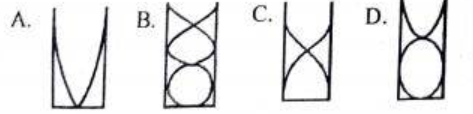
In which of the following diagrams is the length of the tube equal to one wavelength?
In an open pipe (open at both ends), the fundamental mode of vibration produces an antinode at each end and a node in the middle, meaning the length of the pipe \( L \) is equal to half a wavelength (\( L = \lambda/2 \)). For the length of the tube to be exactly equal to one wavelength (\( L = \lambda \)), the wave must complete one full cycle within the pipe. This occurs in the first overtone (second harmonic) of an open pipe, where there are two nodes and three antinodes. If the diagram 'c' represents an open pipe with a full wave cycle visible (from antinode to antinode through two nodes), then that is the correct representation. In a closed pipe (closed at one end), the harmonics are odd, and a full wavelength would require the length to be \( L = \lambda \), which typically corresponds to a configuration not usually tested as a primary harmonic compared to the open pipe second harmonic.
Not clear enough?
Question 37
Which of the following pairs is part of the electromagnetic spectrum?
I. Radio waves
II. sound waves
III. Gamma rays
IV. water waves
I. Radio waves
II. sound waves
III. Gamma rays
IV. water waves
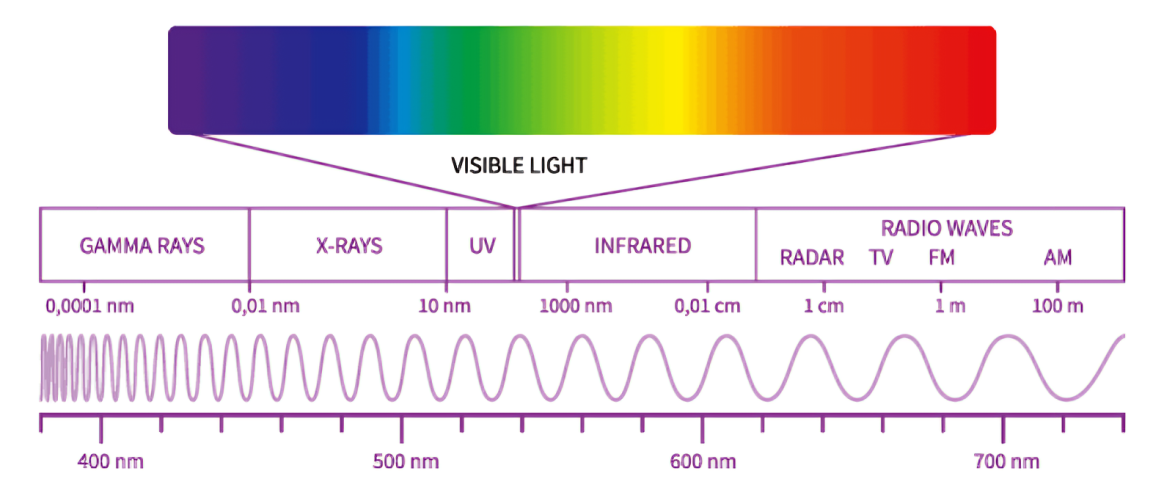
The electromagnetic spectrum consists of waves that are made of oscillating electric and magnetic fields and can travel through a vacuum. These include, in order of increasing frequency: radio waves, microwaves, infrared, visible light, ultraviolet, X-rays, and gamma rays. Radio waves (I) are at the low-frequency end of the spectrum, while gamma rays (III) are at the high-frequency end. In contrast, sound waves (II) and water waves (IV) are mechanical waves. Mechanical waves require a physical medium (like air, water, or solids) to propagate and are not part of the electromagnetic spectrum. Therefore, only radio waves and gamma rays are electromagnetic in nature.
Not clear enough?
Question 38
A substance has half-life of 3 min. After 6 min, the count rate was observed to be 400. What was its count rate at zero time?
To find the initial count rate (at zero time), we need to determine how many half-lives have passed during the 6-minute interval.
Given:
Half-life \( t_{1/2} = 3 \) min
Total time \( T = 6 \) min
Final count rate \( A = 400 \)
Number of half-lives \( n \) is calculated as:\[ n = \frac{T}{t_{1/2}} = \frac{6}{3} = 2 \] The relationship between the initial count rate \( A_0 \) and the final count rate \( A \) is:\[ A = \frac{A_0}{2^n} \] Rearranging to solve for \( A_0 \):\[ A_0 = A \times 2^n \] \[ A_0 = 400 \times 2^2 \] \[ A_0 = 400 \times 4 \] \[ A_0 = 1600 \] Step-by-step logic: After the first 3 minutes (one half-life), the count rate would have dropped from 1600 to 800. After the next 3 minutes (total 6 minutes), it would drop from 800 to 400. This confirms the initial count rate was 1600.
Not clear enough?
You might like
"...You shall indeed hear but never understand and you shall indeed see but never perceive". To which prophet did Paul attribute this saying?
The military coup of July 25, 1975 which toppled general Yakubu Gowon from power took place when he was attending which important event?
According to Mark, the three women that went to the sepulchre to anoint the body of Jesus with spices were
"I called to the Lord, out of my distress, and he answered me, out of the belly of Sheol I cried and thou didst hear my voice ..." Jonah's statement above implies that God_________