
Physics 2020 Jamb Examination
Physics 2020 Jamb Examination

Question 21
If a source of sound is moving, a stationary listener will hear a sound of different frequency. This is called?
The phenomenon described is the Doppler effect, which occurs whenever there is relative motion between a source of waves and an observer. When the source of sound moves towards the listener, the successive wave crests are emitted from positions progressively closer to the listener, causing the effective wavelength to decrease and the perceived frequency (pitch) to increase. Conversely, as the source moves away, the wavelength increases and the frequency decreases. Resonance refers to the vibration of a system at its natural frequency due to an external force, ultrasound refers to sound frequencies above the human hearing range, and rarefaction is the region of low pressure in a longitudinal wave. Only the Doppler effect accounts for the change in perceived frequency due to motion.
Not clear enough?
Question 22
Which of the following can be described as high tension transmission?
High tension (HT) transmission refers to the transport of electrical power over long distances using very high voltages. According to Joule's law of heating, the power lost as heat in transmission lines is given by the formula:
\[ P = I^2R \]
To minimise this power loss, it is essential to keep the current \( I \) as low as possible. Since electrical power is the product of voltage and current (\( P = IV \)), the same amount of power can be transmitted by significantly increasing the voltage, which allowed for a proportional decrease in the current. Therefore, high tension transmission is characterised by high voltage and low current, which makes the distribution of electricity more efficient and reduces the cost of materials by allowing thinner cables.
Not clear enough?
Question 23
What is the cost of running five 50W lamps and four 100W lamps for 10 hours if electrical energy costs 2 Kobo per KWh?
To calculate the total cost, we first find the total power consumed and then the total energy in kilowatt-hours (kWh).
Total power consumed:
\[ P_{\text{total}} = (5 \times 50\text{W}) + (4 \times 100\text{W}) \]
\[ P_{\text{total}} = 250\text{W} + 400\text{W} = 650\text{W} \]
Convert power to kilowatts:
\[ P_{\text{kW}} = \frac{650}{1000} = 0.65\text{kW} \]
Calculate total energy consumed over 10 hours:
\[ E = P \times t = 0.65\text{kW} \times 10\text{h} = 6.5\text{kWh} \]
Calculate the total cost at 2 Kobo per kWh:
\[ \text{Cost} = 6.5 \times 2 = 13\text{ Kobo} \]
Converting to Naira (where 100 Kobo = N1):
\[ \text{Cost in Naira} = \frac{13}{100} = \text{N0.13} \]
Not clear enough?
Question 24
The mass of a proton is approximately equal to that of
In atomic physics, protons and neutrons are both classified as nucleons and reside in the nucleus of an atom. A proton has a mass of approximately \( 1.6726 \times 10^{-27} \text{ kg} \), while a neutron has a slightly larger mass of approximately \( 1.6749 \times 10^{-27} \text{ kg} \). For most general physics calculations, these masses are considered nearly equal (approximately 1 atomic mass unit each). In contrast, an alpha particle consists of two protons and two neutrons (making it four times heavier), while electrons and beta particles are nearly 1,836 times lighter than a proton. Therefore, the neutron is the particle with a mass most closely matching that of the proton.
Not clear enough?
Question 25
A transformer has 300 turns of wire in the primary coil and 30 turns in the secondary coil. If the input voltage is 100 volts, the output voltage is
The relationship between the number of turns and the voltages in an ideal transformer is governed by the transformer equation:
\[ \frac{V_s}{V_p} = \frac{N_s}{N_p} \]
Where:
\( V_s \) = Secondary (output) voltage
\( V_p \) = Primary (input) voltage = 100V
\( N_s \) = Secondary turns = 30
\( N_p \) = Primary turns = 300
Rearranging to solve for \( V_s \):
\[ V_s = V_p \times \left( \frac{N_s}{N_p} \right) \]
\[ V_s = 100 \times \left( \frac{30}{300} \right) \]
\[ V_s = 100 \times \frac{1}{10} \]
\[ V_s = 10\text{ volts} \]
This is a step-down transformer because the number of turns in the secondary coil is less than the primary coil, leading to a decrease in voltage.
Not clear enough?
Question 26
A solid weighs 4.8g in air, 2.8g in water and 3.2g in kerosene. The ratio of density of the solid to that of the kerosene is
To find the ratio of the density of the solid to the density of kerosene, we use the principle of upthrust (Archimedes' principle).
Weight of solid in air = 4.8g
Weight of solid in water = 2.8g
Weight of solid in kerosene = 3.2g
Upthrust in water (which equals the weight of displaced water) is: \[ U_w = 4.8 - 2.8 = 2.0\text{g} \] Upthrust in kerosene (which equals the weight of displaced kerosene) is: \[ U_k = 4.8 - 3.2 = 1.6\text{g} \] The Relative Density (RD) of the solid is: \[ RD_{\text{solid}} = \frac{\text{Weight in air}}{\text{Upthrust in water}} = \frac{4.8}{2.0} = 2.4 \] The Relative Density of kerosene is: \[ RD_{\text{kerosene}} = \frac{\text{Upthrust in kerosene}}{\text{Upthrust in water}} = \frac{1.6}{2.0} = 0.8 \] The ratio of the density of the solid to the density of kerosene is the same as the ratio of their relative densities: \[ \text{Ratio} = \frac{RD_{\text{solid}}}{RD_{\text{kerosene}}} = \frac{2.4}{0.8} = 3 \]
Not clear enough?
Question 27
One of the following readings represents the measurement of the length of a metal rod using vernier callipers. Taking the reading accuracy into consideration, the most likely one is
Accuracy in measurement is determined by the smallest scale division of the instrument used. Standard vernier callipers have a precision or least count of 0.01 cm (or 0.1 mm). This means that any reading taken with a vernier calliper must be recorded to exactly two decimal places when expressed in centimetres. Option B (5.165cm) has three decimal places, which is characteristic of a micrometer screw gauge. Option C (5.0cm) implies the precision of a metre rule (0.1 cm). Option D (5.160cm) also implies a higher precision than a standard vernier calliper provides. Therefore, 5.16cm is the most appropriate representation as it aligns with the 0.01 cm precision limit of the vernier scale.
Not clear enough?
Question 28
When a sound wave passes from air into water its
When a wave travels from one medium to another, its frequency remains constant because frequency is determined solely by the source of the vibration. However, the speed of sound depends on the properties of the medium, specifically its elasticity and density. Sound travels significantly faster in water (approx. 1500 m/s) than in air (approx. 340 m/s) because water is less compressible. According to the wave equation:
\[ v = f\lambda \]
Since the frequency \( f \) remains the same and the speed \( v \) increases as it enters the water, the wavelength \( \lambda \) must also increase proportionally to satisfy the equation. Therefore, both speed and wavelength increase while frequency remains unchanged.
Not clear enough?
Question 29
A convex mirror is used as a driving mirror because
I. its image is erect
II. It has a large field of view
III. It has a long focal length
Identify the CORRECT statement(s)
I. its image is erect
II. It has a large field of view
III. It has a long focal length
Identify the CORRECT statement(s)
Convex mirrors, also known as diverging mirrors, are preferred as rear-view or driving mirrors for two primary reasons. Firstly, regardless of the distance of the object, a convex mirror always forms an upright (erect) and diminished image, which is essential for a driver to quickly identify the orientation of vehicles behind them. Secondly, because the mirror curves outwards, it can capture light from a much wider angle compared to a plane or concave mirror, providing a 'large field of view'. This allows the driver to see more of the road and traffic behind them. Statement III is incorrect because the focal length of the mirror does not fundamentally dictate its utility as a driving mirror in the same way its curvature and image orientation do.
Not clear enough?
Question 30
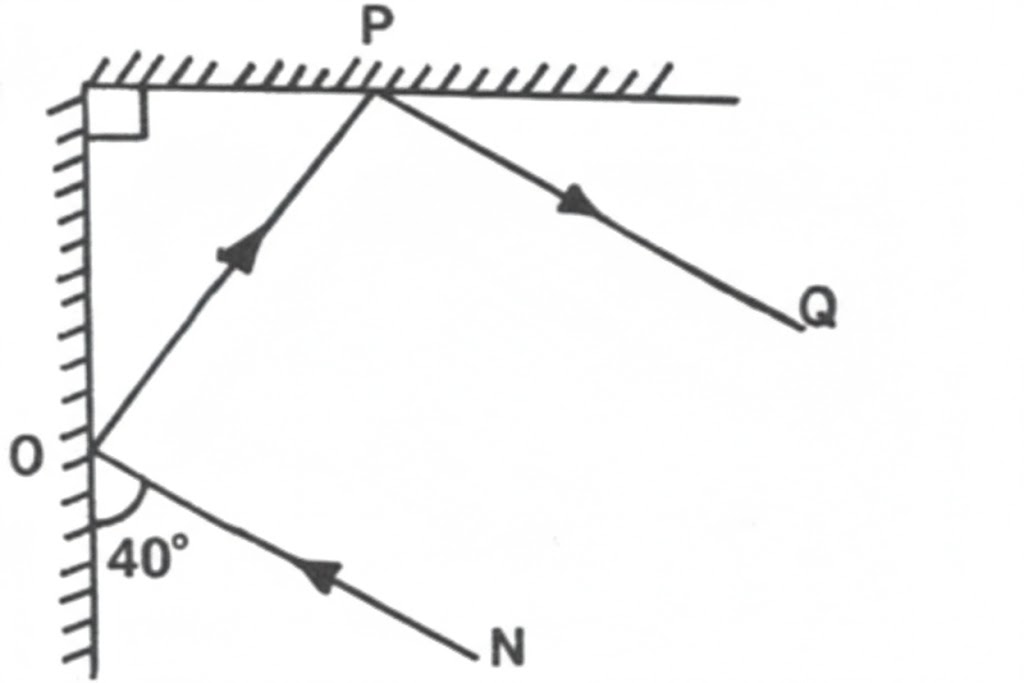
Two mirrors of the same length are arranged as shown in the diagram. A ray of light NO strikes the system at O and emerges along PQ. The emergent ray has been deviated through
When a ray of light is reflected by two mirrors inclined at an angle \( \theta \) to each other, the total deviation \( D \) suffered by the ray after two successive reflections is calculated by the formula:
\[ D = 360^\circ - 2\theta \]
In this specific configuration, the angle between the two mirrors is \( 75^\circ \). Substituting this value into the formula:
\[ D = 360^\circ - 2(75^\circ) \]
\[ D = 360^\circ - 150^\circ \]
\[ D = 210^\circ \]
This total deviation represents the angle between the initial direction of the incident ray NO and the final direction of the emergent ray PQ. The geometry of the reflections ensures that the total angle of turn is independent of the initial angle of incidence on the first mirror, as long as the ray hits both mirrors.