
Physics 2020 Jamb Examination
Physics 2020 Jamb Examination

Question 11
A magnetic needle is suspended first at the earth's north magnetic pole and then at a point on the magnetic equator. The respective angles between the needle and the horizontal are
The angle between the direction of the Earth's total magnetic field and the horizontal is known as the angle of dip or magnetic inclination. At the Earth's magnetic poles, the magnetic field lines are perpendicular to the Earth's surface, meaning they point straight down (at the North Magnetic Pole) or straight up (at the South Magnetic Pole). Consequently, a freely suspended magnetic needle will align itself vertically, making an angle of 90° with the horizontal. Conversely, at the magnetic equator, the magnetic field lines are parallel to the Earth's surface. In this region, the needle aligns itself horizontally, resulting in an angle of dip of 0°. This variation is a direct consequence of the dipole nature of the Earth's magnetic field.
Not clear enough?
Question 12
A hydrometer is an instrument for measuring the
A hydrometer is a specialized scientific instrument used to determine the relative density (or specific gravity) of liquids. It operates based on the principle of flotation, which is a derivation of Archimedes' principle. The law of flotation states that a floating object displaces a weight of fluid equal to its own weight. A hydrometer typically consists of a weighted glass bulb and a thin graduated stem. When placed in a liquid, it sinks to a certain depth; in denser liquids, it floats higher because less volume needs to be displaced to match the instrument's weight, whereas in less dense liquids, it sinks deeper. It should not be confused with a hygrometer, which measures humidity, or the method of weighing in water, which is a different application of Archimedes' principle.
Not clear enough?
Question 13

Consider the three forces acting at O and in equilibrium as shown in the figure. Which of the following equations is/are CORRECT?
I. P1 cos θ1 = p1 cos θ2
II. P3 = P1 cos θ4 + P2 cos 2
III. P1 sin θ1 = P2 sin θ2
For a system of coplanar forces in equilibrium, the sum of the components of the forces in any two perpendicular directions must be zero. Usually, we resolve forces into horizontal and vertical components.
Looking at the horizontal components (assuming \( \theta_1 \) and \( \theta_2 \) are the angles the forces \( P_1 \) and \( P_2 \) make with the vertical axis):
The horizontal component of \( P_1 \) is \( P_1 \sin \theta_1 \) acting to the left.
The horizontal component of \( P_2 \) is \( P_2 \sin \theta_2 \) acting to the right.
For horizontal equilibrium: \[ P_1 \sin \theta_1 = P_2 \sin \theta_2 \] This matches statement III. Statements I and II as presented in the text contain significant typographical errors (such as \( \theta_4 \) and "cos 2") that render them mathematically incorrect or irrelevant to the provided diagram. Therefore, only the balance of horizontal components described in III is a valid correct equation.
Not clear enough?
Question 14
The refractive index of a liquid is 1.5. If the velocity of light in vacuum is \( 3.0 \times 10^8 \, \text{ms}^{-1} \), the velocity of light in the liquid is
The absolute refractive index (n) of a medium is defined as the ratio of the speed of light in a vacuum (c) to the speed of light in that specific medium (v). The formula is expressed as:
\[ n = \frac{c}{v} \]
Given:
Refractive index, \( n = 1.5 \)
Speed of light in vacuum, \( c = 3.0 \times 10^8 \, \text{ms}^{-1} \) To find the velocity in the liquid (v), we rearrange the formula: \[ v = \frac{c}{n} \] Substituting the given values: \[ v = \frac{3.0 \times 10^8}{1.5} \] \[ v = 2.0 \times 10^8 \, \text{ms}^{-1} \] This indicates that light travels slower in the liquid than in the vacuum due to the optical density of the medium.
Not clear enough?
Question 15
A ship travelling towards a cliff receives the echo of its whistle after 3.5 seconds. A short while later, it receives the echo after 2.5 seconds. If the speed of sound in air under the prevailing condition is \( 250 \, \text{ms}^{-1} \), how much closer is the ship to the cliff?
An echo is a reflection of sound that reaches the listener with a delay after the direct sound. The total distance travelled by the sound wave is twice the distance (d) between the source and the reflecting surface, as the sound must travel to the cliff and back.
\[ 2d = v \times t \quad \Rightarrow \quad d = \frac{vt}{2} \]
First, calculate the initial distance (\( d_1 \)) using the first time interval (\( t_1 = 3.5 \, \text{s} \)):
\[ d_1 = \frac{250 \times 3.5}{2} = \frac{875}{2} = 437.5 \, \text{m} \]
Next, calculate the second distance (\( d_2 \)) using the second time interval (\( t_2 = 2.5 \, \text{s} \)):
\[ d_2 = \frac{250 \times 2.5}{2} = \frac{625}{2} = 312.5 \, \text{m} \]
The distance the ship has moved closer to the cliff is the difference between these two distances:
\[ \text{Distance moved} = d_1 - d_2 \]
\[ \text{Distance moved} = 437.5 \, \text{m} - 312.5 \, \text{m} \]
\[ \text{Distance moved} = 125 \, \text{m} \]
Alternatively, using the change in time directly:
\[ \Delta d = \frac{v(t_1 - t_2)}{2} = \frac{250(3.5 - 2.5)}{2} = \frac{250 \times 1}{2} = 125 \, \text{m} \]
Not clear enough?
Question 16
Two divers G and H are at depths 20m and 40m, respectively below the water surface in a lake. The pressure on G is \( P_1 \) while the pressure on H is \( P_2 \). If the atmospheric pressure is equivalent to 10m of water, then the value of \( P_2/P_1 \) is?
To find the total pressure at a certain depth in a liquid, we must account for both the hydrostatic pressure exerted by the liquid column and the external atmospheric pressure acting on the surface. In this problem, pressures are expressed in terms of the height of a water column.
The total pressure \( P \) at a depth \( h \) is given by:\[ P = P_{\text{atmo}} + P_{\text{liquid}} \]Given that the atmospheric pressure \( P_{\text{atmo}} \) is equivalent to 10m of water:
For diver G at depth \( h_1 = 20\text{m} \):\[ P_1 = 10\text{m} + 20\text{m} = 30\text{m of water} \]For diver H at depth \( h_2 = 40\text{m} \):\[ P_2 = 10\text{m} + 40\text{m} = 50\text{m of water} \]The ratio of the pressure on H to the pressure on G is calculated as follows:\[ \frac{P_2}{P_1} = \frac{50}{30} \]\[ \frac{P_2}{P_1} = \frac{5}{3} \approx 1.666... \]Rounding to two decimal places, we obtain 1.67.
Not clear enough?
Question 17
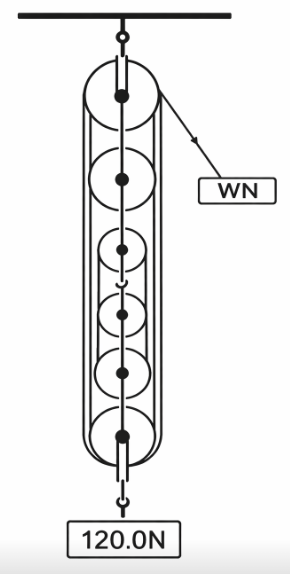
The figure above represents a block-and-tackle pulley system on which an effort of W Newtons supports a load of 120.0N. If the efficiency of the machine is 40%, then the value of W is
The efficiency of a machine is the ratio of its Mechanical Advantage (M.A.) to its Velocity Ratio (V.R.), expressed as a percentage. For a block-and-tackle system, the Velocity Ratio is equal to the number of pulleys in the system or the number of strings supporting the mobile lower block. In this standard configuration, the V.R. is 6.
Given:
Load \( L = 120.0\text{N} \)
Efficiency \( \eta = 40\% = 0.4 \)
Velocity Ratio \( V.R. = 6 \)
We use the efficiency formula:\[ \eta = \frac{\text{M.A.}}{\text{V.R.}} \times 100 \]\[ 0.4 = \frac{\text{M.A.}}{6} \]\[ \text{M.A.} = 0.4 \times 6 = 2.4 \]Mechanical Advantage is also defined as the ratio of Load (L) to Effort (E):\[ \text{M.A.} = \frac{L}{E} \]\[ 2.4 = \frac{120.0}{W} \]\[ W = \frac{120.0}{2.4} \]\[ W = 50.0\text{N} \]Thus, an effort of 50.0N is required to support the load given the internal friction and weight of the pulleys.
Not clear enough?
Question 18
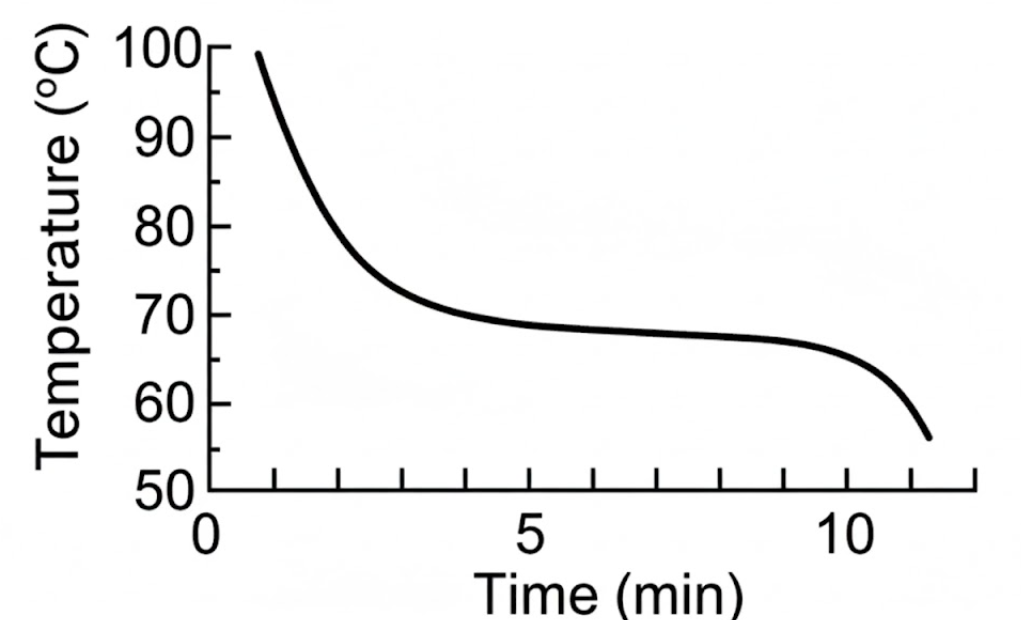
In an experiment in which molten naphthalene is allowed to cool, the cooling curve in the figure was obtained. The temperature 80°C is known as the
A cooling curve maps the change of temperature of a substance as it loses heat over time. When a pure substance like naphthalene reaches its freezing point, the temperature remains constant despite continued cooling. This is because the internal energy being lost is 'latent heat of fusion' being released as the molecules transition from a high-energy liquid state to a more ordered solid state. On the graph, this appears as a horizontal plateau. For a pure crystalline solid, the temperature at which the liquid turns into a solid (freezing point) is identical to the temperature at which the solid turns into a liquid (melting point). Since the plateau occurs at 80°C for naphthalene, this value represents its melting point.
Not clear enough?
Question 19

In the figure, the value of R is
To solve for the unknown resistance R, we must analyse the circuit based on the provided total voltage and total current. According to the diagram, we have a network consisting of parallel and series resistors. Let us assume the circuit has a total voltage of 12V and a total current of 2A, with two 2Ω resistors in parallel connected in series with R.
First, calculate the total resistance (\( R_{\text{total}} \)) using Ohm's law:\[ R_{\text{total}} = \frac{V}{I} = \frac{12}{2} = 6\Omega \]\[ R_T = 3 + \frac{R \times 2}{R + 2} \]\[ 6 - 3 = \frac{R \times 2}{R + 2}\]\[ 3R + 6 = 2R\] R = 6
First, calculate the total resistance (\( R_{\text{total}} \)) using Ohm's law:\[ R_{\text{total}} = \frac{V}{I} = \frac{12}{2} = 6\Omega \]\[ R_T = 3 + \frac{R \times 2}{R + 2} \]\[ 6 - 3 = \frac{R \times 2}{R + 2}\]\[ 3R + 6 = 2R\] R = 6
Not clear enough?
Question 20
\[\begin{array}{|cl|l|l|} \hline \text{I.} & \text{Electric iron} & 250\text{V} & 1\text{kW} \\ \hline \text{II.} & \text{Television set} & 220\text{V} & 110\text{W} \\ \hline \text{III.} & \text{Torchlight} & 6\text{V} & 30\text{W} \\ \hline \text{IV.} & \text{Immersion heater} & 110\text{V} & 500\text{W} \\ \hline \end{array}\]
Which of the following instruments consumes the highest current?
I. Electric iron: 250V, 1kW
II. Television set: 220V, 110W
III. Torchlight: 6V, 30W
IV. Immersion heater: 110V, 500W
Which of the following instruments consumes the highest current?
I. Electric iron: 250V, 1kW
II. Television set: 220V, 110W
III. Torchlight: 6V, 30W
IV. Immersion heater: 110V, 500W
The current (I) consumed by an electrical appliance is determined by the relationship between its power rating (P) and the operating voltage (V), given by the formula:\[ P = IV \quad \Rightarrow \quad I = \frac{P}{V} \]Let us calculate the current for each instrument:
For the Electric iron (I):\[ I_1 = \frac{1000\text{W}}{250\text{V}} = 4\text{A} \]For the Television set (II):\[ I_2 = \frac{110\text{W}}{220\text{V}} = 0.5\text{A} \]For the Torchlight (III):\[ I_3 = \frac{30\text{W}}{6\text{V}} = 5\text{A} \]For the Immersion heater (IV):\[ I_4 = \frac{500\text{W}}{110\text{V}} \approx 4.54\text{A} \]Comparing the calculated values, the torchlight consumes the highest current at 5A. This happens because although its power is low, the operating voltage is extremely low, requiring a higher flow of charge to meet the power demand.
For the Electric iron (I):\[ I_1 = \frac{1000\text{W}}{250\text{V}} = 4\text{A} \]For the Television set (II):\[ I_2 = \frac{110\text{W}}{220\text{V}} = 0.5\text{A} \]For the Torchlight (III):\[ I_3 = \frac{30\text{W}}{6\text{V}} = 5\text{A} \]For the Immersion heater (IV):\[ I_4 = \frac{500\text{W}}{110\text{V}} \approx 4.54\text{A} \]Comparing the calculated values, the torchlight consumes the highest current at 5A. This happens because although its power is low, the operating voltage is extremely low, requiring a higher flow of charge to meet the power demand.